 Historical Figure MBTI
#950 · 7-13-26 · The Pacific War
Hideki Tojo
Prime Minister · "The Razor" · War Criminal
1884 — 1948
10 min read
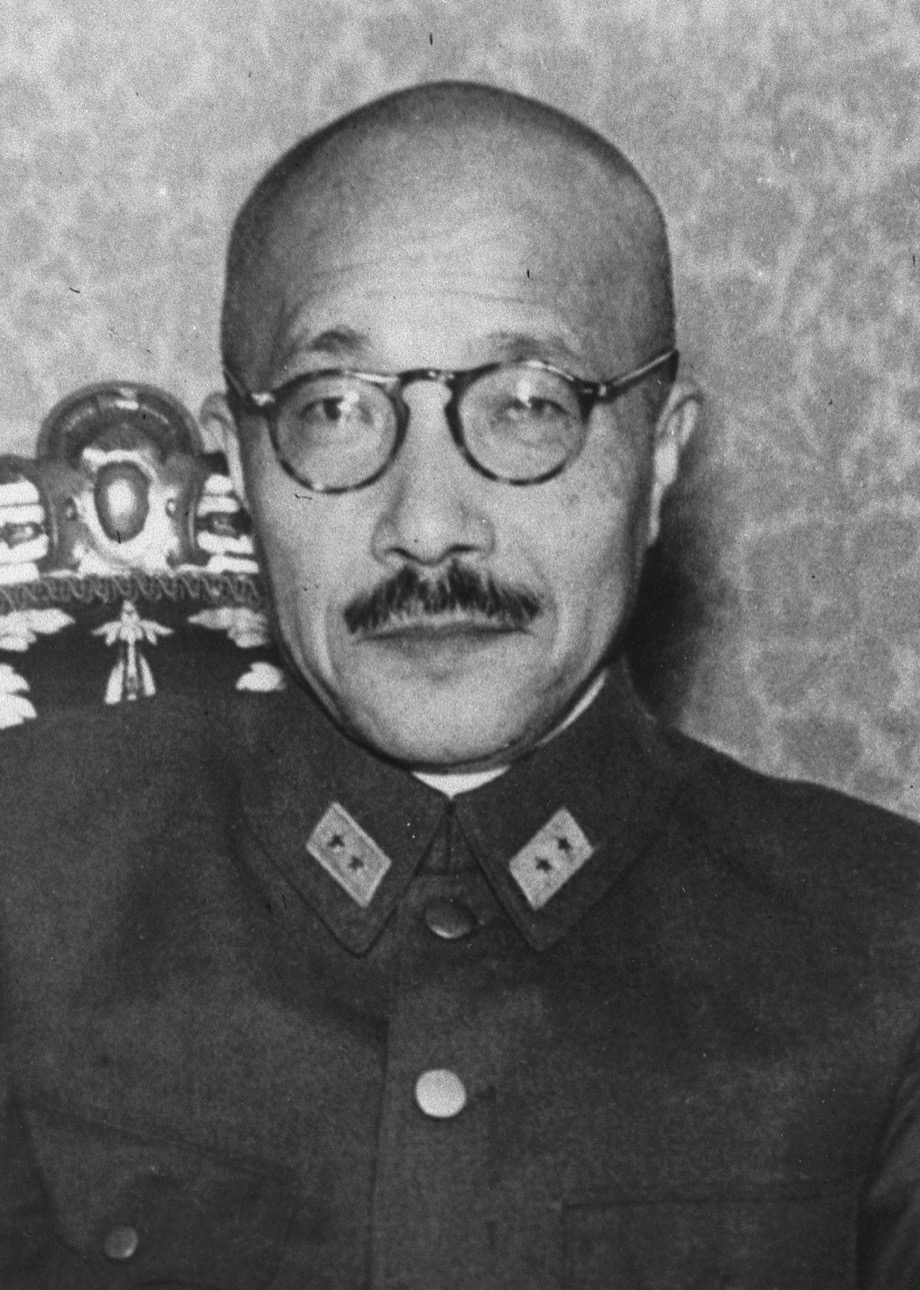
Portrait of Hideki Tojo
The Man Who Filed the Paperwork for a Catastrophe
Begin with what he did, because nothing that follows should be allowed to soften it. As army minister from 1940 and then as prime minister from October 1941, Hideki Tojo presided over the decision to attack the United States and the British Empire; he pressed the widening of a war of aggression in China that had already consumed Nanking, Wuhan and the Chinese countryside in campaigns of extraordinary brutality; and he stood at the head of a military command structure that starved, beat, enslaved and murdered prisoners of war and occupied civilians across Asia — the Bataan Death March, the Burma-Siam railway, the forced labour levies, the reprisal killings. He was army minister when the orders travelled down, and prime minister when the system that produced them was left untouched. In November 1948 the International Military Tribunal for the Far East convicted him on counts of waging aggressive war and of authorising or permitting atrocities. He was hanged at Sugamo Prison on 23 December 1948. That is the verdict, and it is the correct one.
What follows is not mitigation. It is a harder and more uncomfortable question: what kind of mind does this? The answer, in Tojo's case, is disappointingly ordinary — and that is precisely the point. He was not a spellbinder. He had none of Hitler's apocalyptic theatre and none of Mussolini's balcony swagger. He was a career staff officer with a clerk's memory and a martinet's diary, a man who rose through the Imperial Japanese Army by being unfailingly thorough, punctual, uncorrupt in the small ways and utterly conventional in the large ones. His nickname, Kamisori — "the Razor" — was not a tribute to ruthlessness in battle. It described the way he cut through a stack of files. Subordinates recalled that he could recall the service record of a junior officer he had met once, the ration figures for a garrison he had inspected a year earlier, the exact wording of a regulation. He ran the war ministry the way a fastidious registrar runs a registry.
That is the horror of him. Japan's road to the Pacific war was not paved by a single visionary tyrant; it was paved by an institution that had captured the state, and Tojo was the institution's most efficient operator. He did not invent the ideology of the Greater East Asia Co-Prosperity Sphere, and he was never intellectually its author. He administered it. He kept the timetable. He took the consensus of the army and the imperial conferences and turned it into orders, schedules and requisitions, and when that consensus pointed at Pearl Harbor he executed it with the same conscientiousness he had once brought to barracks inspections.
Tojo is the archive's clearest case of an ISTJ dominant Si turned into an instrument of catastrophe: a filing-cabinet mind that mistook the thoroughness of its procedure for the rightness of its cause.
The Registry Mind — Si, dominant
Tojo's authority inside the army was built almost entirely on recall and precedent. He had made his name not as a field commander but in the Bureau of Military Affairs and as chief of staff of the Kwantung Army, where the work was personnel files, supply tables, mobilisation schedules and the internal politics of who had trained under whom. He was famous for reading everything that crossed his desk and remembering it. When he became army minister he kept the habit, and it produced the signature Tojo behaviour that so struck contemporaries: the prime minister of a nation at war turning up unannounced at a factory to check the canteen, or at a garrison to inspect the latrines, or interrogating a ministry clerk about a discrepancy in a rice allocation.
Foreign observers read this as either humility or eccentricity. It was neither. It was the dominant Si conviction that reality lives in the accumulated concrete detail — that if every item in the ledger is correct, the enterprise as a whole must be sound. Tojo genuinely believed he was governing well because the files were in order. He could not conceive of a mistake so large that no amount of administrative rectitude could redeem it, because the scale at which he processed the world was the scale of the individual item.
Si is also the function of precedent, and Tojo was ruled by it. His moral universe was the army's own past: the Meiji inheritance, the Russo-Japanese war, the memorised text of the Imperial Rescript to Soldiers and Sailors, the Senjinkun field code he himself promulgated in 1941 — the document that told Japanese soldiers never to suffer the shame of being taken prisoner alive. That code, born of a traditionalist's reverence for a remembered warrior ethic, hardened into the contempt for surrendered enemies that made captivity under Japanese guard so lethal. Si did not merely fail to restrain the atrocities. It supplied their scaffolding.
Competence Without Conscience — Te, auxiliary
Tojo's Te was the executive edge on the ledger: an impatience with anything that did not resolve into a decision, a quota, a date. He accumulated offices with the logic of a man removing bottlenecks rather than a man building a personal empire — prime minister, army minister, home minister, at points munitions minister and chief of the army general staff. Critics called it dictatorship. Structurally it was, but the impulse behind it was administrative rather than messianic: if the coordination between the ministry and the general staff was slowing production, the obvious fix was to hold both posts and issue the order himself.
The same function produced the decision that ruined him and killed millions. Through the autumn of 1941 the argument inside the government was about the American oil embargo and the deadline it imposed. Tojo's contribution was not strategic imagination; it was insistence on closure. The negotiations with Washington had a date attached, the fleet had a fuel curve attached, and when the diplomatic track failed to produce a result by the stipulated moment, the plan went forward because the plan was what had been decided. He is on record telling his colleagues that at some point a man must shut his eyes and jump. That is Te with nothing behind it — execution decoupled from any assessment of whether the objective was achievable at all.
And it was not achievable. Even Isoroku Yamamoto, who planned the Pearl Harbor strike, told his political masters that he could run wild for six months or a year and after that had no confidence at all. Tojo's Te could organise a war of that length superbly and had no apparatus whatsoever for asking the question Yamamoto was asking. After Saipan fell in July 1944 and the arithmetic became undeniable even to a man who lived in arithmetic, he was forced from office — not overthrown by a rival vision, simply retired when the numbers stopped working.
The Private Code — Fi, tertiary
Tojo had values, and they were narrow, deeply held and almost entirely inward-facing. He was personally austere, financially clean in an era of ministerial graft, devoted to his wife Katsuko and their seven children, and known for writing personal letters to the families of dead soldiers. He kept a private notion of himself as a servant — of the throne, of the army, of Japan — and it was sincere. Tertiary Fi of this kind does not generate ethics in any expansive sense; it generates integrity as loyalty, a felt obligation to a small circle of sacred objects.
Everything outside that circle registered barely at all. Chinese civilians, Filipino and Korean labourers, Australian and American prisoners were administrative categories, not objects of moral attention, and there is no evidence Tojo ever experienced them as anything else. He did not exterminate out of hatred in the manner of the Nazi leadership; he simply never let the question arrive. Fi kept his own hands clean in his own estimation while his signature moved the machinery that made hands like his irrelevant.
The same function explains the collapse of 1945. Ordered by his own code to die rather than be taken, Tojo shot himself in the chest as American military police arrived at his house in September — and botched it, missed the heart, and was saved by American doctors and an American blood transfusion. Under Douglas MacArthur's occupation he then did the one thing that was genuinely his own: at the Tokyo tribunal he took responsibility for the war onto himself and worked, under coaching and on his own instinct, to keep it away from Hirohito. It was not remorse. It was the last act of a private loyalty that had never been troubled by any wider one.
The Alternative He Could Not Imagine — Ne, inferior
The decisive fact about Tojo in 1941 is not that he chose war. It is that he could not construct a usable picture of any other course. Inferior Ne is a poverty of counterfactual: the mind runs the established option with formidable competence and treats the unestablished one as vapour. Asked what would happen if Japan withdrew from China, Tojo's response was that the entire structure — Manchuria, Korea, the army's standing, the sacrifices already made — would come apart. He was not wrong that it would have cost something enormous. He was incapable of following the alternative far enough to weigh it against a war with the United States.
The same blind spot governed his reading of the enemy. He accepted the army's article of faith that American morale was soft and that a decisive early blow would produce a negotiated settlement, a proposition for which there was no evidence and which nobody in the leadership could describe mechanically — how, exactly, would Washington be brought to the table? The plan had a first move and no second. This is what distinguishes Tojo from a genuine strategist and from the ideologues around him: he neither generated the fantasy nor tested it. He inherited it and scheduled it.
Under stress the inferior function turns paranoid, and Tojo's did. As the war went badly he saw sabotage and defeatism everywhere, leaned on the Kempeitai to police criticism, and had opponents inside the political class watched and harassed. The man who could not imagine an alternative future for Japan became fluent, at the end, in imagining enemies at home.
Why ISTJ Over ESTJ
Why not ESTJ?
An ESTJ leads outward: sets the agenda, imposes a personal programme on the institution, and derives authority from command presence. Tojo did the reverse — he derived his authority from the institution and deferred upward to it at every decisive juncture, treating the army's collective view and the emperor's sanction as the sources of legitimacy rather than his own judgement. His power was accumulated in offices, not in a following; he was a poor public speaker with a thin, hectoring voice, no rhetorical gift, and no cult. Even at the summit he behaved like a chief clerk who had been handed the keys — reading the files, holding the schedule, and asking the throne for permission — which is dominant Si with Te in service, not Te running the show.
The distinction matters historically as well as psychologically. Reading Tojo as an ESTJ strongman lets Japan off lightly, because it puts the war inside one outsized personality who can be hanged and thereby closed. He was not that. He was the internally rigid, procedurally obsessive product of a system that had already decided, and his particular gift — an inexhaustible appetite for detail and an absolute deference to the established line — was exactly the gift that system required at the top. Compare him with Yosuke Matsuoka, the true extraverted operator of the period, who talked, improvised and gambled his way into the Tripartite Pact; Tojo generated nothing like that and never wanted to. The ISTJ reading is the one that keeps the responsibility where it belongs: on a man who was fully capable of doing his job and never once asked whether the job should be done.
Connected Figures
Further Reading
- Tojo: The Last Banzai — Courtney BrowneThe standard English-language biography, built on interviews with Tojo's family and staff.
- Japan 1941: Countdown to Infamy — Eri HottaMonth-by-month reconstruction of the decision for war, and of how few of its makers believed in it.
- The Tokyo War Crimes Trial: The Pursuit of Justice in the Wake of World War II — Yuma TotaniThe tribunal that convicted and hanged him, and the political choices embedded in its scope.
- Hirohito and the Making of Modern Japan — Herbert P. BixArgues for an active emperor, and reads Tojo's self-incrimination as protective strategy.
- Embracing Defeat: Japan in the Wake of World War II — John W. DowerThe occupation, the trials, and how postwar Japan built its memory of the men who led it to ruin.
