 Historical Figure MBTI
#951 · 7-13-26 · The Pacific War
Hirohito
Emperor of Japan · Marine Biologist · Contested Sovereign
1901 — 1989
7 min read
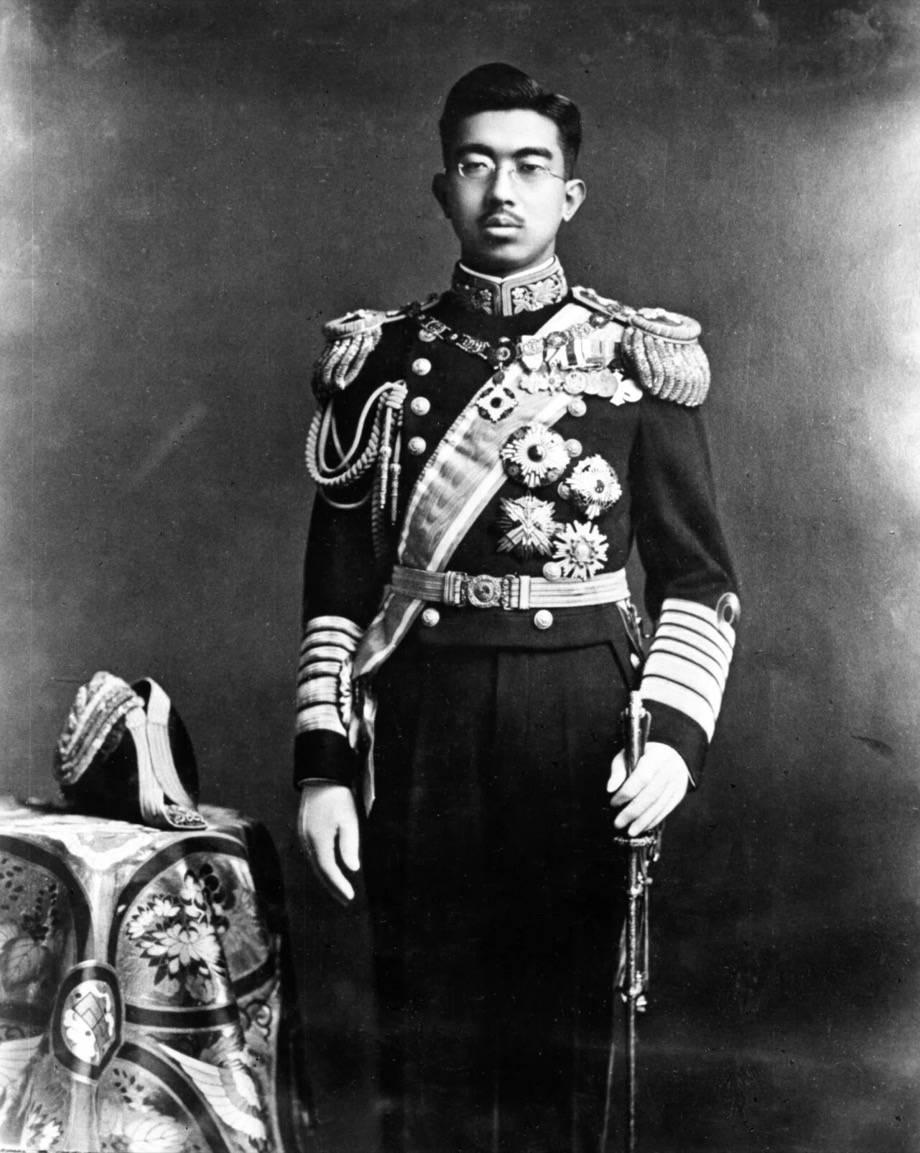
Portrait of Hirohito
The Emperor Who Collected Jellyfish
He was a living god who preferred microscopes. Shōwa — the reign name by which Japan knows him — spent sixty-two years on the Chrysanthemum Throne and much of that time in a small laboratory in the palace grounds, dissecting hydrozoans, mounting slides, and publishing genuine taxonomic work on the marine invertebrates of Sagami Bay, several new species of which carry his name. He was myopic, stooped, awkward on ceremonial horseback, flat and hesitant in speech, and by every account happiest when left alone with specimens. This is the man in whose name Japan invaded China, attacked Pearl Harbor, and conducted the most destructive war in Asian history.
The relationship between those two facts is the most contested question in modern Japanese historiography, and this entry will not pretend to have settled it. The postwar consensus — assembled partly by the occupation, which needed a usable emperor, and partly by Japanese elites, who needed a blameless one — held that Hirohito was a constitutional cipher: a scholar sealed inside a ritual role, briefed after the fact, powerless to refuse what his ministers and generals brought him. That account was always convenient, and Herbert Bix's revisionist work made a formidable case against it: Hirohito attended the imperial conferences, received the daily military briefings, questioned operational plans in detail, sanctioned the China campaigns, and intervened decisively at least twice — in the 1936 mutiny, when he demanded the rebels be crushed, and in August 1945, when he broke the deadlock and accepted surrender. A cipher does not do those things.
What the record shows is a man of unmistakable intellectual engagement and almost total behavioural reticence — someone who understood, analysed, and asked sharp questions, and then usually did not act. That combination is why this entry types him as an INTP, and also why the alternative reading refuses to go away.
An INTP sovereign: dominant Ti that dissected everything put before it — jellyfish, war plans, surrender terms — and a personality with no instrument for turning analysis into command until the very last hour.
The Laboratory in the Palace — Ti, dominant
The biology was not a hobby in the decorative royal sense. Hirohito worked at it for six decades, built a serious research collection, kept staff scientists as colleagues rather than attendants, and published — some of it under the pseudonymous cover appropriate to a sovereign, some of it through the Biological Laboratory of the Imperial Household. His speciality was hydrozoa, an unglamorous corner of taxonomy demanding patience, precise discrimination between near-identical forms, and indifference to whether anyone else cares. It is a Ti pastime in its purest form: the pleasure of getting a classification exactly right for its own sake.
The same faculty is visible in the war records. The men who briefed him did not describe a passive listener. He asked why the Kwantung Army's estimates of Chinese resistance kept proving wrong; he pressed the navy on whether the Pearl Harbor plan's assumptions about American recovery were sound; after Guadalcanal he wanted to know how a position could be lost that he had been assured was held. These are the questions of a mind that tests the internal consistency of what it is told and notices when the pieces do not fit.
And here the honest difficulty appears. Ti explains the questions; it does not by itself explain the sanction that followed them. A man who could see the flaws in the plan and stamped it anyway is not exculpated by his intelligence. If anything, the Ti reading raises the moral stakes rather than lowering them: it describes a sovereign who understood more than he ever admitted afterwards.
The Sceptic Behind the Screen — Ne, auxiliary
Hirohito's 1921 European tour — the first by a Japanese crown prince — left a permanent mark. He came back admiring British constitutional monarchy, wearing Western clothes, playing golf, eating breakfast with a knife and fork, and privately convinced that Japan's future lay with the naval treaty powers rather than against them. He was consistently sceptical of the army's continental adventurism, dubious about the alliance with Germany that Yosuke Matsuoka pushed through, and unpersuaded by the confident timetables he was handed in 1941.
Auxiliary Ne shows in his habit of raising the alternative without pressing it. At the September 1941 imperial conference, rather than speak directly, he read out a poem of his grandfather Meiji about all the seas of the world being brothers — a gesture everyone present understood as a plea for peace, and which changed nothing. That is the characteristic INTP manoeuvre: float the other possibility into the room and leave it there, on the assumption that people who have seen the better argument will act on it. In a court built to convert the sovereign's slightest frown into an order, it was a catastrophic misreading of his own instrument.
The Weight of Ancestors — Si, tertiary
The tertiary function is where the strongest case for the rival typing lives, and it should be given its due. Hirohito was raised inside a ritual apparatus of extraordinary density, trained from childhood in the obligations of an unbroken line, and he took the inheritance seriously: the recurring justification in his own recorded reasoning is not principle in the abstract but continuity — the imperial house, the national polity, the ancestors to whom he would have to answer.
It is a genuinely tradition-saturated mind. But the Si reading has a limit. Hirohito used precedent selectively and instrumentally, invoking Meiji when it supported restraint and setting aside conventions of imperial silence when he judged the situation demanded it. He also broke tradition without evident distress when the logic pointed that way — the European tour, the modern household, and above all the 1946 renunciation of divinity, which he is said to have regarded with something closer to relief than to anguish. A dominant Si would have found that renunciation devastating.
The Voice of the Crane — Fe, inferior
For forty-four years the Japanese public had never heard him speak. On 15 August 1945 they did, in a recording made the night before in an archaic court Japanese most listeners could barely follow, announcing that the war situation had developed not necessarily to Japan's advantage and that the nation must endure the unendurable. The broadcast is the definitive inferior-Fe event: a man with no fluency at all in public emotional address, forced by circumstance into the single most consequential act of collective feeling in his country's modern history, performing it stiffly and successfully.
The same awkwardness marks the intervention that produced it. At the imperial conference of 9–10 August, with the cabinet deadlocked, he was asked to break the tie — the seidan, the sacred decision — and he did, siding with Shigenori Togo for acceptance of the Potsdam terms. He had waited until Hiroshima, Nagasaki, and Joseph Stalin's entry into the war had removed every remaining alternative. It was the right decision, taken years too late by a man who could not deploy his own authority until analysis had exhausted every other option.
Why INTP Over ISFJ
Why not ISFJ?
This is the live alternative and it deserves better than dismissal. The ISFJ reading gives you a dutiful, self-effacing sovereign shaped entirely by role and precedent, deferring to his advisors because deference was what the position required, and it fits the reticence, the ritual gravity, and the lifelong reluctance to impose himself. What it fits less well is the content of his private engagement: the sustained independent research programme, the persistent scepticism about the army's continental strategy, the technical interrogation of operational plans, and the ease with which he abandoned traditions — including his own divinity — once he had reasoned past them. A dutiful ISFJ figurehead absorbs the role; Hirohito analysed it, disliked much of it, and used it decisively exactly once. The honest position is that both readings survive the evidence, and that the choice between them is partly a historians' argument about how much agency he had at all.
That argument is not going to be resolved by a personality framework, and this archive should not pretend otherwise. What the INTP reading offers is the version of Hirohito that best explains the whole record rather than half of it — a mind sharp enough to see where his ministers were leading the country and constitutionally, temperamentally incapable of stopping them until the country was ash. It is a diagnosis, not an alibi. If Bix is right that he was more involved than the postwar story allowed, then the INTP framing indicts him further: he was not too naive to understand the war. He understood it, sanctioned it, and let the analysis stand in for the act.
Connected Figures
Further Reading
- Hirohito and the Making of Modern Japan — Herbert P. BixThe Pulitzer-winning revisionist case for an actively involved emperor; the argument's centre of gravity.
- Hirohito and War: Imperial Tradition and Military Decision Making in Prewar Japan — Peter WetzlerThe counterweight to Bix, reading the emperor's role through the constraints of court practice.
- Japan's Longest Day — Pacific War Research SocietyHour-by-hour account of 14–15 August 1945, the surrender decision and the attempted coup against it.
- Racing the Enemy: Stalin, Truman, and the Surrender of Japan — Tsuyoshi HasegawaPlaces the seidan in its three-way context of atomic bombs and Soviet entry.
- Embracing Defeat: Japan in the Wake of World War II — John W. DowerHow the occupation remade the emperor as a human symbol, and what that cost Japanese memory.
