 Historical Figure MBTI
#953 · 7-13-26 · The Pacific War
Yosuke Matsuoka
Foreign Minister · Architect of the Tripartite Pact · Gambler
1880 — 1946
6 min read
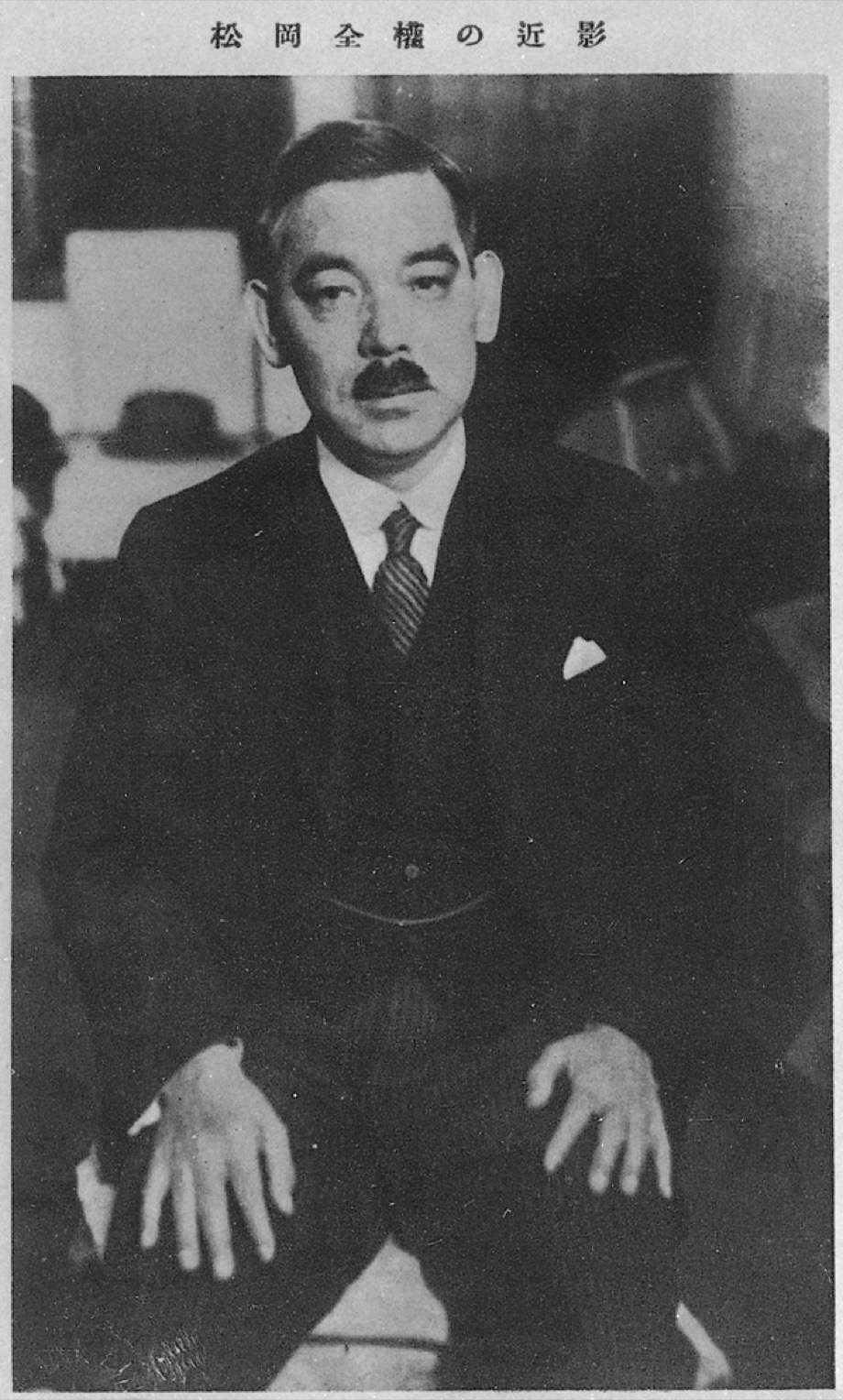
Portrait of Yosuke Matsuoka
The Talker Who Bet a Nation
In February 1933 the League of Nations voted to condemn Japan's seizure of Manchuria. Yosuke Matsuoka, head of the Japanese delegation, delivered a long, fluent, unapologetic speech in the excellent American English he had acquired as a poor teenage immigrant in Oregon — and then walked out of the chamber with his delegation behind him, into the corridors and the newsreels and, permanently, into Japanese political legend. He had not been instructed to withdraw from the League outright. He improvised the gesture, and returned home to crowds treating him as a hero for it. It was the defining Matsuoka performance: theatrical, self-authored, magnificent in the moment, and strategically ruinous.
Seven years later, as foreign minister under Fumimaro Konoe, he assembled the architecture that would take Japan to war. In September 1940 he signed the Tripartite Pact with Nazi Germany and Fascist Italy, negotiated on the German side by Joachim von Ribbentrop. In April 1941 he travelled to Moscow and came away with a neutrality pact and a famously boozy embrace from Joseph Stalin, who broke protocol to see him off at the railway station. Within eleven weeks Hitler invaded the Soviet Union, and Matsuoka — who had built his entire scheme on a Berlin-Moscow-Tokyo continental bloc that would deter Washington — responded by urging Japan to attack the USSR immediately, reversing his own pact on the spot. Konoe dissolved the cabinet in July 1941 purely to remove him.
A dominant-Ne ENTP at the wheel of a great power's foreign policy: inexhaustibly inventive, personally dazzling, and catastrophically unconstrained by anyone's reality but his own.
The Grand Design, Redrawn Weekly — Ne, dominant
Matsuoka thought in continents. His signature idea was a four-power arrangement spanning Eurasia — Germany, Italy, Japan and the Soviet Union bound loosely enough to leave each free and tightly enough to make the United States back down — and the Tripartite Pact and the Soviet neutrality pact were two moves in that single sweeping construction. It was not a stupid conception. It was a genuinely imaginative reading of how a middle-ranking power might leverage the collapse of the old order, and no career diplomat in Tokyo had produced anything so bold.
It was also built entirely on possibilities rather than facts. The design required Hitler not to attack Stalin — a fact Matsuoka had no way of verifying and did not seriously investigate — and required Washington to read the pact as deterrence rather than provocation. Both assumptions were wrong, and the second was catastrophically so: the Tripartite Pact did more than any other single document to convert American opinion from wary to hostile, tying Japan publicly to a European war the United States was already leaning against.
Dominant Ne's other habit is the instantaneous pivot. When Barbarossa demolished the framework in June 1941, Matsuoka did not pause; he argued that Japan should tear up the neutrality pact he had personally signed ten weeks earlier and strike north into Siberia. To him this was adaptation, not inconsistency. To colleagues watching a foreign minister reverse the state's position within a season, it was proof he could not be kept.
Talking Circles Around the Room — Ti, auxiliary
Every account of Matsuoka in a negotiation describes the same phenomenon: the monologue. He talked for hours, in English or Japanese, constructing elaborate chains of reasoning, demolishing objections before they were raised, and exhausting counterparts into acquiescence. Ribbentrop, no small talker himself, found him overwhelming; American officials came away with pages of notes and no idea what had been agreed.
This is auxiliary Ti serving Ne — an internal logic so complete that the speaker mistakes its coherence for its truth. Matsuoka was not a warm persuader but a demonstrator, and he genuinely believed a sufficiently airtight argument would compel agreement from anyone rational. What he never developed was any instrument for checking the premises. His system was consistent and his inputs were fantasy, and Ti has no defence against that combination.
The Showman's Instinct — Fe, tertiary
Matsuoka understood audiences as few Japanese officials of his generation did. Nine years in America had given him not only the language but a feel for press, spectacle and the manufactured moment: the Geneva walkout was staged for cameras, the Moscow farewell was theatre he actively courted, and his domestic reputation rested on a gift for giving the Japanese public a scene it could be proud of. He was the most quotable man in the government.
Tertiary Fe of this kind reads the room brilliantly for effect and badly for consequence. He could sense what would thrill a crowd or flatter a dictator, and could not sense what would frighten a cabinet in Washington. The same evening in Moscow that produced Stalin's celebrated bear-hug at the station produced a treaty Matsuoka believed had secured Japan's northern flank. Stalin had bought himself a quiet border for the war he could see coming; Matsuoka had bought a photograph.
No Memory for the Ledger — Si, inferior
What Matsuoka never did was the arithmetic. Japan's oil reserves, its steel imports, its shipping tonnage, the American industrial base against which he was proposing to raise a deterrent — none of it appears in his reasoning with any weight. He operated a foreign policy of pure leverage while being institutionally uninterested in the material position from which the leverage was supposedly being applied, and he treated the accumulated caution of the professional diplomatic service as timidity to be talked past.
Inferior Si also shows in the way commitments failed to bind him. A pact he had signed was, in his hands, a live option rather than a settled fact; consistency with his own recent past registered as a constraint rather than a value. It made him unusable. Removed in July 1941, he spent the war in obscurity and ill health, was indicted at the Tokyo tribunal in 1946, and died of tuberculosis that June before his trial could reach a verdict — the one man of the group whose case was never argued to a conclusion.
Why ENTP Over ENFP
Why not ENFP?
The theatricality invites an ENFP reading — the charisma, the crowds, the emotional register of the Geneva speech. But Matsuoka's actual method was cold. He dealt in leverage, deterrence ratios and the exploitation of other people's predicaments, and his loyalties shifted with the configuration rather than with any felt commitment: he signed with Berlin, embraced Moscow, then proposed attacking Moscow, without any sign of internal conflict. An ENFP's improvisations run on values and would have snagged somewhere on that sequence. Matsuoka's ran on argument, and the drama was instrumentation — a device for winning the room, not an expression of what he believed. That is Ti under Ne, not Fi.
He is the archive's cautionary case for the ENTP in high office with nothing checking him. Everything that made Matsuoka formidable — the speed, the range, the refusal to accept the existing frame — is genuinely valuable in a diplomat, and Tokyo had nobody else with a tenth of his imagination. But an idea machine needs an editor, and a cabinet led by Fumimaro Konoe, who could not bring himself to say no to anyone, was the worst possible setting for one. By the time Konoe found a way to remove him, the pact was signed and Washington had drawn its conclusions.
Connected Figures
Further Reading
- Japan 1941: Countdown to Infamy — Eri HottaVivid on Matsuoka's Moscow trip, his monologues, and his removal from the cabinet.
- The Deadly Embrace: Hitler, Stalin and the Nazi-Soviet Pact 1939-1941 — Anthony Read and David FisherThe European half of the four-power scheme Matsuoka built his policy on.
- The Origins of the Second World War in Asia and the Pacific — Akira IriyeHow the Tripartite Pact reshaped American perception of Japan; the strategic cost of the gamble.
- Japan's Road to the Pacific War — James William Morley (ed.)Translated Japanese source documents on the Tripartite and Soviet neutrality negotiations.
