 Historical Figure MBTI
#981 · 7-19-26 · The Second World War
Archibald Wavell
Field Marshal · Poet-General · Early Desert Victories
1883 — 1950
4 min read
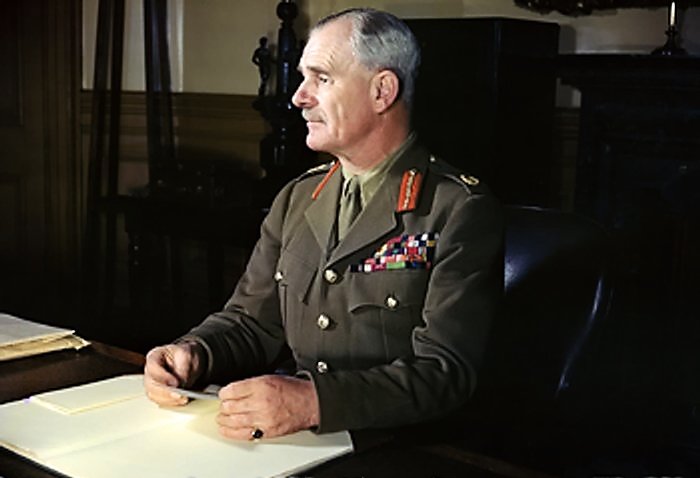
Portrait of Archibald Wavell
A Soldier Who Read Poetry to Fall Asleep, and Meant It
Archibald Wavell’s best-known book is not about war. It is Other Men’s Flowers, an anthology of poetry he assembled almost entirely from memory — several hundred poems he had carried in his head through India, Palestine and the Western Desert, arranged with his own dry commentary. It sold enormously and has never been out of print. That a serving field marshal produced it in the middle of the Second World War tells you most of what you need to know about the man: an unhurried, sceptical, intellectually promiscuous mind that treated soldiering as one interesting problem among several, and was congenitally incapable of the performance of confidence that his prime minister wanted from generals.
As Commander-in-Chief Middle East in 1940 he had a theatre stretching from Libya to Iraq to Kenya, almost no troops, and an Italian army several times his size sitting in Egypt. What he did with those odds was launch Operation Compass, which under Richard O’Connor destroyed ten Italian divisions and took over 130,000 prisoners — one of the most economical victories in British military history. He is nevertheless remembered mainly for the defeats that followed, because an INTP who declines to oversell himself will be judged by the ledger, and the ledger was later brutal.
An INTP whose dominant Ti made him the most original mind in British high command and the worst possible advocate for his own case.
The Analyst in Uniform
Wavell was a theorist before he was a theatre commander. His Lees Knowles lectures, published as Generals and Generalship, argued that the essential qualities of a commander were robustness and administrative grip rather than genius — Rommel is said to have carried a copy. His life of Allenby is a serious piece of military analysis, not a tribute. He thought about his profession the way a scholar thinks about a discipline: by taking apart the received account and seeing whether the parts fitted.
That habit produced Compass. Presented with an Italian army that had advanced into Egypt and then stopped, Wavell noticed what nobody else had bothered to notice — that its fortified camps were sited too far apart to support one another and were open at the rear. The plan he approved was to send a small mobile force through the gap and roll them up from behind, and what was supposed to be a five-day raid became a two-month campaign that cleared Cyrenaica. The insight was structural, not intuitive: a flaw in an arrangement, spotted by someone who examined the arrangement instead of the reputation.
Too Many Interesting Problems
Ne generates options, and Wavell’s command generated them prodigiously: he ran the East African campaign against the Italians in Ethiopia, the suppression of the Rashid Ali coup in Iraq, the Syria–Lebanon operation against Vichy France, and the intervention in Greece, all while fighting in the Western Desert with forces that could barely sustain one of those commitments. He was an early and enthusiastic backer of irregular warfare — the Long Range Desert Group and the raiding units that became the SAS owed their existence to a commander willing to entertain unconventional propositions from junior officers.
The weakness is the same faculty without a closing mechanism. He did not fight hard enough against the dispersal of his resources, and the Greek expedition — undertaken for political reasons he privately doubted — stripped the desert force just as Erwin Rommel arrived in Africa, throwing away everything Compass had won. Operations Brevity and Battleaxe then failed in quick succession, and Churchill, who had long found Wavell’s reticence intolerable, exchanged him with Claude Auchinleck in India.
The Stored Anthology
Tertiary Si in an INTP shows as an unusually retentive memory for detail that has been lived rather than studied, and Wavell is the perfect illustration: an entire anthology of English verse held in his head, recalled and set down without a library. The same faculty served him professionally — a granular recall of terrain, distances, and the administrative facts of supply across a theatre he had spent decades soldiering in.
It also gave him his silence. He had been wounded at Ypres, losing an eye, and had served in the Palestine campaigns; the accumulated weight of remembered experience made him constitutionally unable to promise things he did not believe. Churchill wanted a general who would say the offensive would succeed. Wavell would say what he thought the odds were, and then stop talking — which the prime minister read as defeatism and which was in fact the last honest estimate anyone gave him that year.
Why INTP Over INTJ
Why not INTJ?
The taciturn, cerebral senior officer is a familiar INTJ silhouette, and it fits Auchinleck better than Wavell. An Ni-dominant converges: one strategic picture, held hard, defended against pressure. Wavell diverged. He entertained half a dozen theatres, backed eccentric raiding schemes on their intellectual merits, and accepted the Greek commitment he privately doubted rather than fighting to concentrate on a single decisive point. His writing is exploratory rather than declarative — an anthology and a set of lectures querying what generalship even is, not a strategic thesis. That is Ti-Ne: analysis in search of the interesting question, not vision in search of execution.
The pairing is instructive precisely because Churchill swapped the two men between Cairo and Delhi, as though generals were interchangeable parts. Both were dismissed for insufficient offensive spirit; neither was given the resources that would have justified one. The difference was that Auchinleck went down defending a strategic reading, and Wavell went down declining to make a claim he could not support.
Connected Figures
Further Reading
- Other Men's Flowers — Archibald WavellThe poetry anthology he assembled from memory — the best single document of his mind.
- Generals and Generalship — Archibald WavellHis Lees Knowles lectures on what actually makes a commander; widely read on both sides.
- Wavell: Soldier and Statesman — Victoria SchofieldThe modern biography, covering the Middle East command and the viceroyalty.
- The Wavell Papers / Viceroy's Journal — Archibald Wavell, ed. Penderel MoonHis India diaries — candid on Churchill, the famine, and the transfer of power.
- The Desert Generals — Correlli BarnettReassesses Wavell and Auchinleck against the resources they were actually given.
