 Historical Figure MBTI
4 min read
#227 · 3-21-26 · The Age of Alexander
Cleopatra Eurydice
The Final Queen
c. 355 – 336 BCE
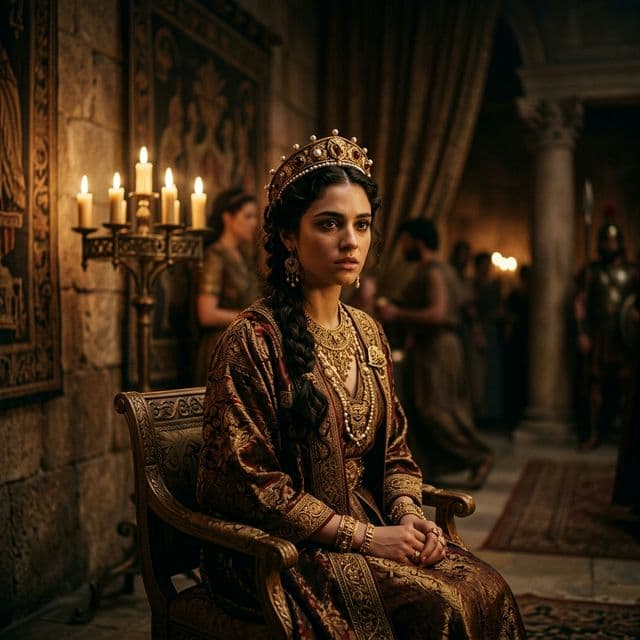
AI-assisted portrait of Cleopatra Eurydice
The Architecture of Impact
Cleopatra Eurydice did not just enter a court; she collided with it. As the final wife of Philip II, her life was defined by a profound, external engagement with the sensory and social reality of the present (Se-Ti). While others like Olympias were driven by an intense, internal vision (Ni), Cleopatra’s genius was profoundly oriented toward the immediate, bold challenge of her new position. She was the one who moved through the court with a direct, sensory intelligence that prioritized her own status and the immediate future of her house.
She was the master of the direct command and the social truth. From her flamboyant marriage feast to her final, tragic confrontation with the past, Cleopatra’s cognitive mode was focused on the internal synthesis of her immediate environment. For Cleopatra, the world was a set of social or physical obstacles that required an authentic, personal touch to navigate.
Historical Context
Cleopatra Eurydice was a Macedonian noblewoman, the niece of the general Attalus, and the seventh and final wife of Philip II. Her marriage in 337 BCE created a massive dynastic rift, as her children would have a full Macedonian claim to the throne, unlike Alexander. This tension famously boiled over during the wedding feast when her uncle Attalus insulted Alexander's legitimacy, leading to a temporary exile of the young prince. Following Philip's assassination, Cleopatra and her infant children were brutally murdered by Olympias to secure Alexander's succession. Her life represents the most volatile and impactful moment of dynastic politics in the Argead house.
The Psychological Verdict
Cleopatra Eurydice is a definitive ESTP. She was a figure defined by her intense engagement with the sensory and social present (Se), guided by a deep, internal mastery of logical and tactical systems (Ti), and supported by an imaginative, if bold, openness to her position (Fe).
Se — Dominant
Her primary mode was the immersion in the immediate, physical environment. Cleopatra’s bold entry into the royal court and her ability to navigate the high-stakes sensory world of the Macedonian elite reflect a dominant Se. She was acutely aware of the "vibe" of the court, using her beauty and her presence to establish her status. She didn't live for the abstract future; she lived for the tangible power and connection of the present moment.
Ti — Auxiliary
Supporting her sensory presence was a deep, internal mastery of how things work. Cleopatra was not just a pawn; she was an active player who understood the internal logic of the court. Her auxiliary Ti allowed her to navigate the complex social and tactical dynamics of her new position, treating the court as a puzzle to be solved with the highest level of individual efficiency. She approached the world as a system of social laws that could be manipulated to achieve her goals.
Fe — Tertiary
Beneath her tactical presence lay a tertiary ability to navigate the emotional landscape of her people and her king. Cleopatra was legendary for her ability to charm Philip and to inspire loyalty in the Macedonian nobility. This function allowed her to be not just a wife, but a popular figure who could lead through charm and public spectacle as much as through status.
Ni — Inferior
What stayed in the background was the pursuit of a long-term, abstract strategic vision. Cleopatra’s life was one of immediate experience rather than inter-generational planning. Her inferior Ni manifested in a relative inability to consolidate her status into a stable, lasting state. She was a woman who could win the court but struggled to secure the future, living a life that was profoundly tied to the presence of her husband rather than the structural legacy of her house.
The Gamble at the Wedding Feast
Cleopatra Eurydice was Philip’s last wife, a Macedonian noblewoman whose marriage to the king displaced Olympias and threatened Alexander’s succession. Her uncle Attalus made the toast at the wedding feast that implied Alexander might not be Philip’s legitimate heir — which reportedly prompted Alexander to throw his cup at Attalus and nearly started a brawl. Philip drew his sword at Alexander and promptly fell down drunk. The whole scene encapsulates the end of an era. When Philip was murdered months later, Olympias had Cleopatra Eurydice’s infant killed and forced her to commit suicide — one of the most direct acts of political elimination in the Diadochi period, carried out before the Diadochi period had even technically begun. Cleopatra Eurydice’s life lasted perhaps twenty years, and her few months as queen of the most powerful state in the world set off a chain of events that consumed a generation. She was the spark. The fire wasn’t her fault, and she didn’t survive it.
Connected Figures
Further Reading
- Women and Monarchy in Macedonia — Elizabeth Donnelly CarneyCovers the dynastic rupture Cleopatra Eurydice's marriage caused and her killing after Philip's assassination.
- Olympias: Mother of Alexander the Great — Elizabeth CarneyTells the same wedding feast and murder from Olympias's side — her deadliest rival's own account.
- The Age of Alexander — PlutarchRecounts the wedding brawl between Attalus and Alexander that made Cleopatra Eurydice's marriage a flashpoint.
