 Historical Figure MBTI
5 min read
#228 · 3-21-26 · The Age of Alexander
Memnon of Rhodes
The Shield of the East
c. 380 – 333 BCE
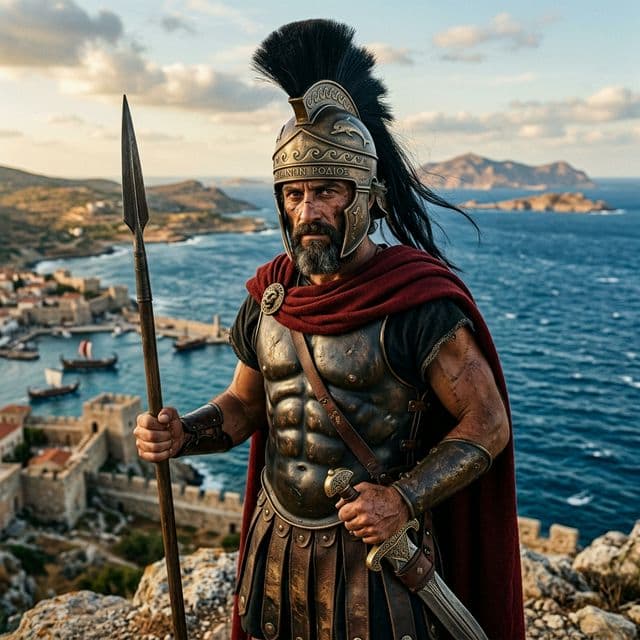
AI-assisted portrait of Memnon of Rhodes
The Architecture of Attrition
Memnon of Rhodes did not just fight a war; he analyzed a system. As the brilliant Greek mercenary commander in the service of the Persian Empire, his life was defined by a profound, internal strategic synthesis and an unwavering commitment to a long-term, asymmetric vision (Ni-Te). While the Persian satraps were driven by an immediate, often arrogant engagement with force (Se-Te), Memnon’s genius was profoundly oriented toward the structural exploitation of Alexander’s logistical weaknesses. He was the intellectual defender of the East, the one who valued the strategic retreat, the scorched earth, and the naval blockade over the catastrophic direct encounter.
He was the master of the indirect blow and the analytical truth. From his prescient advice at the Granicus to his masterful naval campaign in the Aegean, Memnon’s cognitive mode was focused on the internal synthesis of shifting patterns. For Memnon, the world was a logical puzzle that could be solved by denying the enemy the one thing they needed: a battle on their terms.
Historical Context
Memnon of Rhodes was a Greek mercenary general from Rhodes who served the Achaemenid Persian Empire. Most famous for being the only commander who truly understood the threat posed by Alexander the Great, he advocated for a "scorched earth" policy to starve the Macedonian army of supplies. Although his advice was ignored at the Granicus, he was later given supreme command of the Persian forces in the West. He launched a brilliant naval counter-offensive in the Aegean, capturing key islands and threatening to bring the war back to Macedonia itself. His sudden death from illness in 333 BCE at the Siege of Mytilene removed the most dangerous obstacle to Alexander's conquest, leaving the Persian defense without its most sophisticated strategic mind.
The Psychological Verdict
Memnon of Rhodes is a definitive INTJ. He was a leader defined by his deep, internal vision and strategic independence (Ni), supported by a pragmatic, logical approach to military organization and logistics (Te) and an unwavering, if professional, internal set of standards (Fi).
Ni — Dominant
His primary mode was the internal synthesis of complex patterns. Memnon saw the fundamental reality of the Macedonian threat with a clarity that the Persian nobility lacked. He understood that Alexander’s army was a "all or nothing" machine that relied on quick, decisive victories to survive. His auxiliary Ni allowed him to look past the immediate prestige of the Persian satrapies to see the systemic vulnerability of the conqueror. He was the man who planned for the victory that happens in the archives and the shipyards rather than the dust of the field.
Te — Auxiliary
Supporting his internal vision was an objective, effective application of logic. Memnon was a master of logistics and administrative organization. His actions were decisive, calculated, and entirely oriented toward the efficient management of the empire’s resources and his own mercenary fleets. He ran his campaigns with the same precision he used to command his battle lines. He didn't seek glory (Fe); he sought the structural finality of a completed objective. He was the ultimate coordinator of asymmetric warfare.
Fi — Tertiary
Beneath his strategic exterior lay a deeply private and unwavering internal loyalty. His tertiary Fi manifests in his absolute devotion to his service, staying loyal to the Persian throne even when the satraps mocked him. This internal standard of honor was quiet and unobserved, but it provided the bedrock for his decades of service. His resilience was fueled by an internal conviction that remained invisible to his enemies but bedrock to his professional pride.
Se — Inferior
What stayed in the background was the immediate, visceral experience of the physical world. Memnon was always more comfortable with the plan than the sword, and his inferior Se manifested in his relative detachment from the heroic, front-line culture of both the Persians and the Macedonians. He sought to win through abstraction and logistical denial rather than through the sensory chaos of the charge. His sudden death from illness was the ultimate failure of a body that could no longer keep up with the demands of his mind.
The One Who Almost Stopped It
Memnon of Rhodes is history’s great foreclosed possibility. He saw Alexander’s campaign for what it was — overextended, dependent on forward momentum, vulnerable to a strategy of denial and delay — and he had the naval and mercenary resources to execute a counterstrategy. His plan to carry the war to Greece itself, cutting Alexander off from his base, was strategically sound. When he died of illness at Mytilene in 333 BCE, mid-campaign, the Persian high command reverted to the massed land battle strategy he had counseled against — and lost at Issus within months. His widow Barsine passed into Alexander’s keeping. The irony is almost too neat: the man who might have defeated Alexander was replaced, in Alexander’s personal life, by the woman who had been closest to him. History is occasionally this direct in its symbolism.
Connected Figures
Further Reading
- Alexander of Macedon, 356–323 B.C.: A Historical Biography — Peter GreenThe most thorough account of Memnon's naval counter-offensive and why his death was the turning point of Alexander's Persian campaign.
- The Persian Empire — J. M. CookEssential background on the Achaemenid administrative system Memnon served and the satrapal politics he navigated.
- Alexander the Great: The Hunt for a New Past — Paul CartledgeExamines the Aegean theater where Memnon launched his counterattack, with analysis of what a successful campaign might have meant.
- The Generalship of Alexander the Great — J. F. C. FullerA military study that gives serious attention to Memnon as the one commander whose asymmetric strategy posed a genuine strategic threat.
