 Historical Figure MBTI
#674 · 5-18-26 · The Roman Republic
Cornelia
Mother of the Gracchi · Refused a Ptolemy · Keeper of Their Memory
c. 190 BCE — c. 100 BCE
9 min read
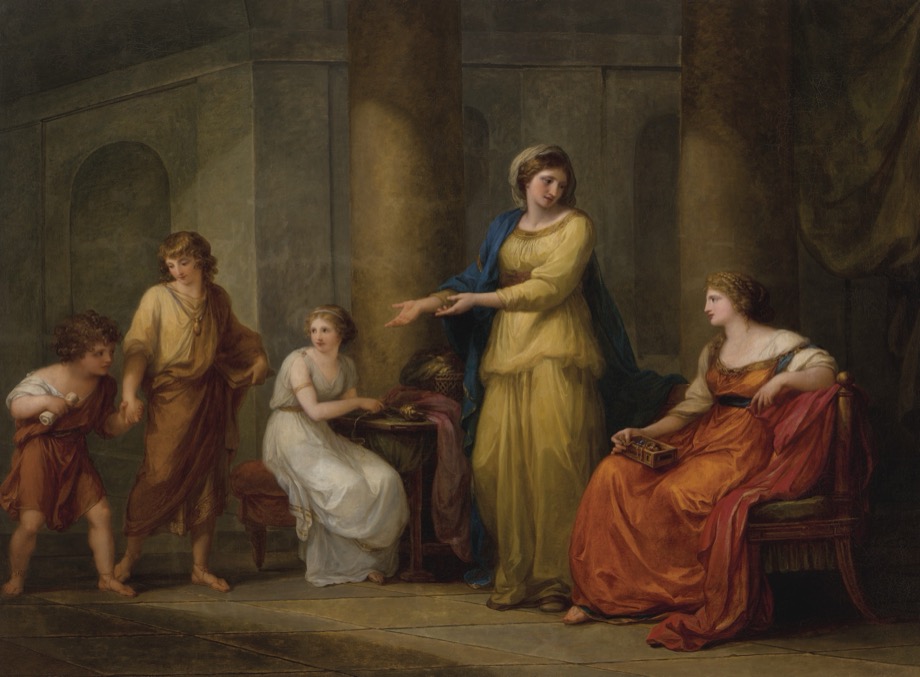
Portrait of Cornelia
The Daughter Who Became Someone Else's Mother
When Ptolemy VIII of Egypt asked her to marry him — a widow, offered a throne — Cornelia said no. She had already buried a husband twenty years her senior and most of the twelve children he had given her; three remained, Tiberius, Gaius, and a daughter, Sempronia. She did not remarry at all. She raised them instead, in a house on the edge of Rome that filled, over the following decades, with Greek tutors, visiting philosophers, and the sons of senators come to sit at her table. She was Scipio Africanus's daughter — the general who broke Hannibal was her father — and she could have spent the rest of her life trading on that name. She spent it instead building a household that outlasted both her sons and, eventually, her.
That choice is the whole of her. Cornelia never held office, never addressed the Senate, never authored a law. Her instrument was the family itself — its education, its reputation, its remembered meaning — and she wielded it with a discipline that later Romans found almost unnerving to describe. After Tiberius was clubbed to death by a mob of senators in 133 BCE and Gaius forced his own slave to kill him a decade later, Cornelia did not withdraw from public life. She held court at her villa at Misenum, received visitors, corresponded with kings, and set the terms on which her sons would be remembered — not as failed radicals but as martyrs to the Roman people, and herself not as Scipio's daughter but, as she reportedly preferred it, "the mother of the Gracchi." Rome eventually agreed: a bronze statue went up bearing exactly that inscription, the first such honor ever given to a Roman woman.
Cornelia is an ESFJ down to the grain of the evidence — a woman whose dominant Fe found its whole expression in the maintenance, education, and public memory of a family, and who never once reached for a stage outside it.
A House Built to Hold the Republic's Attention
Dominant Fe is a gift for reading a room and then organizing it around a shared purpose, and Cornelia used hers to turn a private household into one of the great social institutions of the mid-Republic. Her home became a salon in the fullest sense — poets, rhetoricians, and statesmen came not because she summoned them with authority she did not have, but because she had made the place worth attending. She imported Greek tutors for her sons at a time when Hellenic learning was still viewed with suspicion by conservative Rome, calculating, correctly, that the relationships and reputation this built would outlast any single political victory.
The clearest evidence of that Fe is what she did after the harm was done. When Tiberius was killed, and then Gaius, an inferior-Fe type or a more inward personality might have let the family name recede into private grief. Cornelia did the opposite: she made herself the custodian of how Rome would talk about her sons, receiving visitors at Misenum, keeping their memory in circulation, shaping the sympathetic version of events into something durable. That is Fe under pressure — not performing emotion, but managing a network of relationships and public sentiment as a deliberate, ongoing project.
Even her most famous line works this way. Asked to show off her jewels, she is said to have presented her two sons instead — "these are my jewels." It is a perfectly Fe gesture: value measured entirely in terms of relationship and role, staged for an audience, and delivered in a form built to be repeated. Whether or not the anecdote is verbatim, it survived because it captured exactly how Cornelia wanted, and expected, to be seen.
A Crown Refused for the Weight of a Name
Si gave Cornelia her sense of what a role was owed, and her refusal of Ptolemy VIII is the cleanest window into it. A Hellenistic throne was, by any external measure, a promotion — wealth, security, a kingdom instead of a widow's household. Cornelia turned it down. The decision reads as pure Si: an unwavering loyalty to established role and precedent, to the duty of a Roman matron and the memory of the husband and family she already had, over a novel status that would have required her to become someone new.
That same instinct shaped how she raised her sons — not as innovators for their own sake, but as heirs required to live up to a lineage. She was constantly, explicitly comparing them to the standard set by her father Scipio Africanus, holding the family's past achievements up as the measure of present conduct. It is a traditionalist's method of motivation: not "imagine something new" but "be equal to what came before you."
Her preferred epitaph fits the same pattern from the other direction. Wanting to be remembered as "mother of the Gracchi" rather than "daughter of Scipio" was not a rejection of family-based identity — it was a request to be filed correctly within it, under the role she had spent her life actually inhabiting rather than the one she was born into. Even her rebellion against her birth-identity was conducted entirely inside the grammar of family duty and established precedent that Si supplies.
The Salon She Filled With Other People's Ideas
Tertiary Ne shows up in Cornelia not as a hunger to generate her own novel ideas, but as an appetite for exposing her household to them — and then keeping that exposure going far longer than practicality required. Importing Greek rhetoricians for her sons at a time when Greek learning was still politically suspect in Rome was a genuinely unconventional move for a Roman matron of her class, and she pursued it deliberately, not as an accident of circumstance.
The salon itself is the fullest expression of this: a rotating cast of poets, philosophers, and political men passing through her home, debating and cross-pollinating ideas under her roof for years. Cornelia did not need to originate the arguments to value the traffic in them — she built and sustained the space where other minds could meet, which is Ne working in service of Fe rather than for its own sake.
It shows too in the intellectual ambition she had for her sons' reform program itself — land redistribution, grain provisions, a broadened citizenship were not small, cautious ideas, and the boldness of Tiberius and Gaius's politics plausibly owes something to a household that had spent a childhood entertaining possibilities most Roman families never let in the door. But it was always a supporting current beneath her Si-anchored sense of family duty, never the dominant force in her own choices.
The Argument She Left to Her Sons
Inferior Ti in Cornelia appears less as a capacity she exercised than as a gap she filled by proxy. The Gracchi reforms rested on a genuine legal and political argument — about the ager publicus, about the limits of senatorial custom versus written law — and it was Tiberius and Gaius who built and prosecuted that argument in the Forum. Cornelia, for all her evident intelligence, is never recorded constructing the case herself; she supplied the education and the household in which such argument-building could happen, then let her sons carry it into a domain she did not occupy.
Where her own Ti does surface is in occasional, sharp private judgments — reportedly criticizing Gaius's tactics in letters, questioning the wisdom of specific political moves after the fact. These read as flashes of independent critical analysis rather than a sustained framework; she could evaluate a decision once it existed, but she was not the one generating the theory of Roman law and precedent that Tiberius and Gaius needed for their program.
That imbalance is exactly what the type predicts. A dominant-Fe, auxiliary-Si personality reasons about people, roles, and continuity fluently and constantly; abstract, structural argument stays a background capacity, available in bursts but never the seat of her authority. Cornelia's power in Rome was never that she out-argued anyone. It was that she out-lasted them.
Why ESFJ Over ENFJ
Why not ENFJ?
An ENFJ with Cornelia's social gravity — her father's name, her household full of rhetoricians, two politically formidable sons — would very likely have built a cause of her own under her own name: a faction, a public campaign, a movement she led rather than sustained. Cornelia never did. She worked entirely through the existing, traditional channel of family and household — Fe braced by Si, not by Ne — sustaining and interpreting other people's legacies (her father's, her sons') rather than authoring one of her own. Her refusal of Ptolemy's throne is the tell: an ENFJ chasing an ideal might have seen it as a bigger platform; Cornelia saw it as a role she was not willing to leave.
The two types can look alike from a distance — both are warm, both build networks of people around a purpose, both leave a public legacy larger than their formal station. The difference is where the compass points. ENFJ's dominant Fe pairs with Ne and reaches outward toward new causes and untested ideals; ESFJ's pairs with Si and reaches back toward the roles, households, and precedents already established. Everything documented about Cornelia — the refused marriage, the inherited standard of Scipio, the insistence on being filed as "mother of the Gracchi" within the family record rather than escaping it — points backward, not outward. That is ESFJ.
Connected Figures
Further Reading
- Life of Tiberius Gracchus — PlutarchContains the fullest ancient material on Cornelia's household and influence
- Matrona Docta — Emily HemelrijkStudy of learned Roman women, situating Cornelia's education and salon
- Cornelia, Mother of the Gracchi — Suzanne DixonThe standard modern biographical study
- SPQR: A History of Ancient Rome — Mary BeardPlaces Cornelia and her sons within the crisis of the late Republic
