 Historical Figure MBTI
#675 · 5-19-26 · The Roman Republic
Gaius Marius
Seven-Time Consul · Army Reformer · The New Man
157 BCE — 86 BCE
10 min read
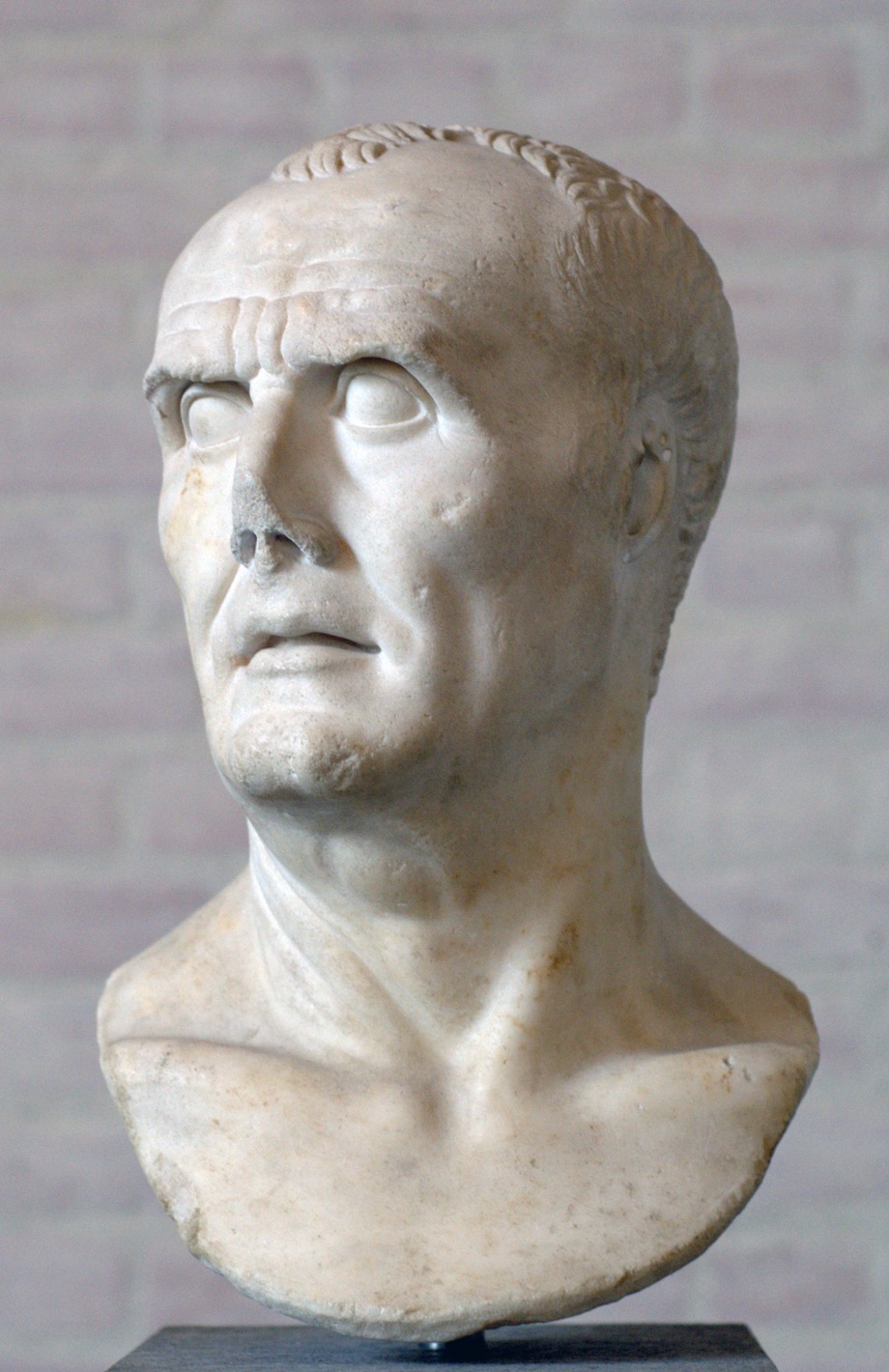
Portrait of Gaius Marius
The Man Who Had No Ancestors
He had a farmer's hands and a soldier's voice, and for most of his life Rome could not decide whether that made him a hero or an embarrassment. Gaius Marius came out of Arpinum, a hill town seventy miles from the Forum, with no consular mask in his atrium and no family name that any senator was obliged to remember. Rome's nobility treated the consulship as a heirloom. Marius took it seven times — a number no one had reached before him and no one would reach again under the Republic — and he did it by being unmistakably better at the one thing the Republic could not fake its way through: winning battles that had to be won.
What makes him extraordinary is not ambition; the late Republic was thick with ambition. It is that Marius seems to have had almost no plan. He responded. A manpower crisis in Numidia produced the recruitment reform of 107 BCE that would remake the Roman army and, in the end, the Roman state. A Germanic migration pouring toward the Alps produced the drill, the reorganized baggage train, the unglamorous reshaping of the legion into something that could march and fight on its own legs. He solved what was in front of him with startling speed and clarity, and each solution turned out to have consequences that ran a century into the future — consequences he neither foresaw nor, on the evidence, much cared to.
The same wiring that saved Italy from the Cimbri destroyed him at the end. Old, sour, obsessed with an eighth consulship and with the ruin of the man who had once been his quaestor, he marched on his own city in 87 BCE and turned the streets over to killing squads. There was no grand design in it. There was appetite, grievance, and the reflex to seize what stood in reach — the reflex that had made him the best soldier of his generation, running without brakes.
Marius is the archive's clearest Roman ESTP — dominant Se, a man who read the field in front of him faster than anyone alive and never once looked past the horizon of the present fight.
Se — The Field in Front of Him
Marius's genius was situational and physical. In Numidia he inherited a war that had been going nowhere for years — a war of bribed commanders, negotiated pauses, and columns marching into terrain Jugurtha knew better than they did. Marius took the campaign apart by simply going at it: hard marching, fortified towns stormed rather than besieged into eventual surrender, garrison after garrison peeled off the Numidian king until there was nothing left for him to hold. He did not out-think Jugurtha in the abstract. He out-moved him, week after week, in real terrain, and made the man's mobility — his one advantage — worthless.
Against the Cimbri and Teutones the same instinct shows in its purest form. Rome had already been mauled at Arausio, and the northern tribes were, in the Roman imagination, less an enemy than a weather front. Marius refused to be hurried. He sat in fortified camps and let his men watch the migration file past, absorbing the sight until it stopped being terrifying — a piece of psychological handling that only a commander who trusts direct perception over rumor would attempt. Then, at Aquae Sextiae, he chose the ground, hid a detachment to fall on the Teutone rear at the moment of contact, and destroyed them. At Vercellae the next year he read the heat and the dust and put the sun and wind at his own army's back. These are not strategies in any grand sense. They are a man looking at the actual field, in the actual hour, and seeing what is available.
And he was always physically in it. He trained alongside the recruits into his sixties, ate what they ate, dug what they dug, and was described by his own soldiers in terms usually reserved for a fellow ranker rather than a commander. Plutarch's Marius is a body before he is a mind — scarred legs, a famously unflinching endurance of the surgeon's knife, a presence that reassured troops simply by standing where they could see it. The Se dominant does not lead from a map. He leads from the middle of the line.
Ti — The Fix That Broke the Republic
In 107 BCE Marius needed men and could not get them. The property qualification that had governed Roman recruitment for centuries assumed a citizenry of smallholders who could arm themselves; decades of long overseas wars and consolidated estates had hollowed that class out. The Senate offered him the Numidian command grudgingly and no soldiers to fill it. So Marius did the obvious thing, which was also the unthinkable thing: he enrolled the capite censi, the head-count, the men with no property to be assessed on, and had the state arm and equip them.
This is auxiliary Ti at work, and it is important to see how small it was in conception. Marius was not designing an institution. He had a problem — bodies — and he found the shortest logical path around the obstacle, which was the qualification itself. Why should a man's ability to fight depend on a valuation of land he did not own? The reasoning is clean, local, and entirely correct on its own terms. Its consequence — that a legionary now had no farm to return to, and so looked to his general for land, pay, and discharge settlement — was a bomb with a sixty-year fuse. Sulla, Pompey, Caesar and every warlord after them inherited an army whose loyalty ran to a man rather than to the Republic, and the man who handed it to them had been trying to fill a muster roll.
The rest of the "Marian reforms" have the same texture: practical, sharp, unsentimental. He reorganized the legion around the cohort rather than the older maniple, giving a commander larger and more independent tactical units. He stripped the baggage train and made each soldier carry his own kit, load and all, until the troops were nicknamed muli Mariani, Marius's mules — a joke about a logistics decision that doubled the army's march speed. Each is a fix, elegant in itself, arrived at by a mind that liked mechanisms and disliked ceremony. None is a blueprint.
Fe — The New Man's Voice
Marius understood a room, and he understood a crowd better. His whole political identity was built out of the gap between himself and the nobility — the novus homo who had earned what they had inherited. Sallust preserves the shape of his rhetoric: he could not display ancestral portraits, so he displayed his scars; he had no eloquent forebears to invoke, so he invoked the spears and standards he had taken. It was a pitch aimed with real precision at the people who actually voted him his commands, and it worked so well that the Assembly stripped the Numidian war from Metellus and handed it to Marius over the Senate's objection.
With soldiers the same faculty operated at closer range. He was famous for knowing what an army felt before it knew itself — when to let men shout at the enemy across a rampart, when to promise land, when to say nothing. His enrollment of the landless was not only a manpower fix; it was an offer of belonging to men Rome had written off, and they repaid it with a devotion no aristocratic commander of the period could match. When he granted citizenship to Italian cohorts on the field at Vercellae without authorization and was challenged on it, his answer was that the noise of battle had drowned out the law. That is a joke, a boast, and a piece of emotional politics all at once.
But tertiary Fe is a reach, not a foundation, and under pressure it curdled. The same sensitivity to standing and slight that made him magnetic made him unable to let an insult go. Late in life the connection with the crowd narrows into grievance and faction; the man who once spoke for the head-count ends by using Sulpicius's street gangs and his own veterans as instruments of a personal vendetta. The warmth was always real. It was never in charge.
Ni — The Horizon He Never Looked At
Ask what Marius wanted Rome to become and there is no answer, because he never framed the question. He wanted commands, and then more commands. Six consulships came in a rush between 107 and 100 BCE, most of them held in defiance of the custom requiring ten-year gaps, and the justification each time was the emergency at hand. When the emergencies ran out, so did he. The Marius of the 90s is a becalmed man — rich, decorated, politically clumsy, entangled with Saturninus and then abandoning him, unable to convert unprecedented military prestige into anything that lasted a season.
Where the inferior function does appear, it appears as superstition rather than foresight. He kept a Syrian prophetess, Martha, in his entourage and consulted her on sacrifices; he treasured an omen of seven eagles read in his youth as a promise of seven consulships, and in old age that omen became less a prediction than an itch — the eighth consulship he pursued past all reason was, in part, a man chasing a number he had been given decades earlier. Vision arrives here not as strategy but as an oracle he could not argue with.
The end follows from that absence. Stripped of the Mithridatic command in favor of Sulla, humiliated, seventy years old, he had no long game to fall back on — only the immediate move. He fled Italy, hid in the marshes at Minturnae, came back with troops the moment Sulla's back was turned, took Rome by force, and let his men run loose through the city for days of killing. Then he had himself made consul for the seventh time and died about two weeks later, in January of 86 BCE, of illness and exhaustion. The prophecy was fulfilled and meant nothing. He had spent his last strength seizing an office he did not live to use.
Why ESTP Over ESTJ
Why not ESTJ?
The ESTJ reading is tempting: a career soldier who restructured the Roman army and held the consulship seven times looks, from a distance, like dominant Te imposing order on an institution. But a Te-dominant reform is an overhaul — a deliberate redesign with a stated long-range structure, the way Crassus built and ran his commercial apparatus, or the way an administrator legislates a system meant to outlive him. Marius's reforms were emergency measures: he enrolled the landless because he could not otherwise raise an army in 107 BCE, and he never once addressed the obvious consequence — that soldiers with no land would look to their general for it — because the consequence lay beyond the crisis in front of him. And nothing in Te-dominance produces the final act: a seventy-year-old consul ignoring every institutional lever he had spent a lifetime accumulating in order to take his own city by force over a personal grudge. That is not control. That is appetite with an army attached.
The ESTP reading holds because it explains both halves of him with one mechanism. The commander who let his troops stare down the Cimbri until fear wore off, who picked his ground at Aquae Sextiae by looking at it, who turned a recruitment statute into scrap because it was in his way — that is Se leading and Ti tidying up behind it, and it is very close to the best version of a human being in a crisis. The politician who could not conceive of a Rome after Marius, who chased an omen's seventh consulship into the proscriptions, is the same faculty with nothing left to perceive but his own hunger. He was magnificent when reality supplied the emergency, and lost the moment he had to invent a purpose for himself.
Connected Figures
Further Reading
- Life of Marius — PlutarchThe indispensable ancient portrait — the scars, the mules, the prophetess Martha, and the squalid final consulship.
- The Jugurthine War — SallustContemporary-minded account of the Numidian war and the source for Marius's new-man rhetoric against the nobility.
- Gaius Marius: A Political Biography — Richard J. EvansThe standard modern scholarly life, sceptical about how deliberate the 'Marian reforms' really were.
- The Fall of Carthage — Adrian GoldsworthyBackground on the pre-Marian legion and the manpower strains that made the recruitment change inevitable.
- Caesar: Life of a Colossus — Adrian GoldsworthyTraces the Marian army straight through to Caesar, including the family tie Caesar exploited.
- SPQR: A History of Ancient Rome — Mary BeardPlaces Marius inside the longer collapse of Republican politics rather than treating him as its single cause.
