 Historical Figure MBTI
#679 · 5-20-26 · The Roman Republic
Crassus
Richest Man in Rome · Triumvir · Died at Carrhae
c. 115 BCE — 53 BCE
9 min read
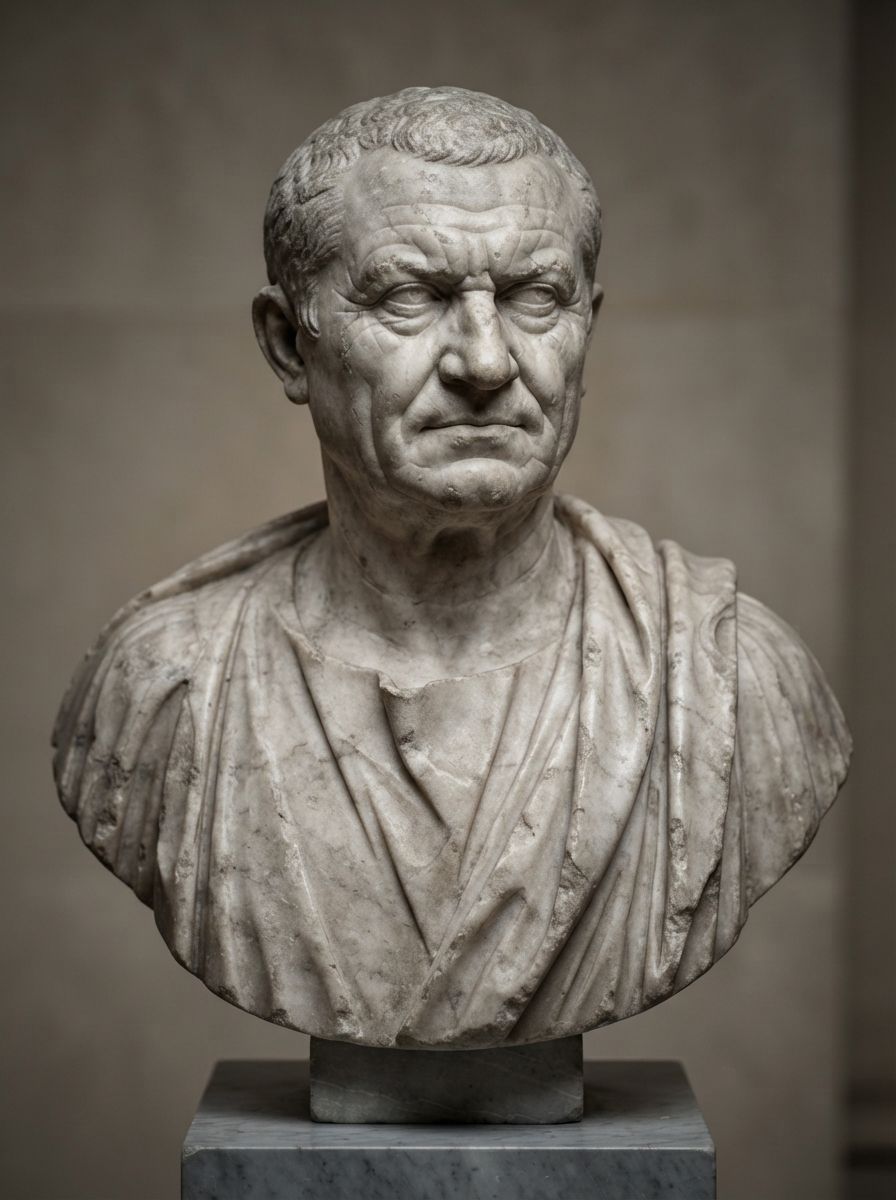
AI-assisted Portrait of Crassus
The Man Who Owned Rome and Could Not Buy It
Rome produced conquerors, orators, and demagogues; Crassus was something the Republic had fewer words for. He was a proprietor. While Pompey collected triumphs and Caesar collected provinces, Marcus Licinius Crassus collected buildings, mines, ships, slaves, favors, and debts — enough of all of them that by the 60s BCE no Roman could easily be elected, prosecuted, or defended without his consent. No man should call himself rich, he said, unless he could pay for an army out of his own income. It was less a boast than an accounting standard.
His methods were famous and unromantic. Rome burned constantly, its tenements stacked six storeys of timber, and Crassus kept a private brigade of some five hundred trained slaves who arrived promptly at a fire — and waited. He negotiated with the owner and the panicked neighbors while the flames worked in his favor, bought the block and everything adjacent at whatever the terror of the moment would bear, and only then ordered the fire put out and the rebuilding begun. He treated the proscriptions of Sulla the same way: a list of condemned men read as a cheap property catalogue. Plutarch despised him for it and could not deny that the operation ran beautifully.
What is striking across forty years is how little he ever changed the machinery. He learned a set of procedures early, verified that they produced results, and applied them to silver, real estate, slaves, lawcourts, elections — and finally to a slave army loose in Italy that two consuls had already failed to stop.
Crassus is the Republic's definitive ESTJ: dominant Extraverted Thinking turning the whole city into an inventory with margins, schedules, and enforceable terms — and never once mistaking that inventory for a destiny.
The City as a Ledger — Te dominant
Extraverted Thinking imposes order on external conditions until they yield measurable results, and Crassus applied it to the physical fabric of Rome. The fire brigade was not opportunism in the ordinary sense; it was a designed instrument. He identified a recurring, predictable event, built a standing capability to convert it into acquisition — trained crews, architects and builders among his slaves — and attached a contract term that made rescue conditional on sale. The cruelty is real; the psychology is procedural. He was not seizing. He was operating, with repeatable inputs and a known yield.
The same structure runs through everything else. He worked silver mines at scale. He ran Rome's largest slave-training business, buying men and having them educated as readers, stewards, and architects before renting out their labor — improving an asset rather than merely holding it. He lent to senators without interest and collected in obligation instead of cash; Caesar's astronomical debts before Spain were Crassus's paper. Every relationship had terms, and he kept the terms in his head.
Against Spartacus in 71 BCE he switched the ledger's units from money to men. Given command after the consular armies had been beaten, he did not seek a decisive battle: he raised and equipped six legions at his own expense, drove the rebels into the toe of Italy, and dug a ditch and wall some thirty miles across the isthmus to pen a mobile army in place — a war reduced to a construction problem. The six thousand survivors were then crucified at regular intervals along the Appian Way from Capua to Rome, spaced so that every traveler on Italy's main road would receive the message for months. Te does not punish. It publishes policy.
Decimation, or the Restoration of Procedure — Si auxiliary
The act that has followed him through two thousand years is also the one that best explains him. Early in the Spartacus campaign a subordinate engaged the rebels against orders and was routed; the legionaries threw down their weapons and ran. Crassus reinstated decimation, a punishment already archaic in his own day — the broken cohorts divided into tens, lots drawn, each group beating the tenth man to death before the assembled army. Plutarch preserves the detail that matters: it was done publicly, by lot, with the traditional forms observed, so that no soldier could believe he had been singled out by a general's temper.
That is Introverted Sensing supplying the answer, and it is not sadism. Faced with an army that had stopped behaving like one, Crassus reached back into the remembered institutional past for the oldest formal remedy available and executed it exactly. He was not inventing a deterrent; he was restoring one — the reasoning of a man who believes discipline is a condition you rebuild by reapplying a known procedure, not by inspiring men. It worked. Those legions did not break again, and afterward, Plutarch says, they feared their commander more than the enemy.
Si shapes the career as well. He had watched his father and brother die in the Marian terror, returned with Sulla, and rebuilt the family's position by the conventional cursus: praetor, consul in 70 and again in 55, censor in 65. He gave the people ten thousand tables of feasting and three months' grain because that is what a Roman magnate did. And his memory for the concrete was legendary — he was said to greet every citizen he had ever met by name. The past filed as an asset, retrievable on demand.
Every Angle, No Horizon — Ne tertiary
Crassus's intelligence was lateral rather than long-range. He was quick to see that one thing could be turned into another: a fire into a sale, a proscription list into a property catalogue, an educated slave into an appreciating asset, a loan to an ambitious young man into a claim on a future province. Nothing in the portfolio was a bet on a single future — it was a broad net of concrete, repeatable positions, each of which paid on its own.
He worked the courts the same way, taking the cases nobody wanted, defending men of no distinction, preparing laboriously where Cicero relied on brilliance. Every acquittal was a client. He cultivated tribunes and equestrians the great families ignored, until scarcely a faction in Rome lacked someone who owed him something. The First Triumvirate of 60 BCE was assembled by the same instinct: not a movement or a program but a transaction between three men who each held what the other two needed — and when Pompey and Caesar fell out, Crassus was the one who patched it back together at Luca.
But tertiary Ne generates options, not destinations. Nowhere in forty years is there a picture of what Rome should become — no reform, no constitutional theory, no Alexander to measure himself against. He wanted to be first. That he could never say first at what is the fault line his last two years ran straight into.
The Ovation He Never Forgave — Fi inferior
For a man who computed everything, Crassus carried one unpriced quantity, and it governed his end. He had beaten Spartacus — but Pompey, returning from Spain, cut down a fugitive band of five thousand and wrote to the Senate that Crassus had won the battle while he himself had pulled the war up by the roots. Pompey got a triumph. Crassus got an ovation: the lesser honor, on foot, myrtle instead of laurel, the ceremony reserved for victories over slaves. He never spoke of it as a grievance. He simply never let it go.
Inferior Introverted Feeling is a private, inarticulate valuation the dominant function cannot audit and therefore cannot correct. Crassus could tell you the yield of a mine to the denarius; he could not tell you, or himself, what exactly he needed in order to be the first man in Rome. He knew only that Pompey had it, and that Caesar — twenty years younger, once his creature, borrowing against his signature — was acquiring it in Gaul by the year.
So in 55 BCE, consul a second time and near sixty, he took Syria and announced a war on Parthia that Rome had no quarrel to justify. A tribune cursed him publicly at the gates; the omens were bad and he ignored them, which was itself out of character for a man so attentive to form. He crossed the Euphrates with seven legions and let a local guide draw him off the river into open plain at Carrhae, where Surena's horse archers, resupplied with arrows from a camel train, shot the legions apart at a range they could not close. Twenty thousand Romans died and ten thousand were taken. His son Publius was killed and the head shown to him on a spear. Crassus was cut down at a parley he had not wanted to attend. Every step of it violated the discipline of the man who once dug thirty miles of wall rather than risk a battle.
Why ESTJ Over ENTJ
Why not ENTJ?
An ENTJ organizes the world around a single long-range vision, and the men beside Crassus show what that looks like: Caesar bending a decade of campaigning toward one destination, Sulla rebuilding the constitution to a design settled years in advance. Crassus never had a design. He diversified — real estate, mines, slave-training, litigation, credit, patronage — a spread of concrete, present, repeatable ventures held together by structure rather than by direction, which is Te governing opportunity, not Te executing a vision. Even the Triumvirate was a contract rather than a project: he brokered it, profited by it, and produced no idea of his own about what the three of them were building. Parthia clinches it against Ni — not a strategic conception but an appetite for glory he had never earned by his own methods, undertaken without a casus belli, a plan, or reliable intelligence.
The distinction matters because the Republic's collapse is usually narrated as a contest of visionaries, and Crassus does not fit that story — which is exactly why he belongs in it. He was the operator among them, drawing power from a thousand small verified positions rather than one large idea, and for most of his life that made him the most durable of the three. ESTJ built him and ESTJ served him: a machine for converting the observable present into enforceable advantage. What it could not do was tell him when to stop, because the thing he finally wanted was not an asset, and he had no instrument for valuing it.
Connected Figures
Further Reading
- Life of Crassus — PlutarchThe indispensable source, and openly hostile: the fire brigade, the proscription purchases, the decimation, and Carrhae, all told by a moralist who cannot stop noticing how well the system worked.
- Pompey: The Roman Alexander — Peter GreenhalghThe rivalry from the other side — Spain, the disputed credit for the slave war, and the ovation that Crassus never forgave.
- SPQR: A History of Ancient Rome — Mary BeardPlaces Crassus inside the machinery of late-Republican wealth, patronage, and slavery rather than treating him as a personal vice.
- Caesar: Life of a Colossus — Adrian GoldsworthyThe clearest account of the Triumvirate as a transaction, and of what Crassus's debts and guarantees actually bought him.
- Roman History, Book XL — Cassius DioThe Parthian campaign and the death at Carrhae, including the molten-gold story that fixed his reputation for good.
