 Historical Figure MBTI
#680 · 5-20-26 · The Roman Republic
Spartacus
Gladiator · Rebel General · Beat Nine Roman Armies
c. 111 BCE — 71 BCE
12 min read
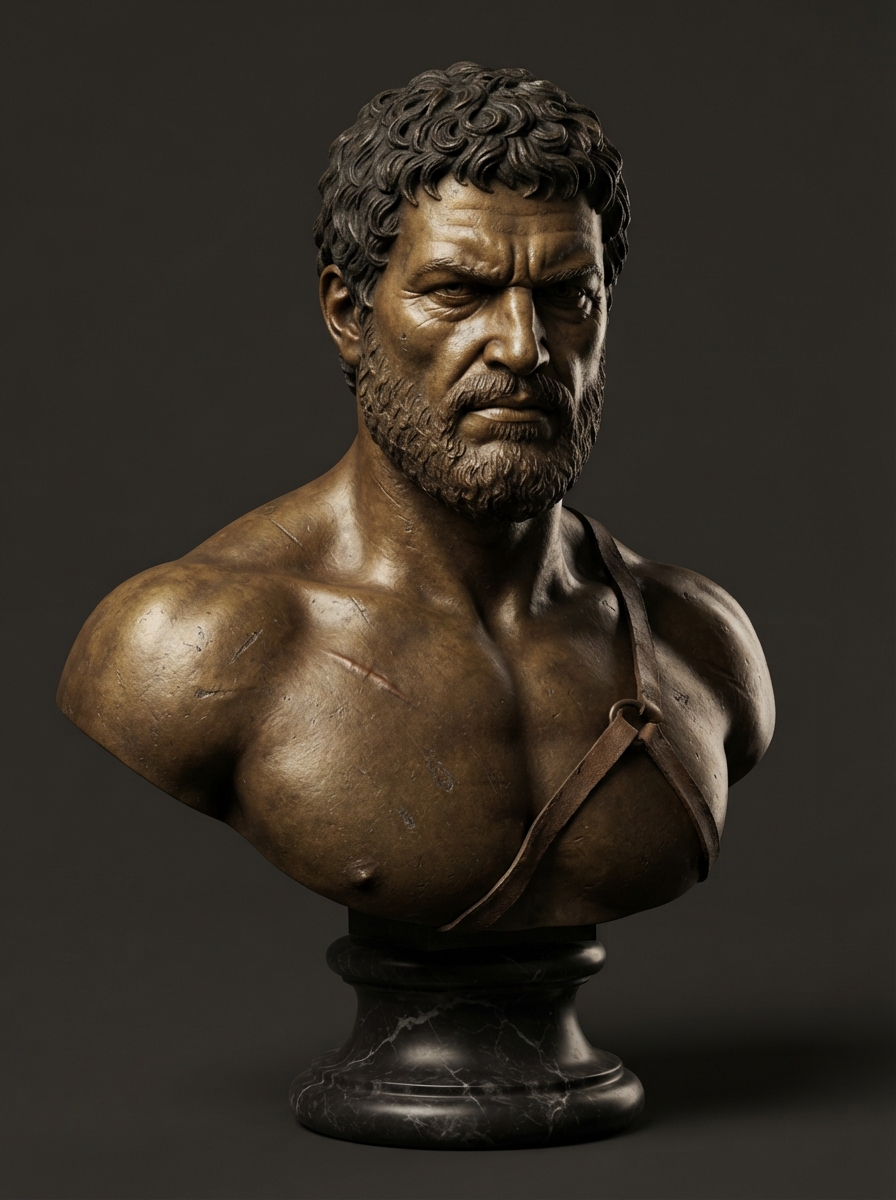
AI-assisted Portrait of Spartacus
The Man Who Fought His Way Out of the Kitchen
The revolt that nearly broke the Roman Republic began with cooking knives. In 73 BCE, inside a gladiatorial school at Capua, roughly seventy men who had been bought to die for an afternoon's entertainment took whatever the kitchen held — spits, cleavers, skewers — and cut their way into the street. It was not a plan so much as a decision made at the speed of a hand closing on a blade. Within hours the escapees had ambushed a wagon convoy carrying gladiatorial arms and were suddenly, absurdly, an armed band. Within days they had scattered the local militia sent to round them up. The man at the front of them was a Thracian named Spartacus, who had once served in Rome's own auxiliary forces before ending up on an auction block, and who therefore knew exactly what a Roman soldier looked like from the inside.
What followed has no real parallel in ancient military history. In under two years, with no formal training in command, no staff, no logistics apparatus, and an army that swelled from seventy men to something between ninety and a hundred and twenty thousand people — escaped slaves, herdsmen, farm laborers, deserters, entire families — Spartacus defeated nine separate Roman forces, including armies commanded by both consuls of 72 BCE. He did it in Rome's own backyard, against the finest military machine of the Mediterranean world, without ever holding a city or fielding a professional legion. The Senate, which had at first treated the affair as a policing matter, ended up handing the war to Marcus Licinius Crassus and eight legions.
The temptation is to read that record as visionary leadership — the liberator with a cause, the prophet of freedom. But the sources describe something more concrete and, honestly, more impressive. Spartacus won because he read whatever was in front of him faster and more accurately than the men opposing him, and because he was willing to act on that reading before anyone else had finished forming an opinion. The cliff face at Vesuvius was impassable until he looked at the wild vines growing on it and decided it wasn't. That is not vision. That is perception, converted directly into motion.
Spartacus is the archive's clearest ancient ESTP — a dominant Se that turned the physical world into a weapon faster than Rome could draw up a plan against it.
The Vine Ropes — Se as dominant
The escape from Mount Vesuvius is the single cleanest window into how this man's mind worked. Trapped on the summit by a Roman force under Gaius Claudius Glaber, who had simply blocked the one path down and settled in to let starvation do the work, Spartacus had no options in the sense a strategist would recognize. What he had was a hillside covered in wild grapevine. He had his men cut the vines, plait them into ladders long enough to reach the base of a cliff the Romans had not bothered to guard because no one climbs a cliff, and go down it in the dark — then come around behind the besiegers and hit a camp that had no rear defenses because it was not facing an enemy. Glaber's force was routed by men who had, that morning, been considered already dead.
This is Se in its purest operating mode: the environment is not scenery, it is inventory. Kitchen implements are weapons. A passing wagon is an armory. Vines are rope. A cliff nobody watches is a door. Nothing in that sequence required a theory of war; it required looking at the actual physical situation with total attention and zero preconception about what things are supposed to be for. Rome's commanders kept losing to Spartacus because they were fighting the situation they had drawn up, and he was fighting the one that was there.
The same faculty shows in his rhythm. He struck fast and moved constantly, refusing the set-piece pitched battle whenever the odds were wrong and taking it instantly when a Roman column strung itself out on a march or camped badly. He beat the consuls of 72 BCE not by out-planning them but by arriving before their plans matured. It is the fighter's instinct scaled up to an army — the gladiator's habit of reading an opponent's weight shift a half-second before the strike, applied to legions. And like every dominant-Se operator, his greatest strength was inseparable from his blind spot: the tempo that made him unbeatable in the moment kept him from ever choosing a destination.
Nine Armies, Nine Different Answers — Ti as auxiliary
Beating nine Roman forces is not luck, and it is not the same trick performed nine times. Each Roman command that came at Spartacus was differently constituted — a praetor with hastily levied troops, a pair of consular armies operating on separate axes, veteran legions under an experienced hand — and each was beaten by a solution fitted to its particular flaw. Glaber lost to terrain he had dismissed. The forces that tried to catch the rebel army on the march lost to the fact that Spartacus would concentrate against one column while the other was still days away, defeating armies that on paper outnumbered him only because he never let them be added together. This is auxiliary Ti doing what it does best: taking the raw perceptual data Se supplies and finding, quickly and privately, the load-bearing weakness in the structure.
Note what is absent. There is no Spartacan doctrine, no signature formation, no reproducible method the way there is with a Marius or a Caesar. He did not build a system; he solved problems. His Roman service gave him the raw material — he knew how legions camped, marched, deployed, and where the seams were — and Ti turned that knowledge into a diagnostic tool rather than a template. The question he seems to have asked of each new enemy was not "what is my strategy" but "what specifically is wrong with this force, right here." Given that his army had no shared training, no uniform equipment, and no common language, an approach built on fixed doctrine would have collapsed on contact anyway. Improvised analysis was the only kind that could survive the material he had.
It also explains the arms and the logistics. A body of a hundred thousand people cannot be fed, armed, and moved through the Italian countryside by inspiration; someone was organizing forges, requisition, and march order well enough that the army held together through two winters. That is the unglamorous Ti substrate under the spectacular Se surface — a mind that liked working machinery and could see quickly how a thing must be put together to function.
The Loyalty of Strangers — Fe as tertiary
The hardest fact to explain about Spartacus is not that he won battles. It is that his army existed at all for two years. It had no state, no pay, no citizenship, no tradition, and no common tongue — Thracians, Gauls, Germans, Italian farm slaves, herdsmen from the southern latifundia, all of whom had every incentive to melt into the countryside the moment the fighting looked bad. Instead they stayed, fought Roman legions in the open field, and at the end died in a battle they had to know was lost. That is real Fe, and it is why the ENFJ reading has genuine pull.
But look at how the loyalty was earned. Spartacus led from the front and won, visibly, repeatedly, against the people who had owned them. The sources give us gestures rather than speeches — his reported refusal of luxury, the funeral games he is said to have staged for a fallen comrade in which captured Romans were made to fight as gladiators, a deliberate and legible inversion that every man in that army could read instantly without translation. That is Fe in the tertiary position: warm, sincere, powerfully effective, and expressed through action and shared experience rather than through articulated vision. He bound people by standing where they could see him.
The limits show up exactly where tertiary Fe would predict. He could hold an army through victory; he could not hold a coalition through disagreement. When the leadership split — Crixus and others peeling off to keep raiding the rich south while Spartacus reportedly wanted to march the whole force north and out of Italy — he had no instrument for reconciling them. A dominant-Fe leader converts a fracture into a renewed common purpose. Spartacus lost a large detachment, which was promptly destroyed, and carried on with the rest.
The War With No Destination — Ni as inferior
Every account of the revolt runs aground on the same question, and it is the question Spartacus himself never answered: what was the army for? Not what did it want — freedom, obviously — but what was supposed to happen next. The one aim attributed to him with any consistency is the plan to march north, cross the Alps, and let the army disperse to the homelands its members had been taken from. That is a sensible aim. It is also not a vision of anything; it is an exit. There is no evidence he ever proposed a new order, a state, a settlement, or a future that would exist after the running stopped.
This is inferior Ni in its characteristic form: not absent, but thin, late, and unable to compete with the immediate. Twice the army reached the north of Italy after a victory that opened the road, and twice it turned back south — because there was plunder there, because the men wanted it, because the present was more vivid than the plan. Then came the negotiation with the Cilician pirates for passage to Sicily, which ended with the fleet simply not arriving and the army trapped in the toe of Italy behind Crassus's ditch and wall. A long-horizon thinker would have secured that crossing before needing it. Spartacus arranged it when it became urgent.
The end has the same shape. Cornered in Apulia in 71 BCE with Pompey marching back from Spain and Lucullus landing at Brundisium, he chose to fight rather than maneuver, and — in the detail Plutarch preserves — killed his own horse before the battle so that victory would leave him nothing to ride away on and defeat would cost him nothing he had not already given up. It is a magnificent gesture and an entirely Se one: burn the exit, resolve everything in the physical present. He drove toward Crassus through the line and was killed somewhere in the press. His body was never identified among the dead.
Why ESTP Over ENFJ
Why not ENFJ?
This is the closest call in the cluster, and it deserves the respect of a real hearing. Holding a polyglot host of escaped slaves, gladiators, herdsmen, and deserters together for two full years — across languages, origins, and the enormous centrifugal pull of a hundred thousand people with nothing in common but a former owner — is genuine Fe work, and an ENFJ reading explains it in one stroke. But the mechanism the sources actually describe is competence, not rhetoric: he was followed because he kept winning in front of them, and because he shared their conditions, not because he articulated a cause. No ancient account credits him with a program, a manifesto, or a proclaimed new order — precisely the things a dominant-Fe leader with Ni behind it produces almost involuntarily. The decisive evidence is the fracture itself: the split with Crixus was an argument about concrete action — march north or keep raiding the south — not a crisis of shared meaning, and Spartacus's answer to it was to keep moving with whoever came, which is the Se-Ti response, not the Fe-Ni one.
The distinction matters because it changes what the revolt was. Read as an ENFJ, Spartacus is a prophet whose movement failed for want of numbers or luck — a liberation ideology defeated by force. Read as an ESTP, he is something rarer and more disturbing to Rome: a man with no ideology at all who nearly wrecked the Republic on pure tactical talent, because he could see what was physically in front of him and act on it faster than an empire's command structure could deliberate. The tertiary Fe is real; it is what made the army loyal enough to be dangerous. The inferior Ni is what made a loyal, victorious, hundred-thousand-strong army march up the length of Italy twice and then turn around, having nowhere in particular to go.
Connected Figures
Further Reading
- Life of Crassus — PlutarchThe fullest ancient narrative of the revolt, and the source for the Vesuvius vine ropes, the split with Crixus, and the horse killed before the last battle.
- The Civil Wars, Book I — AppianThe other main ancient account, valuable for the scale of the army, the northward marches, and the six thousand crucifixions along the Appian Way.
- The Spartacus War — Barry StraussThe best modern military reconstruction — terrain, tactics, and the Roman command failures, campaign by campaign.
- Spartacus — Aldo SchiavoneA short, sharp reassessment that presses hard on what the revolt actually aimed at, and on how little the sources let us claim about his intentions.
- SPQR: A History of Ancient Rome — Mary BeardPlaces the war inside the late Republic's slave economy and its politics, and is properly skeptical about the legend that grew over the man.
