 Historical Figure MBTI
#681 · 5-21-26 · The Roman Republic
Vercingetorix
Chieftain of the Arverni · United Gaul · Surrendered at Alesia
c. 82 BCE — 46 BCE
9 min read
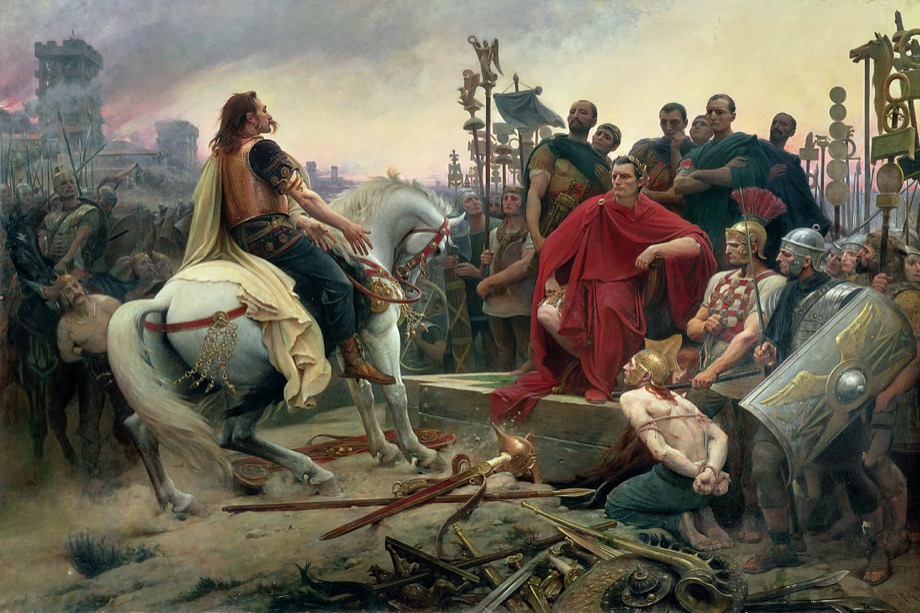
Portrait of Vercingetorix
The Man Who Made Gaul One Thing
No one had done it before him, and no one would do it again in quite the same way. Gaul in the first century BCE was not a country but a quarrel — dozens of tribes, the Aedui and the Sequani chief among them, bound as often by old grudges as by any shared tongue or shared gods. Julius Caesar had spent years exploiting exactly that fracture, picking off allies one treaty at a time, playing tribe against tribe while his legions ground westward. Then, in 52 BCE, a young Arverni chieftain named Vercingetorix rode from village to village and did what Roman diplomacy assumed was structurally impossible: he made the quarrel stop, at least long enough to fight.
He did it with almost nothing but his own presence. Vercingetorix held no crown that bound the other tribes to him, no treasury deep enough to buy their loyalty, no army large enough to compel it. What he had was the ability to stand in front of men who had spent generations distrusting each other and make them feel, if only for a season, like one people with one enemy. He backed the appeal with a strategy that asked for real sacrifice — burn the granaries, burn the towns, starve the legions by starving Gaul itself — and the tribes did it, because he asked them to and because they believed, however briefly, that he was asking for all of them and not for himself.
A man who could unite what Caesar could not divide — and who, when the cause was lost, gave Rome his own body rather than his people's — is the clearest ENFJ the ancient world produced.
The Coalition That Should Not Have Held Fe — dominant
Vercingetorix's genius was never generalship in the narrow sense. It was the older, harder art of getting people who dislike each other to act together — and to keep acting together after the first defeat, when every incentive points toward blaming your neighbor and cutting a separate peace. He rode a circuit of Gallic councils in person, tribe by tribe, arguing not logistics but identity: that they were Gauls before they were Arverni or Aedui or Sequani, and that Rome's real weapon was never the legion but the old habit of Gallic tribes selling each other out.
That appeal cost him, and he let it cost him. When he ordered the scorched-earth campaign — burning stores and towns ahead of Caesar's advance, including Arverni towns, including his own people's granaries — he was asking the coalition to suffer collectively for a collective good, and he asked it in terms of shared cause rather than command. It worked because the tribes trusted the man making the case more than they trusted each other, which is exactly the currency a dominant Fe leader trades in: not fear, not tribute, but felt loyalty to a cause he embodied.
The clearest expression of that Fe came at the very end. Encircled at Alesia with defeat total and the relief army broken, Vercingetorix did not scatter his men to save what could be saved, and did not negotiate terms for himself. He rode out and surrendered his own person to Caesar, betting — correctly — that Rome would accept one man's life in exchange for calling off the slaughter of the rest. It is hard to imagine a purer act of using the self to absorb a cost so the group does not have to.
The Long View From Inside the Siege Ni — auxiliary
Before Ni ever shows up as strategy, it shows up as a wager on the future no one else in the room is willing to make. Vercingetorix's entire campaign was built on a read of where things were heading rather than where they stood: that Rome's conquest of Gaul, tribe by isolated tribe, was a trajectory that could still be broken if the tribes stopped acting like isolated tribes. That was not an obvious conclusion in 52 BCE. Caesar had already spent years establishing that Gallic resistance collapsed the moment it stopped being unified — and Vercingetorix's answer was to unify it, years before anyone else had drawn that conclusion.
The scorched-earth policy was the same long-range reasoning applied to logistics: sacrifice the near-term (food, shelter, an intact homeland) for a distant strategic outcome (a starved, overextended Roman army). It is a bet only a mind oriented toward the far horizon makes comfortably, and Vercingetorix made it repeatedly, including at Avaricum, where he argued for burning the town and was overruled — a partial defeat for his vision that he absorbed and kept building past.
And it was Ni, as much as Fe, that produced the final act. By the last days at Alesia, Vercingetorix could see what the moment required more clearly than what his own survival required: that the war was over, that continued resistance meant a massacre of everyone still inside the walls, and that there remained exactly one move left that could still spare them — trading himself for the siege's end. That is long-range pattern recognition turned, at the last, entirely inward.
His Best Armor, On Horseback, In Person Se — tertiary
Vercingetorix was not a leader who governed from behind the lines. He fought at Gergovia and won there, one of the very few pitched engagements in which a Gallic army bested Caesar outright, and the win was physical as much as strategic — a defended hilltop, a battle Vercingetorix's forces held by contesting ground with their bodies. Tertiary Se shows up in that comfort with direct, embodied confrontation: not a distaste for the field, but an instinct to be on it.
It shows up even more starkly in how the surrender was staged. Vercingetorix did not send a herald, and he did not write to Caesar under truce. He dressed in his finest armor, mounted his horse, rode a circuit around Caesar's seated tribunal, and dismounted to lay his weapons at the Roman general's feet in full view of both armies. That is not the choice of someone comfortable operating at a remove — it is a physical, staged, bodily act, using presence itself as the final instrument of the appeal.
Se in the tertiary slot rarely runs the show, and it did not here either; it served the Fe-Ni core rather than replacing it. But it explains why Vercingetorix's leadership never read as merely rhetorical. He was a man willing to put his own body on the line first — at Gergovia, and again, finally, at Alesia — which is a large part of why the tribes believed him when he asked them to put theirs on the line too.
The Logic He Left Unbuilt Ti — inferior
What is most conspicuously absent from Vercingetorix's campaign is the thing a dominant Ti or even a strong auxiliary Ti commander would have supplied: a coherent internal system for fighting Rome on Rome's own terms — standardized logistics, a formal chain of command across the coalition, a doctrine for meeting Caesar's engineering with engineering of its own. Vercingetorix led through persuasion and vision, not through an architecture of rules, and the coalition's discipline depended on his continued presence and continued appeal rather than on any system that could function without him.
Alesia exposed the cost of that gap directly. Caesar's response to the siege was a masterwork of Ti-Te engineering — a double ring of fortification, eleven miles of wall, built and defended with the kind of systematic precision Vercingetorix's coalition had no equivalent for. The relief army that Gaul sent to break the siege arrived in overwhelming numbers but without the coordinated, disciplined execution to translate numbers into a breakthrough, and it failed against fortifications a more structurally-minded opponent might have anticipated and planned around from the start.
None of this diminishes what Vercingetorix built; it clarifies what kind of thing it was. He did not out-engineer Rome. He out-persuaded a continent's worth of rival tribes into acting as one, for one summer, against the most disciplined army in the ancient world — and when the logic of the siege finally closed around him, the response was not a better system. It was himself, offered up in person, one last time.
Why ENFJ Over ENTJ
Why not ENTJ?
Uniting rival tribes into one coalition and ordering a scorched-earth campaign both look, from a distance, like ENTJ command-and-system-building — decisive, coalition-scale strategy imposed from the top. But the surrender at Alesia is the tell. An ENTJ backed into that corner negotiates: extracts terms, preserves personal leverage, treats the endgame as one more problem to be solved rationally in his own favor. Vercingetorix instead staged a personal, symbolic, relationship-preserving sacrifice — riding out in his finest armor to offer his own body so the siege would end for everyone but him. That is Fe absorbing a cost for the group, not Te optimizing an outcome for the self.
The whole arc argues for Fe-Ni over Te-Ni. Vercingetorix never held the kind of institutional authority an ENTJ builds and leans on — no throne, no standing army loyal to an office rather than a man. What he held was the tribes' trust in him personally, earned and re-earned through appeal rather than command, and spent, in the end, on a single irreversible act of personal surrender. A cause-driven idealist who gives himself up so his people are spared is not running a system. He is closing a relationship the only way left to close it honorably.
Connected Figures
Further Reading
- Commentarii de Bello Gallico — Julius CaesarThe primary source for the Gallic War and the siege of Alesia, written by Vercingetorix's own conqueror.
- Caesar's Invasion of Britain — Peter Berresford EllisA history of Caesar's Gallic campaigns and the resistance that culminated in Vercingetorix's revolt.
- SPQR: A History of Ancient Rome — Mary BeardSituates the Gallic War and its aftermath within the wider collapse of the Roman Republic.
- Caesar's Gallic Wars 58–50 BC — Kate GilliverA focused military history of the campaign, including the siege works at Alesia.
