 Historical Figure MBTI
#682 · 5-21-26 · The Roman Republic
Catiline
Bankrupt Patrician · Conspirator · Died Among Enemy Dead
c. 108 BCE — 62 BCE
7 min read
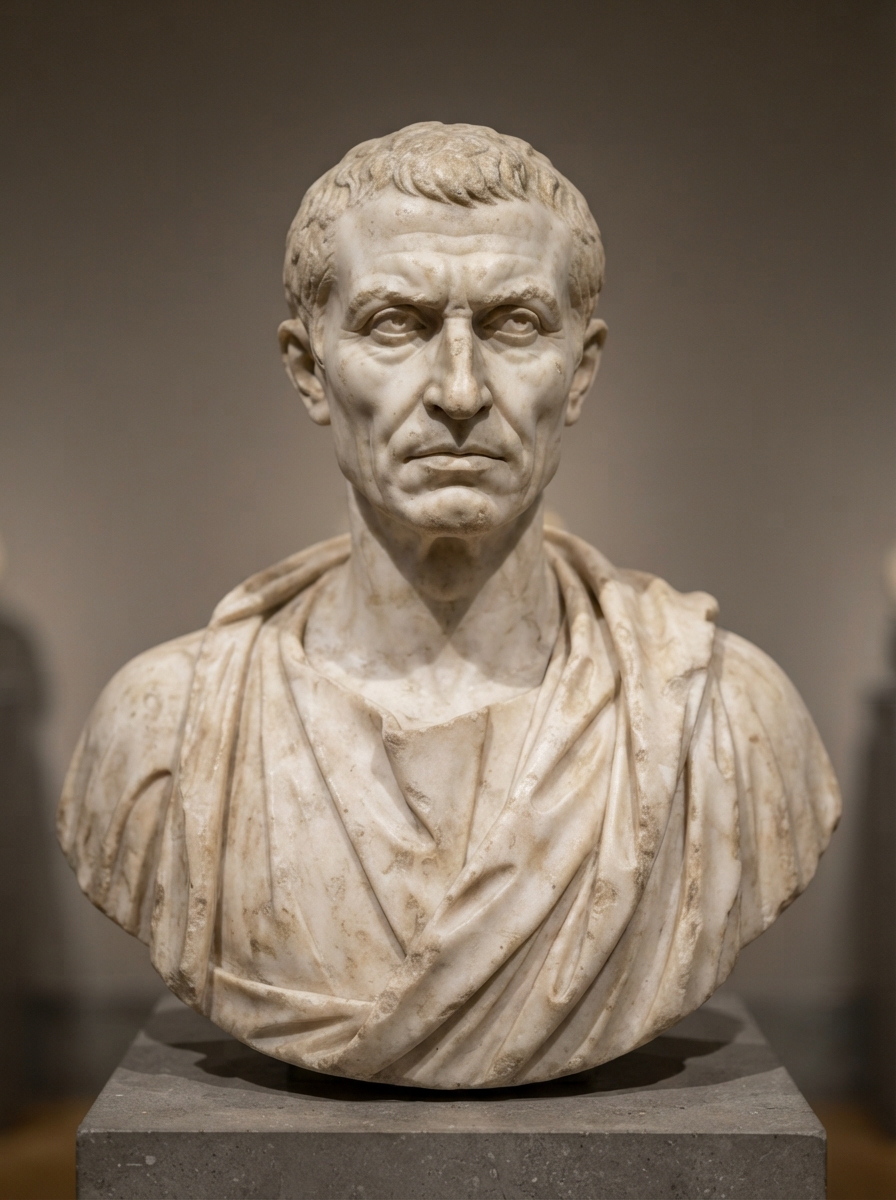
AI-assisted Portrait of Catiline
The Last Hand, Played to the Death
Lucius Sergius Catilina came from a patrician family that had spent centuries producing consuls and had, by his own generation, produced nothing but debt. He ran for the consulship twice — in 64 and 63 BCE — and lost twice, the second time to a talented outsider named Cicero, a new man from Arpinum with no ancestral statues in his atrium and every rhetorical gift Catiline lacked. A patient, long-range operator absorbs a defeat like that, regroups, waits for the next cycle. Catiline did not wait. Within months of his second loss he had assembled a coalition that reads like a census of Roman grievance — indebted veterans of Sulla's old armies, bankrupt nobles, disaffected farmers, the restless poor of the city itself — and offered them the one thing that could bind them together instantly: the cancellation of debts, enforced at swordpoint if the Senate would not grant it by vote.
It was a conspiracy built for speed, not depth. Word of an armed camp forming in Etruria reached Rome quickly; informants — including, famously, a woman named Fulvia — carried details of assassination plots and planned arson straight to Cicero's household. None of it was insulated, none of it was patient, and none of it survived contact with a consul willing to read it aloud in the Senate. That is the shape of a ESTP life under pressure: blocked ambition answered with immediate, physical force rather than a private, long-game reworking of the board — and when the force failed, answered again, at the end, with a body thrown forward into the enemy line rather than a mind retreating to plan another day.
Catiline never played a long game — he played the hand in front of him, hard, and when the cards ran out at Pistoria he simply kept swinging. That is ESTP dominant Se with nothing left to mediate it: appetite and action, start to finish, right down to the last physical inch of the fight.
A Politics Fought With the Body Se — dominant
Twice denied the consulship by ballot, Catiline did not spend the intervening months drafting position papers. He recruited. He rode out to the camps of former Sullan veterans in Etruria who still remembered how to hold a line, and he armed them. Plutarch and Sallust both describe a man who moved among the desperate and the discontented in person — at dinners, in the Forum, in the houses of Rome's poor — closing the distance between grievance and weapon with his own physical presence, not with pamphlets or proxies.
The plot itself was built for immediate, visible effect: senators to be murdered in their beds, fires set across the city on a single signal night, a march on Rome timed to a specific date rather than an unfolding strategy. When Cicero named him to his face in the Senate on the seventh of November — the speech that opens "O tempora, o mores!" — Catiline did not deny it with clever argument. He sat through the accusation, then walked out of the chamber and rode to the camp he had already built, choosing the field over the courtroom.
And at Pistoria, cornered between two consular armies with no realistic hope of victory, he did not attempt to slip away and salvage the cause for another season. He fought in the front rank alongside his men, and when the battle collapsed his body was found, by the historians' account, driven deep into the mass of enemy dead — further from his own lines than any other man on the field. It is the most literal possible portrait of Se with nothing behind it to soften the impact: the present moment, met with the whole of the body, to the very end.
Whoever Was Angry, Recruited Ti — auxiliary
Catiline's coalition had no unifying doctrine. It was not a faction bound by shared philosophy the way the Optimates and Populares at least gestured toward competing visions of the Republic; it was a working solution to a practical problem — how does a man with no money and no more legitimate paths to power assemble enough force to seize it anyway. Ancient sources describe him sorting people by usefulness rather than by ideology: ruined nobles who wanted their debts erased, veterans who wanted land, the urban poor who wanted anything at all. He built the plot the way a Ti-user solves a puzzle — component by component, testing what fit — rather than the way a Fi-idealist recruits, around a shared cause.
That same improvisational logic shows in the plot's mechanics: a signal fire here, an assassination assignment there, a date set and reset as circumstances shifted. It was internally coherent as a piece of tactical engineering — who does what, on what night, with what weapon — even as it remained, at the level of persuasion and secrecy, badly executed. Ti auxiliary gave Catiline the ability to structure a conspiracy logically; it never gave him Fe's instinct for reading a room of potential informants, which is exactly where the plot came apart.
Charm as a Recruiting Tool Fe — tertiary
Even his enemies conceded that Catiline was magnetic. Sallust, writing a famously hostile portrait, still admits the man had "great vigor both of mind and body" and a gift for winning loyalty — the young nobles who followed him into ruin, the veterans who trusted him with their last hope, the poor who believed his promises of debt relief were more than a slogan. That is Fe used instrumentally: warmth, promises, personal attention, deployed to bind a fractious coalition together rather than to genuinely read what any of it would cost the people he was rallying.
It never rose above tertiary use. Fe in service of Se and Ti reads a crowd well enough to move it, but it does not manage the ongoing, patient social diplomacy that might have kept the plot secret, or negotiated a face-saving retreat once Cicero's orations had turned the Senate against him. Catiline could rally a camp of veterans in Etruria; he could not out-charm a consul working the Senate floor, and he did not try. When persuasion failed him at the political center, he simply left the room.
No Contingency, No Retreat Ni — inferior
The clearest sign of Ni sitting at the bottom of the stack is the plot's total absence of a fallback. Catiline had no second plan for what happened if the conspiracy leaked before the signal night — and it did leak, almost immediately, through informants who reached Cicero with names and dates. A mind with stronger long-range foresight would have built in redundancy, cover stories, an exit that did not require riding openly to an armed camp the moment he was named in the Senate. Catiline had none of that. He had a plan for one timeline only, and when it broke he did not improvise a new future — he executed the plan he had, straight through to its worst possible ending.
That inferior-Ni blind spot is visible again, one last time, at Pistoria. Faced with certain defeat, a strategic mind under grip might still have grasped for escape — live to fight again, rebuild in exile, wait for a better hour. Catiline did not reach for that kind of vision. He stayed inside the only mode he had ever fully trusted, and the battlefield became the last and most complete expression of it.
Why ESTP Over INTJ
Why not INTJ?
On paper, a coup organized around debt cancellation and a coalition of the aggrieved can look like a calculated, long-range power play — the kind of patient private strategy an INTJ might design. But the plot Catiline actually ran was hasty and leaky, penetrated by Cicero's informants within weeks of its formation, and driven by immediate financial desperation and wounded pride rather than a sustained strategic vision refined over years. An INTJ backed into that corner plans an exit; Catiline, cornered at Pistoria, charged forward into the enemy line instead. That is Se in the grip of the moment, not Ni managing a long game.
The distinction matters because Catiline is so easy to over-read as a schemer — Sallust's hostile history practically invites it, painting him as a man of dark, calculating ambition. But look at the actual sequence of his decisions and the pattern is reactive, not premeditated: defeat at the polls, immediate armed response; exposure in the Senate, immediate flight to the camp; military defeat, immediate physical commitment to a battle he could not win. Every hinge point in his life was answered with action taken now, not a plan laid years in advance. That is the signature of dominant Se meeting the world directly, an ESTP to the last.
Connected Figures
Further Reading
- The Catiline Conspiracy (Bellum Catilinae) — SallustThe primary ancient source, written a generation later — hostile but detailed.
- In Catilinam (The Catiline Orations) — CiceroThe four speeches that destroyed Catiline's political standing and drove him from Rome.
- SPQR: A History of Ancient Rome — Mary BeardPlaces the conspiracy within the wider strain on the late Republic's institutions.
- Cicero: Politics and Persuasion in Ancient Rome — Kathryn TempestA modern account of the crisis from the perspective of Catiline's chief antagonist.
