 Historical Figure MBTI
#853 · 6-19-26 · The American Civil War
David Farragut
Union Admiral · 'Damn the Torpedoes'
1801 — 1870
8 min read
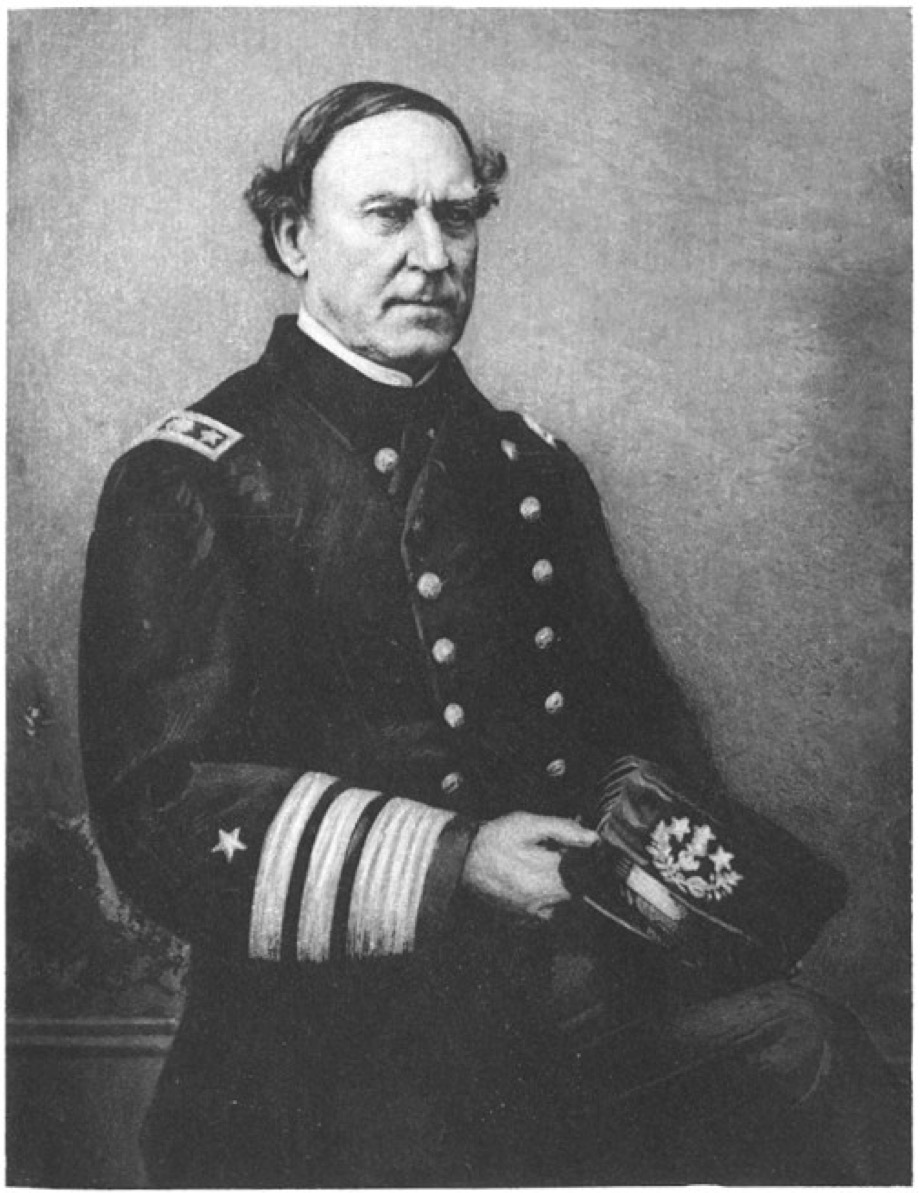
Portrait of David Farragut
The Man Who Went Toward the Explosion
On the morning of August 5, 1864, at the mouth of Mobile Bay, the ironclad monitor USS Tecumseh swung out of the Union line, struck a submerged mine, and went down in under a minute with most of her crew. The column behind her stalled. Every rational instinct in the water that morning said stop — the channel was seeded with what the period called torpedoes, the forts were firing, and the proof of what lay under the surface had just vanished in front of a hundred witnesses. David Farragut, sixty-three and lashed into the rigging of his flagship USS Hartford so he could see over the gunsmoke, ordered his fleet forward through the minefield. The sentence that came down through the century — Damn the torpedoes, full speed ahead — is almost certainly a tidied version of whatever he actually shouted. The decision is not in doubt, nor the two or three seconds in which he made it.
He had been making decisions like that since childhood. Farragut went to sea as a midshipman at nine, was in combat by twelve during the War of 1812, and spent six decades in a service that had no rank high enough for him until Congress invented one. Two years before Mobile Bay he ran his wooden fleet at night past the forts guarding the lower Mississippi and took New Orleans. Both signature acts have the same shape: a narrow passage, a defended chokepoint, no way to know the outcome in advance, and a commander who chose to go through rather than around.
Farragut is the archetypal ESTP commander: dominant Se, thinking fastest and clearest at the precise moment the situation became most chaotic, physical, and immediate.
Se — The Present Tense of War
Dominant Se is attention nailed to the physical world as it is happening — not the plan, but the water, the smoke, the range, the next thirty seconds. A boy under fire at twelve either learns to think inside noise or does not survive it. Farragut learned, and by the time he had a fleet, chaos was the medium he was most fluent in.
New Orleans in April 1862 is the clean demonstration. The conventional approach to Forts Jackson and St. Philip was reduction by bombardment, which the mortar flotilla spent a week failing to achieve. Farragut's answer was to stop trying to solve the forts and go past them, in the dark, with wooden ships, through a broken chain barricade, against fire ships and a current. It worked because he would accept a fight whose variables could not be known until his hull was inside them — and because once inside, he read a shifting river in real time.
Mobile Bay repeated the logic at higher cost. The Tecumseh's sinking destroyed the plan mid-execution, and the value of Se is precisely that it does not need the plan to survive. He saw the column stalling under the guns of Fort Morgan — the worst possible place to stop — judged the shallower water his ships were entering unlikely to be mined as thickly, and drove through.
Ti — The Arithmetic Behind the Nerve
Se without Ti is recklessness, and a reckless officer does not last sixty years afloat. Auxiliary Ti is the fast private logic running underneath the daring that makes it defensible. Farragut was a compulsive technician: he drilled his crews relentlessly, draped his hulls with chain cable as improvised armor, had decks whitewashed so gun crews could work in the dark, and lashed the smaller gunboats to the disengaged side of the larger ships so a disabled vessel could still be carried through.
Each is a small solved problem, and together they are why the "impossible" runs were survivable. The logic is characteristically Ti: it works the specific case from first principles until the internal model is tight, then discards whatever the model says is irrelevant. Orthodoxy held that wooden ships could not pass masonry forts; Farragut worked out that the real variable was time under fire, not weight of metal — and time could be shortened by speed, darkness, and a favorable current. The torpedo order has the same structure: bravado on the surface, underneath it a judgment that the certain cost of stopping exceeded the probable cost of going on. He was right. Several ships heard primers snap beneath their hulls and none detonated.
Fe — Command Where the Men Can See You
The rigging is the tell. Farragut climbed the Hartford's shrouds not because the view was marginally better but because a fleet under fire needed to look up and find its admiral — visible, exposed, above the smoke, unmistakably not sheltering. A worried quartermaster climbed after him and lashed him to the ratlines so a shot or a lurch would not drop him to the deck. That image did as much for the Union Navy's morale as the victory, and Farragut, who understood audiences, knew what he was doing up there. Tertiary Fe here is not sentimentality; it is a live sense of a group's emotional weather and an instinct for adjusting it by physical presence. He met the collapse after the Tecumseh went down the only way that could have worked — not with an argument but with a body and a voice where everyone could see them.
The same faculty shows in the hardest choice of his life. Southern-born, raised in Tennessee and Virginia, married into Norfolk society, he chose the Union — but not by the long constitutional reasoning of a Lincoln. His loyalty was relational and immediate: a service, men he had sailed with, a flag he had served since he was nine. When Virginia seceded he took his family north, lost friends and kin over it, and never made a public performance of the grief.
Ni — The Long View He Left to Others
Inferior Ni shows in the negative space of Farragut's career. He was not a naval strategist in the sense his contemporaries in Washington were: he did not design the blockade, did not theorize about sea power, wrote nothing that shaped doctrine, and left no framework — only results. Given a chokepoint and a fleet he was without equal; given an open-ended strategic question he waited for orders. Where Ni surfaces in such a temperament it comes as sudden conviction rather than gradual foresight — a flash of certainty impossible to argue with, arriving without traceable reasoning. That is the register of the torpedo order.
Then comes the shadow that follows an Se-dominant into age. Farragut's health broke not long after Mobile Bay. He commanded no more great actions, declined the political eminence his fame could have bought, and died in 1870, restless to the end and reportedly asking to be taken aboard a ship once more. A man whose intelligence lives entirely in the present has little to fall back on when the present goes quiet.
Why ESTP Over ISTP
Why not ISTP?
The Ti-Se ordering fits a quieter, more private officer — one who solves the technical problem superbly and directs the action from wherever the work is best done, without needing to be watched doing it. Farragut inverts that. He placed himself at the point of maximum visible risk, strapped into the rigging so every deck in the fleet could see him under fire; the exposure was not incidental to the command, it was the command. That habit, his easy sociability with his crews, and his instinct for what his presence would do to men whose morale had just collapsed all point to Se turned outward with Fe reading the room — not to the withdrawn, solitary focus of an ISTP.
The contrast has a convenient control case in the same war. Ulysses S. Grant is the ISTP: unremarkable in a room, indifferent to spectacle, grinding out an answer with a cigar and a map. Farragut solved his problems the same way at the level of mechanics, but he could not have executed them from a chair and would not have wanted to. Put both men in the same crisis: Grant goes quiet and thinks; Farragut goes up the mast and shouts. Both work. Only one of them needs to be seen.
Connected Figures
Further Reading
- Lincoln's Admiral: The Civil War Campaigns of David Farragut — James P. DuffyThe accessible one-volume campaign narrative, strongest on New Orleans and Mobile Bay.
- Admiral David Glasgow Farragut: The Civil War Years — Chester G. HearnThe standard modern military biography of the war years, close on tactics and fleet handling.
- War on the Waters: The Union and Confederate Navies, 1861–1865 — James M. McPhersonPlaces Farragut inside the whole naval war — blockade, rivers, ironclads — from the leading Civil War historian.
- The Life of David Glasgow Farragut, First Admiral of the United States Navy — Loyall FarragutThe son's 1879 life, built on his father's journals and letters; partisan, but the root source for much of the detail.
