 Historical Figure MBTI
#849 · 6-19-26 · The American Civil War
Ulysses S. Grant
Union General-in-Chief · Architect of Victory · Future President
1822 — 1885
11 min read
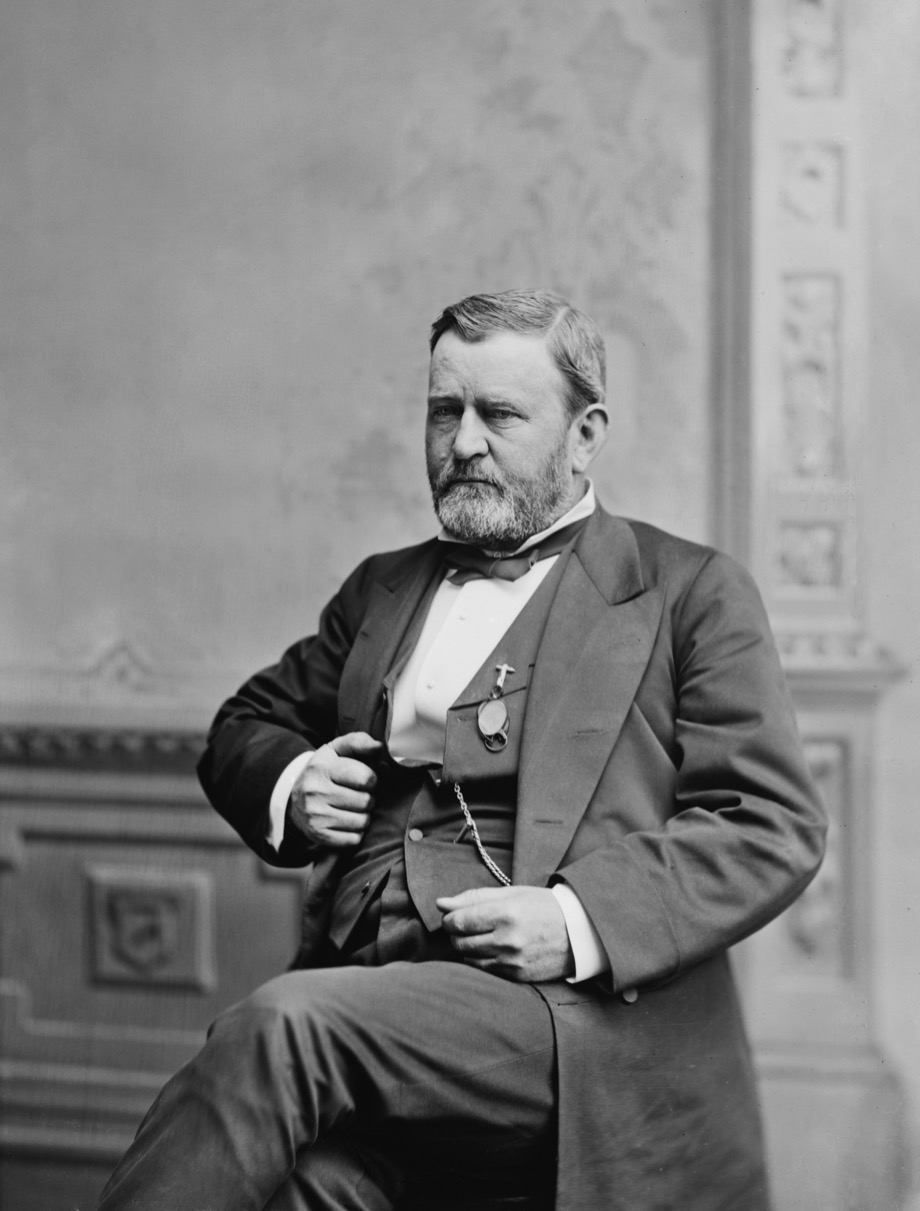
Photographic Portrait of Ulysses S. Grant
The Clerk in the Leather Goods Store
In the spring of 1861 a thirty-nine-year-old man was selling harnesses and saddles in Galena, Illinois, for his younger brothers. He had graduated West Point without distinction, fought well in Mexico in a war he privately believed unjust, then spent a decade losing: resigned his commission on the Pacific coast under a cloud of rumors about drinking, failed at farming, failed at real estate, failed at bill collecting, and came home to work a counter under his father’s name. Nothing in that record predicted anything. Four years later he commanded every soldier the United States had, and the general who had beaten everyone else the Republic sent surrendered to him at Appomattox Court House.
What changed was not Grant. What changed was the problem. Peacetime commerce asks for salesmanship, credit, and the reading of other men’s intentions across a table — the exact skills he never acquired. War asked something else: look at the terrain, work out what can be done with the men and boats and roads you actually possess, do it, and keep doing it after the first attempt fails. He was not a visionary and never pretended to be. He was a mechanic of war who could see a situation stripped of its rhetoric, reduce it to components, and act on the reduction without flinching.
Everything anecdotal points the same way. He rode in a private’s coat with shoulder straps for rank, despised parade-ground polish, was silent in company to the point of awkwardness, and wrote dispatches so plain no subordinate had to ask what he meant. Lincoln, casting about for a general who would use the army instead of admiring it, put it in the flattest possible terms: this man fights.
Grant is the archive’s purest military ISTP — a dominant-Ti mind that took war apart like a mechanism, found the one moving part that mattered, and applied pressure to it until it broke.
The Problem, Stripped of Its Rhetoric
Vicksburg settles the argument. Through the winter of 1862–63 Grant tried everything the engineers could think of to get an army onto dry ground east of the Mississippi — canals, bayou routes, a scheme to reroute a river. All of it failed publicly, while the northern press called for his removal. What he did next looked like recklessness and was not. He marched down the west bank, had Porter run the batteries at night, crossed below the city, then cut loose from his supply line entirely, living off the country while he interposed between two Confederate forces and beat them separately. Five battles in eighteen days, a siege, and the surrender of an entire army on the Fourth of July. It reads as audacity. It was arithmetic — a private calculation about distances, foraging capacity, and the specific inability of Pemberton and Johnston to coordinate.
That is dominant Ti: an internal model built from first principles, tested silently, trusted over consensus. Grant did not argue his way to decisions in councils of war; he consulted, listened, then went off and decided alone. His orders are the evidence. Where his contemporaries wrote in the ornamental high-Victorian register, Grant wrote sentences a tired colonel could read once by candlelight and execute — no adjectives, no hedging, no glory. The Donelson note that gave his initials a second meaning is two lines: no terms except unconditional and immediate surrender, I propose to move immediately upon your works. That is not modesty. It is a mind that has already done the thinking and sees no reason to perform it again in public.
The same faculty produced the war-winning insight of 1864. Made lieutenant general and general-in-chief, Grant looked at three years of Union failure and found the actual defect: the Confederacy had been fighting one Union army at a time, shuttling the same brigades between theaters as each threat came. His answer was structural — press everywhere at once, so no reserve could be moved anywhere. He against Lee in Virginia, Sherman into Georgia, Sheridan in the Shenandoah. Not a brilliant maneuver; the correct diagnosis of a mechanism, and it ended the war in thirteen months.
What Is Actually in Front of Me
Grant’s realism was physical before it was intellectual. He was one of the finest horsemen West Point ever produced, a man who read ground the way other officers read maps, and who could hold in his head the actual condition of roads, fords, and mule teams across a hundred miles. Shiloh is the ugly demonstration. Surprised on the first morning, driven back nearly to the river, his army wrecked and his reputation about to be wrecked with it, Grant spent the night under a tree in the rain among the wounded and told Sherman, when Sherman came to propose retreat, that they would lick them tomorrow. He was not being stoic for effect. He had counted: Buell was arriving, Lew Wallace was arriving, and the enemy in front of him was as broken as he was. The present tense contained a fact everyone else had missed.
Auxiliary Se also explains what he was not distracted by. Grant never worried, in the McClellan manner, about the enemy’s imagined strength. During the Wilderness he told a nervous staff that they had been thinking too much about what Lee was going to do to them and not enough about what they were going to do to Lee. His predecessors fought an opponent constructed in their own heads; Grant fought the one in the woods in front of him, whose replacement pool he knew to be finite.
And it explains the tolerance for horror. The Overland Campaign cost near fifty-five thousand Union casualties in six weeks, and Grant — who could not stand the sight of blood and would not eat meat that showed red — absorbed it because the ledger said the exchange was one the North could survive and the South could not. Cold Harbor he later called the one assault he would take back. He did not take back the campaign. After the Wilderness he reached the crossroads where every previous commander of the Army of the Potomac had turned north to lick his wounds, and he turned south, and the soldiers understood what it meant and cheered him in the dark.
The Long Line He Could See
Tertiary Ni in an ISTP shows up not as prophecy but as one narrow, stubborn conviction about where a thing is going, held with unreasonable confidence while everything else stays open. Grant had exactly one, and it was the shape of the whole war: the Confederacy was a body with finite blood, and continuous pressure, however unglamorous, would eventually empty it. Every contemporary alternative — the decisive Napoleonic battle, the capture of Richmond as a talisman, the negotiated settlement — depended on a single dramatic event. Grant never believed in the single dramatic event. He believed in the line, extended.
It gave him something rarer than brilliance: immunity to the reversal. Shiloh, the failed bayou canals, Cold Harbor, the Crater at Petersburg — each ended a lesser career or produced a retreat, and none altered his direction by a degree. Halleck sidelined him after Donelson out of jealousy and he simply waited; the newspapers demanded his head after Shiloh and Lincoln declined. What looks from outside like inhuman equanimity was a man who had already located the endpoint and treated the intervening disasters as weather.
The same faculty ran the war’s last act. At Appomattox, Grant understood before the politicians did that the terms of surrender were the first terms of the peace, and that a war ending in humiliation would not end. He let the Confederates keep their horses for the spring plowing and their officers their sidearms, wrote parole terms that quietly foreclosed treason trials, sent rations into Lee’s starving lines, and stopped his own artillery from firing salutes. The rebels were our countrymen again, he wrote afterward — a sentence doing strategic work, not sentimental work.
Loyal to Faces, Blind to Men
Inferior Fe is the seam where Grant broke. Within the small circle he trusted, his loyalty was total and unexamined: Sherman, who had been called insane and whom Grant never doubted; Rawlins, his conscience and his guard against the bottle; Julia, whose presence in camp visibly steadied him. Sherman put the arrangement exactly — Grant stood by him when he was crazy and he stood by Grant when he was drunk. Grant delegated to such men with a breadth almost no other commander of the war attempted, handing Sherman an entire theater and a mandate rather than a plan.
But the underdeveloped function is the one that cannot be calibrated, and Grant’s loyalty had no error-checking in it. Once a man was inside the circle, the internal machinery that dismantled a river campaign into its components simply did not run on him. This is the psychological engine of the presidency: Black Friday, the Whiskey Ring, Belknap and the trading posts, the Santo Domingo fiasco — scandal after scandal erupting among appointees and relations, with Grant himself never personally corrupt and never able to believe in advance that the men around him were. The same trait that made him the best manager of generals in American history made him the worst judge of a cabinet.
It cost him at the end. In 1884, out of office, he put his name and his savings into the brokerage of a partner named Ferdinand Ward, who was running a fraud, and lost everything. Diagnosed with throat cancer and penniless, he sat on the porch at Mount McGregor through his last summer writing the Memoirs to provide for Julia, finishing days before he died. The book — flat, exact, without a line of self-justification — sold three hundred thousand sets and made her rich. It is still read as the finest military prose an American ever wrote, and it is fine for the same reason the dispatches were: the man had no capacity whatsoever for decoration.
Why ISTP Over ESTP
Why not ESTP?
The boldness is real, so the case for ESTP is worth making — and it fails on temperament. ESTP is outward-facing, performative, energized by an audience and by improvisational risk taken partly for its own sake; the archive’s own ESTP of this war is David Farragut, lashed to the rigging shouting through the torpedoes at Mobile Bay. Grant was the opposite in every social register: silent in company, uncomfortable at receptions, contemptuous of pageantry, so unassuming that sentries repeatedly failed to recognize the general-in-chief. His courage was not display but a refusal to be moved — dogged persistence rather than flash. And his boldest strokes were never spontaneous: cutting loose below Vicksburg was a private calculation worked out over months of failure, the product of an inward Ti analysis that only looked like a gambler’s nerve from the outside.
The distinction matters because it explains the decade of failure. An ESTP would have thrived at something in the 1850s — selling, trading, charming a room into a partnership. Grant could do none of it. War was the one arena that asked only for what he had: a concrete problem, physical materials, and permission to solve it his own way in silence. He was not a failure who became a genius. He was a specialist who spent thirty-nine years waiting for his specialty to be needed.
Connected Figures
Further Reading
- Personal Memoirs of U.S. Grant — Ulysses S. GrantWritten while dying of throat cancer; the primary document and the best evidence for how his mind worked.
- Grant — Ron ChernowThe major modern biography — full life, including the presidency and the drinking, sympathetically reassessed.
- Grant Takes Command — Bruce CattonThe classic narrative of 1864–65: general-in-chief, the Overland Campaign, and Appomattox.
- Battle Cry of Freedom: The Civil War Era — James M. McPhersonThe standard one-volume history; the essential context for Grant's campaigns.
- The Man Who Saved the Union: Ulysses Grant in War and Peace — H. W. BrandsArgues the presidency and the Reconstruction enforcement record deserve equal weight with the generalship.
