 Historical Figure MBTI
#852 · 6-19-26 · The American Civil War
Ely S. Parker
Seneca Chief · Grant's Military Secretary
1828 — 1895
6 min read
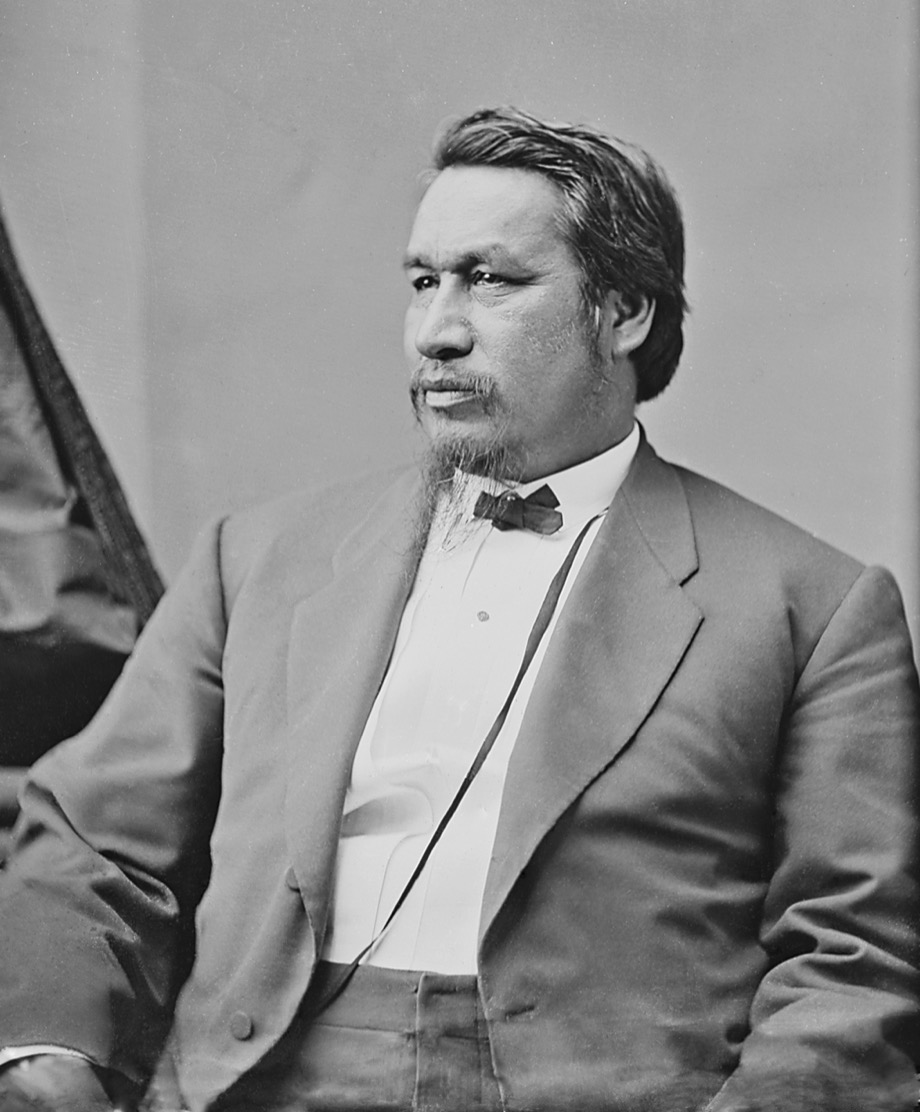
Portrait of Ely S. Parker
The Man Who Wrote the Terms
On the afternoon of April 9, 1865, inside a farmhouse parlor at Appomattox Court House, the officer who took Grant's dictation and wrote out the final terms of Robert E. Lee's surrender in a clean, unhurried hand was not a West Point aide but a Seneca chief — Ha-sa- no-an-da, known also by his sachem name Donehogawa, and to the Union Army as Lieutenant Colonel Ely S. Parker. Lee, studying the officer across the table, is said to have first taken him for a Black man and then, realizing his mistake, offered a strange compliment: "I am glad to see one real American here." Parker's reply — "We are all Americans" — has outlasted the war itself as a line of quiet rebuke.
He had earned that room the hard way. Trained as both an engineer and a lawyer, Parker was barred from the New York bar because, as a Native American, the state did not recognize him as a citizen. He turned to civil engineering instead, and it was on an Erie Canal project in Galena, Illinois, in the 1850s that he struck up a friendship with a failed, drinking, seemingly finished former army officer named Ulysses S. Grant. When the Civil War began, Parker tried to raise troops and was refused a commission on racial grounds by New York's governor; it took Grant's direct intervention to get him into uniform at all. He spent the war's final campaigns at Grant's side, and the country's most consequential room, when it finally opened to him, opened because a friend from a canal survey had not forgotten him.
Parker is the INTJ who answered exclusion not with argument but with competence banked for decades — a dominant Introverted Intuition patient enough to wait for the door Extraverted Thinking would then walk through.
A Trajectory Held Against the Odds
What separates Parker from a merely diligent striver is the sheer length of the arc he seemed to be quietly building toward, long before there was any evidence it would pay off. Denied the bar, he pivoted to engineering not as a fallback but as a second credential stacked onto the first — as though he sensed that a Native man's path to influence in American institutions would require more doors tried, not fewer. That is Ni's signature: a private, long-range image of where things are heading, held steady while the present offers no confirmation it is right.
The friendship with Grant is the clearest case. In the 1850s, Grant was a failed farmer and a clerk in his family's leather-goods store — nobody's idea of a future president. Parker cultivated the relationship anyway, on its own terms, without any way of knowing where it would lead. When the war came and every official channel turned Parker away, that one private bet — years old, unglamorous, sustained through Grant's obscurity — became the single thread that pulled him into the war and, eventually, into the room at Appomattox.
The postwar turn to Indian Affairs reform reads the same way: not an improvised reaction to opportunity but the next visible step in a pattern Parker had been assembling his whole life — expertise piled on expertise, aimed at a form of influence he could not yet possess but had never stopped positioning himself to receive.
The Hand That Wrote the Terms
Extraverted Thinking is the function of getting the external system to run correctly, and nowhere is it more visible in Parker than at the surrender table itself. Grant dictated; it was Parker who produced the document — organized, legible, procedurally exact, ready to be signed and to hold up as a binding record of the war's end. That was not a ceremonial role. It required someone who could translate a momentous verbal agreement into precise, administratively sound language under the eyes of two armies.
The same competence ran through his engineering years and his staff work for Grant more broadly — logistics, correspondence, the unglamorous machinery that let a general actually command. And it defined his tenure as the first Native American Commissioner of Indian Affairs, where he went after the corrupt contracting rings and fraudulent supply schemes that were bleeding reservations dry, applying the same insistence on correct, verifiable process to a system that had never been asked to answer for itself.
That reforming zeal cost him: entrenched interests he had exposed turned around and accused him of the very fraud he was fighting. He was formally cleared, but resigned anyway, worn down by a system that punished the person who tried to fix it more than the people who had been robbing it.
"We Are All Americans"
Parker was not a confrontational man, and that restraint is easy to misread as passivity. It was closer to Introverted Feeling held on a very tight leash — a private, unshakeable sense of his own worth and his own claim to belong, defended not through public argument but through simply refusing to let exclusion become the final word. His reply to Lee at Appomattox is the whole method in five words: not a lecture, not an accusation, just a flat correction offered once and allowed to stand on its own.
That same quiet conviction shaped his choice to keep working within Seneca governance and identity even as he rose inside white institutions — he did not trade one for the other. It surfaces again in how doggedly, and how personally, he took up the Indian Affairs commission: not as a political appointment to be managed, but as a cause he had a right and an obligation to fight for, whatever it cost him in the end.
Why INTJ Over ISTJ
Why not ISTJ?
An ISTJ works competently inside whatever system is in front of him, present-focused and procedure-bound, rather than holding a decades-long private image of where his life is headed. Parker's arc — engineer, then lawyer-by-training-if-not-by-license, a friendship banked with an unknown Grant years before it mattered, a late appointment to overhaul an entire federal agency — is not diligence applied to the task at hand. It is strategic vision sustained across a horizon most people couldn't hold in view at all.
ISTJ would have executed brilliantly within each individual role and stopped there. What Parker did instead was treat each credential, each posting, each relationship as a piece of a pattern only he could see — Ni reaching forward, Te building the machinery to make each step real. The distance between "capable within the system" and "patiently building toward a system that doesn't exist yet" is the distance between ISTJ and INTJ, and Parker's life sits unmistakably on the INTJ side of it.
Connected Figures
Further Reading
- Warrior in Two Camps: Ely S. Parker, Union General and Seneca Chief — William H. ArmstrongThe standard biography, tracing Parker's dual life inside Seneca leadership and the U.S. Army.
- Grant — Ron ChernowPlaces Parker's friendship with Grant and his role at Appomattox in the fullest biographical context.
- The Life of General Ely S. Parker — Arthur C. ParkerAn early biography by his grand-nephew, drawing on family memory and papers.
