 Historical Figure MBTI
5 min read
#80 · 2-28-26 · The Founding Generation of USA
David Ramsay
Physician, statesman, and one of the first historians of the American Revolution.
1749 — 1815
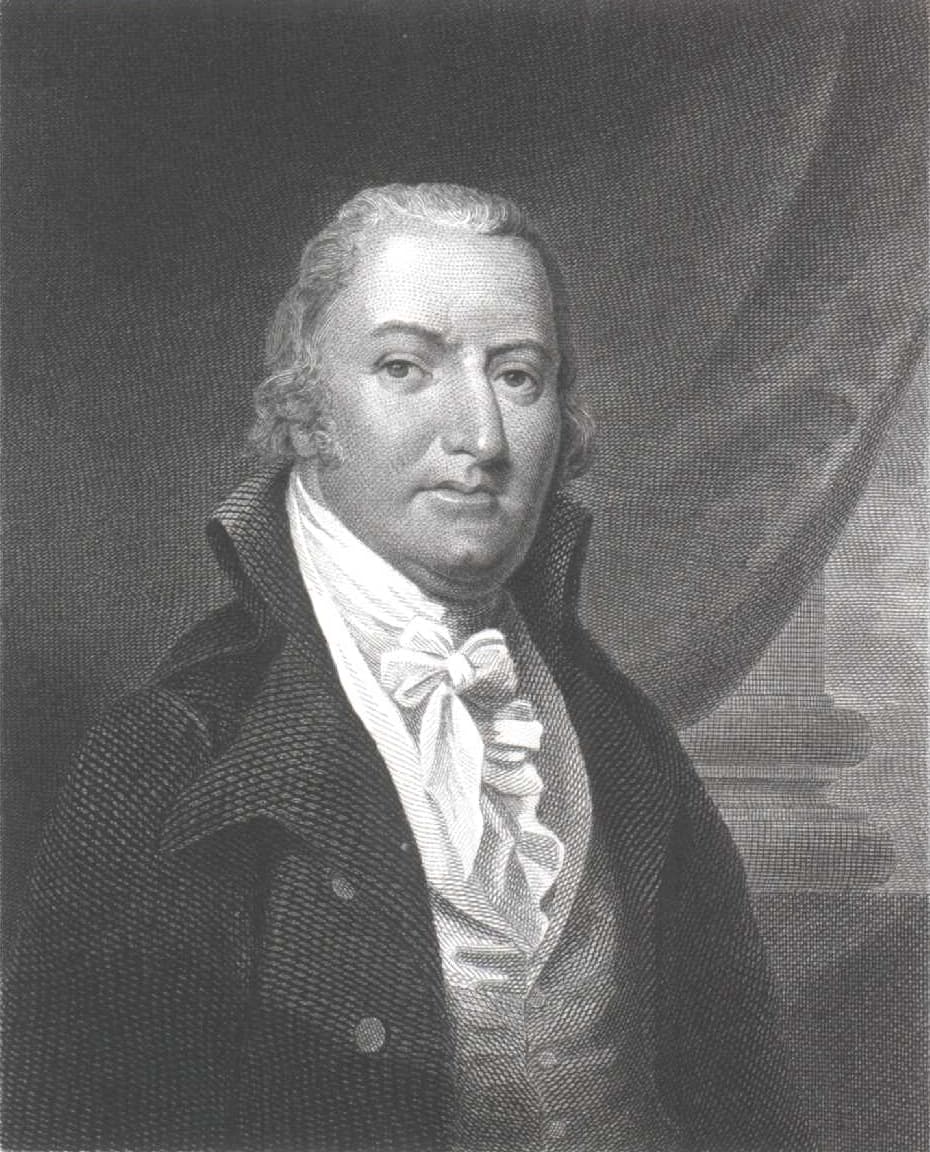
Portrait of David Ramsay.
The Architect of Early American Memory
Born in 1749 in Lancaster County, Pennsylvania, David Ramsay would become one of the earliest intellectual interpreters of the American Revolution. Trained as a physician, he moved to Charleston, South Carolina, where he quickly became involved in both politics and public life during the revolutionary era.
Ramsay served in the Continental Congress and remained closely connected to the political leadership of the young republic. But his most enduring contribution would not be legislative.
It would be historical.
In 1789 he published History of the American Revolution, one of the first comprehensive narratives of the conflict. At a moment when the United States was still defining itself, Ramsay attempted to document the causes, struggles, and consequences of the revolution in a systematic and analytical form.
His approach to history was not simply descriptive. Ramsay treated the Revolution as a political and philosophical transformation, one whose deeper logic could be understood through careful examination of events.
Through his writings, the Revolution became not just a war of independence — but a coherent story about the emergence of a republic.
The Psychological Verdict
David Ramsay’s intellectual style suggests a personality organized around long-range interpretation, structural thinking, and analytical synthesis.
His historical works reveal a mind focused on identifying patterns within complex political developments and arranging them into a coherent explanatory framework. Rather than emphasizing emotional narrative or rhetorical persuasion, Ramsay consistently pursued clarity, structure, and intellectual order.
These patterns align strongly with INTJ.
Ramsay did not merely recount the events of the Revolution. He sought to understand the underlying architecture of how revolutions unfold.
Ni — dominant
Ramsay approached history through the lens of underlying patterns rather than isolated events.
In History of the American Revolution, he repeatedly moves beyond immediate circumstances to examine the deeper forces shaping the conflict: colonial political culture, British imperial policy, and the evolving identity of the American colonies.
This tendency reflects dominant Ni — the drive to synthesize scattered information into a unified explanatory model.
Ramsay treated the Revolution not as a collection of battles, but as a long-term historical process whose meaning extended beyond the moment itself.
Te — auxiliary
Alongside this interpretive vision, Ramsay’s writing displays strong organizational discipline.
His historical works are methodically structured, carefully documenting events while maintaining a clear analytical framework. He arranged vast amounts of information into coherent chronological and thematic narratives, allowing readers to follow the development of the Revolution step by step.
This systematic presentation reflects auxiliary Te: the ability to translate internal insights into organized intellectual structures.
Ramsay did not simply observe history. He constructed a framework through which others could understand it.
Fi — tertiary
Although analytical, Ramsay’s work was not morally neutral.
Like many thinkers of the revolutionary generation, he believed that history should illuminate the virtues required to sustain a republic. His writing frequently emphasizes civic responsibility, public virtue, and the moral character of political leadership.
This ethical dimension reflects tertiary Fi — a quiet internal value system that informs interpretation without dominating it.
Ramsay’s histories were not written merely to preserve facts. They were written to teach the lessons of republican citizenship.
Se — inferior
Ramsay’s intellectual focus rarely lingered on sensory immediacy or dramatic storytelling.
While he described battles and political confrontations, these details served primarily as evidence for broader historical patterns. His attention remained fixed on interpretation rather than vivid narrative.
This distance from the immediate physical drama of events reflects inferior Se.
The Revolution unfolded around him as a series of urgent crises. Ramsay’s instinct was to step back and ask what those crises revealed about history itself.
Why not INFJ?
Ramsay’s interest in moral reflection could suggest INFJ at first glance. However, his writing consistently prioritizes analytical structure over interpersonal interpretation.
INFJ historians often focus on the emotional experiences of individuals and the moral psychology of historical actors. Ramsay, by contrast, concentrates on political systems, institutional development, and cause-and-effect relationships within large historical processes.
His work reads less like a meditation on human character and more like an attempt to map the structural logic of revolutionary change.
This analytical orientation aligns more strongly with Ni supported by Te.
The Laurens–Ramsay Circle
Ramsay’s intellectual world intersected closely with the Laurens family through his marriage to Martha Laurens Ramsay.
Her reflective and philosophical temperament complemented Ramsay’s analytical mind, creating a household deeply engaged with the intellectual questions raised by the Revolution.
Within the same family circle stood her brother, John Laurens, whose passionate activism represented yet another response to the revolutionary moment.
Together they embodied three distinct roles within the same historical drama:
The revolutionary who fought for ideals.
The historian who interpreted the system behind those events.
And the observer who reflected on their moral meaning.
The war created a nation.
Ramsay explained how it happened.
Connected Figures
Further Reading
- History of the American Revolution — David Ramsay (1789)Ramsay's landmark work — one of the first systematic histories of the Revolution, treating it as a philosophical and political transformation rather than mere military narrative.
- To Be an American: David Ramsay and the Making of the American Consciousness — Arthur H. Shaffer (1991)The definitive scholarly study of Ramsay's life, thought, and role as the young republic's first serious historian.
- The Life of George Washington — David Ramsay (1807)Ramsay's biographical study of Washington — an example of how he used biography to explore republican virtue.
- A History of South-Carolina — David Ramsay (1809)Ramsay's state history, revealing how he applied his analytical framework to the particular story of South Carolina's role in the Revolution.
