 Historical Figure MBTI
3 min read
#243 · 3-23-26 · The Age of Alexander
Drypetis
Princess · Bride of Hephaestion · Last Achaemenid Daughter
died c. 323 BC
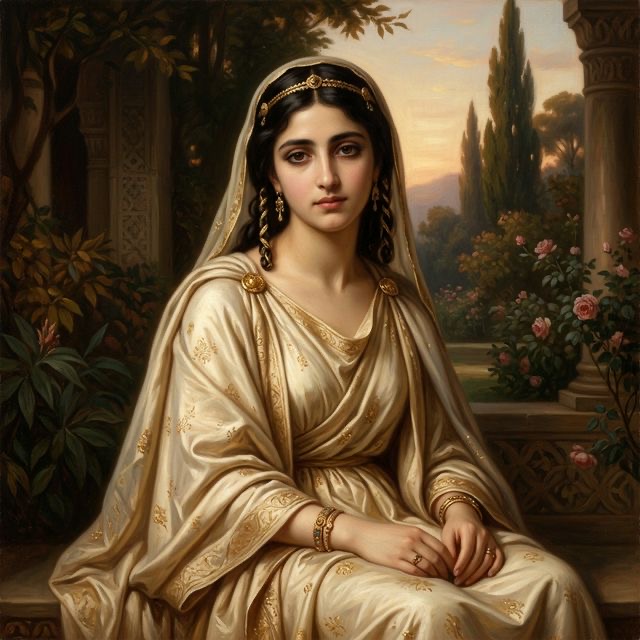
AI-assisted portrait of Drypetis
The Princess Who Outlived Everything Except the World That Needed Her
Drypetis was a daughter of Darius III and Stateira I. She was captured along with the rest of the royal family after the Battle of Issus in 333 BC — she was perhaps eight or ten years old. Alexander kept the royal family in honored captivity, providing for their education and maintenance. Drypetis grew up within the Macedonian court, speaking Greek, surrounded by the men who had destroyed her father's empire.
Drypetis was an INFP — a woman whose inner world and personal attachments were her primary reality, navigating a world that had no interest in her personhood, only her symbolic value.
The Inner Life in a Political Prison
Dominant Fi is the function of deep personal values and internal emotional processing. Drypetis lived within a world that treated her as a political instrument — her marriage to Hephaestion at the mass wedding at Susa in 324 BC was Alexander's symbolic gesture of fusing Macedonian and Persian nobility. She had no say in it. What the sources hint at is that the marriage, once made, was genuine — Hephaestion treated his Persian wife with apparent care, and the pairing lasted until his death in 323 BC.
The question of what Drypetis experienced in all this — the years of captivity, the arranged marriage, the death of her husband, the death of Alexander himself — is a question the ancient sources do not answer. She existed at the intersection of every major event of her age and left no recorded words.
The Impossible Future
Auxiliary Ne in an INFP generates sensitivity to possibility — the ability to imagine what could be, what might happen, what alternative worlds exist. For Drypetis, the space of possible futures collapsed rapidly after Alexander's death. Roxana, Alexander's Bactrian wife, had both Drypetis and her sister Stateira II killed — reportedly to eliminate rivals for her son's claim. Drypetis was executed not because of anything she had done but because of what she represented: a bloodline.
Why INFP Over ISFP
Why not ISFP?
Her sister Stateira I reads more clearly as ISFP — grounded, quietly dignified, present-focused. Drypetis's story, thin as it is, suggests someone whose inner life ran deeper in the imaginative direction: a child who grew up in captivity, in a foreign court, in an arranged marriage — the kind of existence that either destroys an Fi-Se type or produces an Fi-Ne one who survives through an interior world the external world cannot reach.
Connected Figures
Further Reading
- Alexander the Great — Robin Lane FoxThe fullest narrative of Alexander's campaigns; covers the Battle of Issus, the captive royal family, and the Susa weddings.
- The Persian Empire — J. M. CookBackground on the Achaemenid dynasty and the royal household Drypetis was born into.
- Alexander the Great: The Hunt for a New Past — Paul CartledgeExamines the sources critically; useful for understanding how little the Greek historians recorded about Persian women.
- Who's Who in the Age of Alexander the Great — Waldemar HeckelA prosopography of Alexander's court; the entry on Hephaestion is the most direct scholarly treatment of Drypetis's husband.
