 Historical Figure MBTI
#476 · 4-15-26 · The Wars of Scottish Independence
Edward Bruce
Robert's Brother · High King of Ireland
c. 1280 — 1318
8 min read
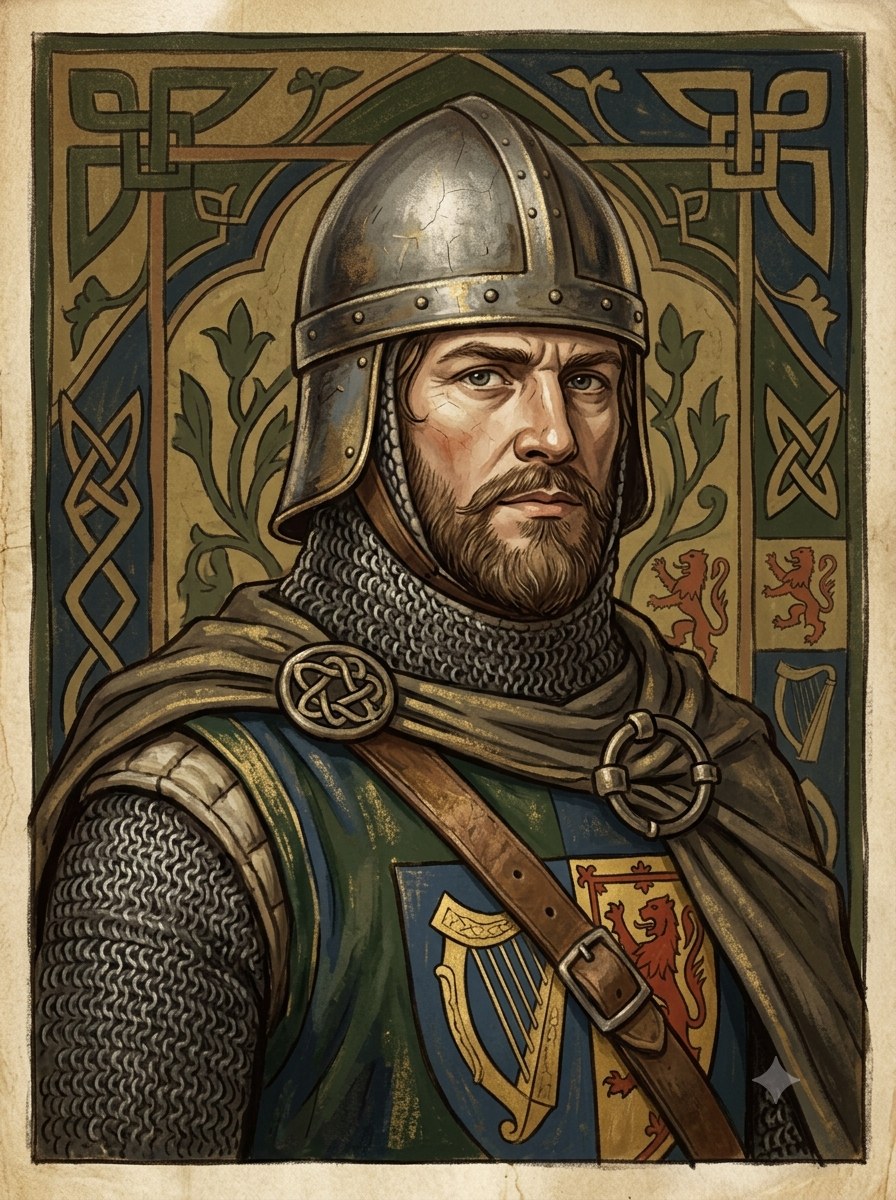
AI-assisted Portrait of Edward Bruce
The Brother Who Reached for His Own Crown
Edward Bruce lived his whole life one step behind a more famous man — and could never abide it. The younger brother of Robert the Bruce, he was bold where Robert was patient, rash where Robert was calculating, and hungry for a throne of his own where Robert already wore one. He was among the most dangerous Scottish commanders of the wars of independence, a cavalry leader who charged first and reckoned the odds later. But the same audacity that made him formidable on a battlefield made him reckless with a kingdom, and it eventually cost him everything.
His ambition had a single shape: a crown. In 1315, with Scotland barely secured, he led a Scottish army across the Irish Sea, opening a second front against the English and casting himself as liberator of the Gaelic Irish. A year later he had himself crowned High King of Ireland. It was the great gamble of his life — and it failed utterly. Famine, scorched earth, and stubborn Irish resistance ground the campaign to ruin, and in 1318 he was defeated and killed at the Battle of Faughart. His Irish kingdom died with him, barely two years old.
That trajectory — the spectacular seizure followed by the spectacular collapse — is the whole man in miniature. He is the ESTP: the gambler who trusts the moment over the plan, grabs the prize within reach, and finds too late that holding it required a foresight he never had.
Edward Bruce was an ESTP at the edge of his luck — all nerve and seized opportunity, a man who could take a crown by force and daring but never possessed the patient strategy to keep it.
The Warrior Who Seized the Moment
Se — dominant
Dominant Se reads the world as a field of immediate opportunity, and it acts before the window closes. Edward Bruce was a creature of the charge — aggressive, physical, and most alive when the situation demanded decision now. His instinct was always to press, to take ground, to force the issue, and that instinct made him one of the boldest field commanders his brother had.
The clearest case came before the war's defining battle. Besieging Stirling Castle in 1314, Edward struck a chivalric bargain with its commander: surrender the castle by midsummer, or be relieved. It was a gambler's pact — vivid, dramatic, and made without weighing what it set in motion. The agreement gave Edward I's successor a fixed date and a reason to march, dragging both armies toward the collision at Bannockburn that Robert had been carefully trying to control. The decisive Scottish victory followed, but it came on Edward's impatient terms, not the king's. He had forced the moment; the moment happened to break his way.
The Irish gambit was the same reflex at the scale of a kingdom. A crown sat within reach across the sea, Gaelic lords were ready to back a challenger to English rule, and Edward moved — fast, hard, and on the strength of an opening rather than a settled plan. Se sees the chance and takes it. Whether the chance can be sustained is a different question entirely, and not one this function is built to ask.
The Tactician Behind the Charge
Ti — auxiliary
Auxiliary Ti gives the ESTP a cool internal logic that runs underneath the daring — the part of the mind that sizes up terrain, leverage, and the mechanics of a fight. Edward was not merely a brawler; he was a capable soldier who understood how campaigns worked. The relentless raiding that defined the Scottish war effort — striking where the enemy was weak, refusing pitched battle on bad ground, bleeding a larger force through mobility — was warfare governed by a hard practical sense of cause and effect, and Edward was fluent in it.
In Ireland that tactical competence was real but isolated. He won engagements, took towns, and outmaneuvered local forces for a time. The trouble was that Ti, in this position, serves the immediate problem in front of it — this battle, this siege, this season's campaign — rather than the long arc of consolidation. Edward could solve the tactical puzzle of a given fight and still have no working answer to the larger question of how a war-ravaged, famine-struck country was supposed to feed and hold a kingdom. The logic was sound at close range and blind at distance.
The Would-Be Liberator King
Fe — tertiary
Tertiary Fe gives the ESTP an instinct for the mood of a crowd and a hunger for its acclaim. Edward grasped, at least in outline, that a crown is partly a performance — that a claimant has to be wanted. The Irish invasion was sold not as a naked land-grab but as liberation: Edward came as the deliverer of the Gaelic Irish from English rule, a Bruce offering the Irish what his brother had won for the Scots. The coronation as High King was theater in that key, an image meant to rally an entire people behind him.
But tertiary Fe is shallow and self-serving, and the role outran the man. The campaign laid waste to the very country it claimed to free; Edward's army lived off a land already gripped by famine, and the devastation turned potential supporters cold. He could strike the pose of a liberator far more easily than he could earn the loyalty of the people he meant to rule. The performance was vivid and the substance behind it thin, and when the goodwill ran out there was nothing underneath to hold the kingdom together.
The Crown He Could Not Hold
Ni — inferior
Inferior Ni is the blind spot at the heart of the ESTP: the missing sense of where a course of action ultimately leads. Edward could seize a crown but had no patient vision for keeping one. He grabbed at a kingdom without securing the supply lines, the alliances, or the slow consolidation that turning a claim into a durable state requires. The audacity was total; the foresight was absent. Where Robert thought in years and consequences, Edward thought in the next move — and a kingdom cannot be governed one charge at a time.
The Irish disaster was inferior Ni made flesh. Edward had built his fortune on the moment, and the moment is precisely what a contested throne does not give you — it demands the long game, the unglamorous patience of holding ground through a famine and outlasting your enemies. He had no instrument for that. The kingdom he won in 1316 was already unravelling by 1318, and at Faughart he did what he had always done: he attacked, against the odds, without waiting for reinforcements close at hand. This time the moment broke against him. He was killed, his head sent to the English king, and the crown he had reached so far to grasp vanished as if it had never been.
Why ESTP Over ENTJ
Why not ENTJ?
The ENTJ is the strategic state-builder — the type that wins a throne by long design and then constructs the institutions to hold it. That was Robert, not Edward. Robert spent years rebuilding a shattered cause, choosing his moments, and turning a guerrilla war into a recognized kingdom. Edward grabbed at a crown by daring and force, fought brilliantly in the short term, and left no durable structure behind — his kingdom collapsed the instant his luck did. He was a bold opportunist, not an architect.
The two brothers make the distinction unusually clean, because they ran the same gamble with opposite cognition. Robert's ENTJ vision saw the whole arc — the alliances, the timing, the slow conversion of a claim into a state — and he had the patience to build toward it. Edward's ESTP saw the opening and lunged. The Irish adventure had all of Robert's audacity and none of his design, which is exactly why it died with the man who launched it. Where the ENTJ builds something meant to outlast him, Edward built nothing that could survive a single bad day on the field.
Connected Figures
Further Reading
- Robert the Bruce's Irish Wars — Seán Duffy (ed.)The essential modern study of Edward's invasion and High Kingship — the campaign reconstructed in its full Irish context.
- Robert Bruce and the Community of the Realm of Scotland — G. W. S. BarrowThe classic scholarly account of the Bruce cause and the wars of independence; indispensable on Edward's place in the family's strategy.
- Robert the Bruce: A Life — Michael PenmanThe leading recent biography of Robert, with sustained attention to Edward and the dynamics between the brothers.
