 Historical Figure MBTI
#472 · 4-15-26 · The Wars of Scottish Independence
Robert the Bruce
King of Scots · The Victor of Bannockburn
1274 — 1329
9 min read
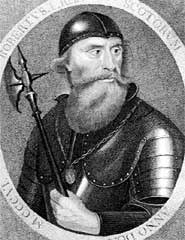
AI-assisted Portrait of Robert the Bruce
The Cold Man Who Won a Kingdom
He became king by committing a murder in a church. In February 1306, Robert Bruce met his chief rival, John Comyn, before the high altar of Greyfriars in Dumfries—and stabbed him to death on consecrated ground. It was sacrilege as well as homicide; it earned him excommunication from a pope who would harry his soul for years. It was also the most decisive act of his life. With Comyn dead, the field was clear. Six weeks later Bruce had himself crowned at Scone, by tradition with the hands of Isabella MacDuff, whose family held the ancient right to make a king of Scots. From a single, ruthless, opportune killing he manufactured a throne.
Almost everything then went wrong. Defeated in the field within months, Bruce became a hunted fugitive—his lands seized, his cause apparently dead. Three of his brothers were captured and executed. His wife, Elizabeth de Burgh, his daughter, and Isabella MacDuff were all taken; two of the women were hung in cages on castle walls. This is the nadir to which the legend of the cave spider belongs—the broken king watching an insect fail and try again. What the legend conceals is the temperament that actually pulled him back: not patience as inspiration but patience as cold method. Bruce returned not as a romantic but as a guerrilla—refusing pitched battle, taking castles by stealth and slighting them so the English could not hold them, grinding an empire down over years until, in 1314, he annihilated the vast army of Edward II at Bannockburn. He spent the rest of his reign converting that victory into permanence: the great Declaration of Arbroath of 1320, the 1328 treaty that won England's recognition of Scotland's freedom, and a dynasty that would run from Bruce into Stewart. He is the ENTJ as nation-builder.
Bruce is the ENTJ in its hardest form: a man who treated a crown as an objective and pursued it for twenty years with Te's relentless campaign and Ni's long, patient vision— turning murder, exile, and disaster into a free kingdom and a lasting line.
The Warrior-King as Engineer
Te — dominant
Dominant Te organizes the external world toward an outcome, and Bruce's outcome never changed: a free Scotland with a Bruce on its throne. Everything he did was instrumental to that end. His military method was Te in its purest form—not the pursuit of glory but the pursuit of effectiveness. He understood that he could not match England in open battle, so he refused open battle. He took castles by night escalade and ruse rather than siege, then tore them down so they could never again be garrisoned against him. He carried devastating raids deep into northern England, less for plunder than to make Scotland's independence more expensive to deny than to grant. It is the logic of a man who measures a campaign by its results, not its honors.
But Bruce's Te is best seen in what came after the fighting, because winning a war and building a state are different problems, and he solved both. A lesser warlord wins Bannockburn and rules a contested, excommunicate kingdom for the rest of his life. Bruce turned the battlefield victory of 1314 into the diplomatic victory of 1328—the Treaty of Edinburgh–Northampton, in which the English crown formally recognized him as king and Scotland as independent. He worked the institutions methodically: he held parliaments, settled the succession by statute, rebuilt a ravaged realm's administration, and labored for years to have his excommunication lifted so that his kingship would be unimpeachable in the eyes of Christendom. The murderer of Greyfriars became a legislator.
The deepest Te signature is the dynasty. Bruce did not fight merely to be king; he fought so that his blood would be king after him. He named heirs, secured oaths, and arranged the realm so it would survive his death—and it did, passing through his daughter's line into the House of Stewart and, eventually, onto the throne of a united Britain. That is the characteristic ENTJ horizon: not the self, but the institution that outlasts the self.
The Long Game
Ni — auxiliary
Auxiliary Ni gives Te its direction—a single, fixed vision of the future toward which all the maneuvering bends. In Bruce it shows first in the most discreditable chapter of his life: the side-switching. In the early wars he was politically slippery, shifting between the Scottish cause and the service of Edward I more than once, swearing fealty and then breaking it as circumstances changed. Read as character, this looks like mere self-interest. Read as Ni–Te, it looks like a man keeping himself alive and powerful enough to seize the prize when the moment finally came—refusing to be martyred for a cause before the cause could be won. He was positioning, not vacillating.
The guerrilla years are Ni made visible as strategy. To fight a war of avoidance for the better part of a decade—surrendering territory, declining the glory of the set-piece battle, absorbing the loss of brothers and the imprisonment of a wife—requires holding a picture of the end state so firmly that no present humiliation can shake it. The impulsive man fights when challenged; the Ni strategist refuses the fight he cannot win and waits for the one he can. Bannockburn was not luck. It was the battle Bruce had spent years declining to fight until the ground, the numbers, and the moment were finally his.
The cave spider is the wrong legend for the wrong reason: Bruce did not persevere out of inspiration. He persevered because he could see, with cold clarity, exactly the kingdom he intended to build—and he was willing to lose everything in front of him to reach it.
That same long vision produced the Declaration of Arbroath. It was not a battlefield document but an idea—a letter to the pope arguing, in famous terms, that the Scots would never submit to English rule while a hundred of them remained alive, and that even Bruce himself might be cast off if he tried to subject them. Bruce grasped that independence had to be made into a principle that outlived its king. That is Ni: securing not just the throne but the meaning that would keep it free.
The Blade and the Charge
Se — tertiary
Tertiary Se gives the ENTJ strategist a capacity for sudden, decisive physical action—the ability to seize the present moment with violence when the plan demands it. In Bruce it is vivid and unmistakable. The killing of Comyn was Se: a flash of lethal action in a confined space, blade drawn before the altar, the kind of irreversible deed that an over-deliberating man never commits. Whether it was premeditated or erupted from a quarrel, Bruce did not flinch from it—and then he acted on it instantly, riding for Scone before his enemies could regroup. The strategist supplied the timing; Se supplied the nerve.
The same boldness ran through his war. He led raids in person, took castles by hand-to-hand escalade, and lived for years in the open as a hunted man, hardened to cold and hunger and the physical reality of the fight. The most celebrated image of his life is pure Se: on the eve of Bannockburn, the English knight Henry de Bohun spotted Bruce in the open, lowered his lance, and charged. Bruce, mounted only on a light palfrey and carrying nothing but a battle-axe, stood his ground, sidestepped the charge at the last instant, and split de Bohun's skull with a single blow. His commanders rebuked him for risking the entire cause on one reckless stroke. He answered only that he had broken his good axe—the remark of a man fully present in the violence of the moment.
In a dominant function, that recklessness would define him. In Bruce it is tertiary—a weapon the strategist keeps sheathed until the instant it will do the most good, then draws without hesitation. The discipline to wait years for Bannockburn and the nerve to kill de Bohun in the open belong to the same man.
The Conscience He Could Not Outrun
Fi — inferior
Inferior Fi is the ENTJ's buried interior—a private moral weight that the instrumental mind usually overrides, but that surfaces under pressure and at the end of life. For most of his career Bruce subordinated personal feeling to the objective with formidable completeness. He killed a rival in a church; he broke oaths; he accepted the deaths of his brothers and the caging of the women of his family as the price of the throne. The Te machine did not stop for grief.
Yet the sacrilege at Greyfriars seems to have lodged in him in a way nothing else did. Excommunication was a political problem he worked to solve, but the murder before the altar was also, for a medieval man, a wound to the soul—and the evidence is that Bruce felt it as one. The clearest expression of inferior Fi comes in his dying request. As death approached in 1329, he asked that his heart be cut from his body and carried on crusade to the Holy Land, to fight against Christ's enemies as he had vowed and never managed to do in life—an act of penance for the king who had begun his reign in blood and sacrilege. James Douglas, his feared lieutenant, took the embalmed heart in a silver casket and bore it into battle against the Moors in Spain, flinging it ahead of him into the enemy as he charged.
It is a strikingly personal, almost private gesture from a man defined by cold public effectiveness—the inferior function finding its voice at the last. The strategist who had organized a kingdom spent his final wish trying to settle an account with his own conscience.
Why ENTJ Over ESTP
Why not ESTP?
The case for ESTP is real: the church murder, the personal raids, the killing of de Bohun in the open are all Se boldness of the highest order, and Bruce had the warrior's nerve in abundance. But the ESTP is an opportunist of the moment—a brilliant tactician who reads the immediate situation and strikes. Bruce was something else. His genius was the long, patient strategy that turned a single act of violence into a twenty-year campaign, and that campaign into a state and a dynasty. He declined battle for years; he labored over treaties and parliaments and the lifting of an excommunication; he built an institution to outlive him. That is Te–Ni playing for the whole board, not Se–Ti playing the hand in front of it.
The contrast is sharpest within Bruce's own circle. His brother Edward Bruce and his lieutenant James Douglas were the true ESTPs of the war—magnificent in the charge, reckless, hungry for the immediate fight; Edward's impatience eventually got him killed chasing a crown in Ireland. Robert used men like that, and outlived their kind of brilliance, because he was never merely fighting. The Se was a tool the strategist deployed; it never ran him. Where the ESTP wins the battle, the ENTJ wins the war, writes the peace, and founds the line—and that is exactly the shape of Robert the Bruce's life.
Connected Figures
Further Reading
- Robert Bruce and the Community of the Realm of Scotland — G. W. S. BarrowThe definitive scholarly biography — places Bruce within the political community of the realm and remains the standard work.
- Robert the Bruce: King of the Scots — Michael PenmanThe fullest modern biography, drawing on recent scholarship; especially strong on the kingship and the years after Bannockburn.
- Robert the Bruce: King of Scots — Ronald McNair ScottThe most readable popular narrative of the life — a vivid, accessible account of the wars and the man.
- The Bruce — John BarbourThe medieval verse epic, written within two generations of his death — the foundational source for the legend, including de Bohun and the heart.
