 Historical Figure MBTI
#479 · 4-15-26 · The Wars of Scottish Independence
Elizabeth de Burgh
Queen of Scots · Bruce's Imprisoned Wife
c. 1284 — 1327
6 min read
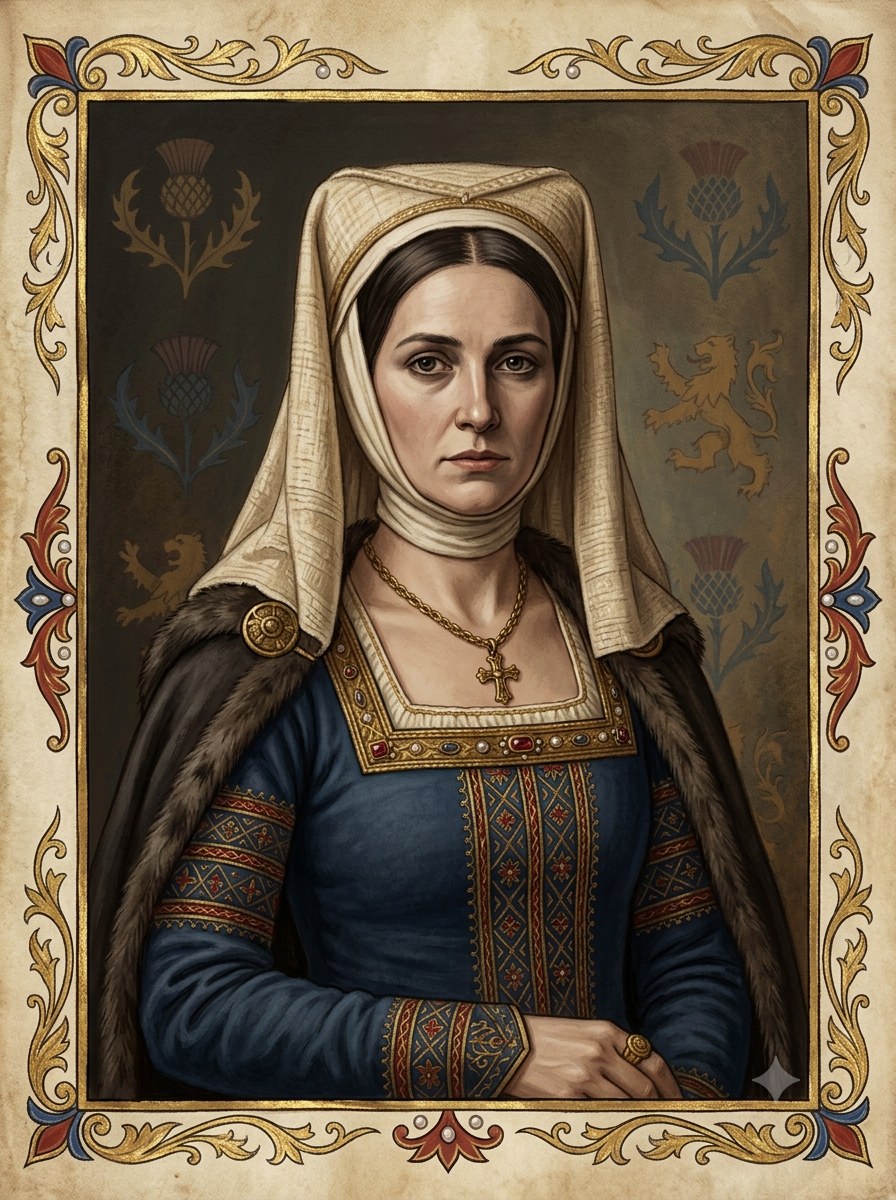
AI-assisted Portrait of Elizabeth de Burgh
The Queen Who Waited
In 1306, Elizabeth de Burgh was crowned queen of a kingdom that did not yet exist in any settled sense. Her husband, Robert the Bruce, had seized the Scottish crown in open defiance of England; within months his rebellion had collapsed and his family were hunted across the Highlands. She was the daughter of the powerful Earl of Ulster, a trusted ally of Edward I — an Irish noblewoman who had married, by her own account, into a doomed cause. “It seems to me,” she is said to have told her new husband, “that we are but a summer king and queen, whom the children crown in their sport.”
The prophecy held for eight years. Captured as the Bruce party fled north, Elizabeth was held prisoner for nearly a decade in honorable but isolating confinement; her father's loyalty to Edward spared her the savagery visited on other women of Bruce's circle, who were hung in cages from castle walls. She was not caged — simply removed from the world and made to wait, year after year, with no word of whether her husband lived. When the Scots routed the English at Bannockburn in 1314, Bruce finally had prisoners enough to trade for her. She returned to a throne that had become real, reigned beside him, and bore him the heir who would rule as David II.
Elizabeth de Burgh was the ISFJ at its most enduring — dominant Si fused with Fe into a single steadfast constancy, a loyalty that did not require proof or reward to hold, and that held through eight years of silence.
The Constancy That Outlasted Everything
Si — dominant
Dominant Si is an orientation toward what endures — toward a commitment that does not loosen because circumstances have turned against it. Where another temperament might have read the collapse of 1306 as a release, a sign that the cause was lost and survival now meant distance, Elizabeth read it as the thing she had promised to keep. The vow did not expire when the kingdom fell; if anything it became heavier, and she carried it.
The eight years of captivity are the clearest evidence. There was no daily heroism in them, no battle to win, nothing to do but persist — and persistence under that kind of erosion is precisely the Si gift. The English could not break her loyalty because there was nothing dramatic to break; it was not a position she defended in argument but a continuity she simply did not abandon. Sustained by routine, by faith, and by the remembered fact of whom she belonged to, she waited the way Si waits — without spectacle, and without end, until the end came.
Faithful to Husband and to Heir
Fe — auxiliary
If Si gave Elizabeth her endurance, auxiliary Fe gave that endurance its object. Si alone is constancy in the abstract; Fe directs it toward people and bonds — the husband she had married, the dynasty she had entered, the role of queen she was expected to embody. Her loyalty was never a private act of will held in isolation. It was relational to its core: she endured for Robert, and for the line that would carry his name forward.
That she returned to him at all, after eight years that would have justified bitterness, is the measure of it. There is no record of recrimination. She resumed the marriage and the office, bore the heir the kingdom needed, and gave the fragile new dynasty the continuity it required. Fe sustains the warmth and faith that hold a household and a realm together under strain; in Elizabeth it produced a queen whose chief political contribution was simply that she remained — faithful and dynastically indispensable — when remaining was the hardest thing to do.
The Clear-Eyed Reckoning
Ti — tertiary
Tertiary Ti in an ISFJ is quiet but real: a private capacity to see plainly what is true even when the truth is unwelcome. Elizabeth was not a naive woman swept along by a romance she did not understand. The “summer king and queen” remark is the voice of someone who had measured the odds clearly and named them aloud; she knew, when she was crowned, how slender the Bruce claim was. But the reckoning did not govern her. She saw the danger and stayed anyway — a lucidity in service of endurance, not an argument for abandoning it.
The Unknowable Future
Ne — inferior
Inferior Ne is the ISFJ's most vulnerable point: the open, branching field of what might happen, which the Si-dominant mind finds not exhilarating but threatening. Captivity weaponized exactly this. Elizabeth's confinement was a prison of unresolved possibility — her husband might be dead or alive, the cause reviving or finished, her release a year away or never. Her response was the characteristic ISFJ one: she did not try to master the open future but anchored herself against it, holding to what was solid — routine, faith, the fixed fact of her name — until the future finally arrived and resolved itself in her favor.
Why ISFJ Over ISFP
Why not ISFP?
The ISFP's loyalty flows from Fi — an inner code of personal values that the world is not allowed to violate, expressed as a stand the self takes on its own terms. That fits the women who defied Edward in self-possessed protest, but it does not fit Elizabeth. Her defining act was not self-expression but self-effacement: she endured for her husband and the dynasty, holding a role she had been given rather than asserting a truth she had chosen. That is Si-Fe constancy — faithfulness to a bond and a duty — not the Fi-driven personal stand of an ISFP.
The distinction is one of direction. The ISFP holds firm because something in the self will not bend; the ISFJ holds firm because something owed to others must not be let go. Elizabeth's eight years were not a protest she was making but a promise she was keeping, and she kept it the way ISFJs keep things — quietly, dutifully, and without ever appearing to do anything heroic at all. The heroism was entirely in the not-letting-go.
Connected Figures
Further Reading
- Robert Bruce and the Community of the Realm of Scotland — G. W. S. BarrowThe classic scholarly account of the Bruce and his cause — the authoritative frame for Elizabeth's captivity and queenship.
- Robert the Bruce: King of the Scots — Michael PenmanThe leading modern biography, attentive to the dynastic stakes and to the women of Bruce's circle.
- Under the Hammer: Edward I and Scotland — Fiona WatsonReconstructs the English occupation that made Elizabeth a prisoner — essential for the politics of her confinement.
