 Historical Figure MBTI
#480 · 4-15-26 · The Wars of Scottish Independence
Isabella MacDuff
Countess of Buchan · Who Crowned Bruce and Was Caged
fl. 1306
6 min read
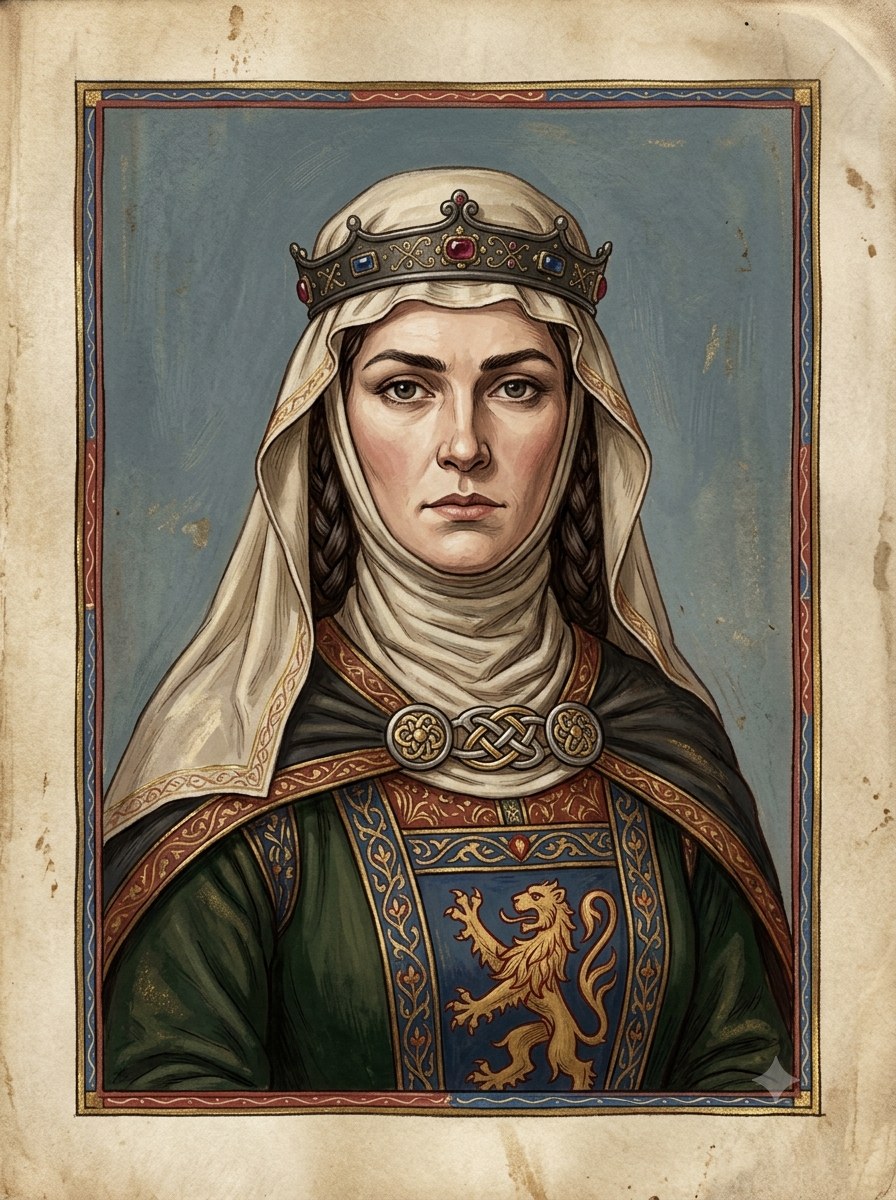
AI-assisted Portrait of Isabella MacDuff
The Woman Who Crowned a King Against Her Own Blood
On a March day in 1306, a Scottish noblewoman placed a crown on the head of Robert the Bruce and, in the same gesture, signed her own death warrant — or what should have been one. Isabella MacDuff was Countess of Buchan by marriage, the wife of a Comyn, which placed her inside the family that hated Bruce more bitterly than any in Scotland. Bruce had murdered her husband's kinsman, John “the Red” Comyn, before the altar of a Dumfries church only weeks earlier. Every tie of marriage and loyalty bound her to oppose the man. She crowned him instead.
Her claim to do so was ancient and personal. The MacDuffs, the family of her birth, held the hereditary right to enthrone the King of Scots. When Bruce seized the throne in haste at Scone and the MacDuff who should have performed the rite — her brother — was a prisoner of the English, Isabella came in his place. She rode hard to Scone and crowned Bruce a second time by her own hand, so that no one could say the old MacDuff right had been skipped: a calculated, theatrical act of defiance against both Edward I of England and her own Comyn kin.
The price was monstrous. When Bruce's rebellion collapsed within months and his supporters scattered, Isabella was captured. Edward I, sensing the propaganda value of a woman who had publicly defied him, devised a punishment of deliberate cruelty: a wooden cage, partly open to the air, hung from the walls of Berwick Castle for all to see. She lived in it, exposed to crowds and weather, for roughly four years.
Isabella MacDuff is the ISFP at its most uncompromising — Fi's private, absolute conviction translated through Se into a single irreversible act, performed in public and paid for in an iron cage.
The Conscience That Answered to No One
Fi — dominant
Dominant Fi is a private moral compass that recognizes no external authority — not family, not duty, not the king of England — and simply knows what is right and acts on it, regardless of cost. Isabella's whole story is that interior certainty under maximum pressure. By every conventional measure she should have stood with the Comyns: her marriage, her title, the feud over the murdered Red Comyn all pointed one way. She went the other, because something in her own judgment told her the MacDuff right belonged to the rightful king, and that Bruce was that king.
What marks this as Fi rather than mere ambition is that the act offered her nothing. She gained no power and no security by crowning Bruce; she gained a cage. The choice was costly in exactly the way Fi choices tend to be — it served an inner principle at the direct expense of self-interest — and the four years on the wall are its final testament. The records do not show her recanting, bargaining, or pleading her marriage as an excuse. She had acted on her own conscience, and she paid for it without renouncing it: the dominant-Fi pattern carried to its harrowing limit.
The Ride to Scone
Se — auxiliary
If Fi supplied the conviction, auxiliary Se supplied the nerve to act on it physically and at once — moving in the moment, into the immediate world, rather than deliberating toward some long-range plan. Isabella did not write letters or wait for a safer season. She got on a horse and rode. Learning that Bruce had been crowned without the MacDuff rite, she covered the distance to Scone fast enough to arrive while it still mattered, and performed the enthronement herself, with her own hands, in front of whoever was assembled.
The crowning was a profoundly Se gesture — concrete, public, and irreversible. It was not a private vow but a physical act witnessed by the kingdom, a piece of living theatre that fixed Bruce's legitimacy in a single visible moment: not a manifesto but a crown, placed on a head, in the open. There is a grim symmetry in the fact that her enemy answered that boldness in kind. Edward I understood that a public act demanded a public reply, and the cage on the walls of Berwick Castle was its mirror image — her body, like her gesture at Scone, made into a spectacle the whole realm could see.
A Glimpse of the Symbol
Ni — tertiary
Tertiary Ni gives the ISFP an occasional grasp of larger meaning — a sense that an act in the present can stand for something far beyond itself. Isabella seems to have understood that the MacDuff right was not a private heirloom but a symbol the whole kingdom recognized, and that the second crowning was not redundant but insurance, closing any gap in Bruce's legitimacy an enemy might later exploit. But Ni in the tertiary position is a flicker, not a floodlight: she saw what the crowning would mean without foreseeing the cage. It reads the significance of the present act far better than the future that act will unleash.
No Calculation of Cost
Te — inferior
Inferior Te is the ISFP's blind spot: the cool, strategic accounting of risk and consequence that barely registers for someone led by Fi. A Te-driven actor in Isabella's position would have run the numbers — Bruce's thin odds, the certainty of Comyn retaliation, the reach of Edward's armies — and very likely declined; the crowning was, by any strategic measure, a poor bet on a rebellion that collapsed within the year. She made the bet anyway, because the question she answered was not “what are the odds?” but “what is right?” She acted on conviction with no plan to survive the aftermath — no exit, no leverage to bargain with — and the cage was the bill that the unweighed risk eventually delivered.
Why ISFP Over ISFJ
Why not ISFJ?
The ISFJ, led by Si and Fe, is the type of loyal, role-conforming duty — the woman who upholds family, marriage, and tradition because that is what the group expects of her. An ISFJ in Isabella's place would almost certainly have stood with the Comyns, because her duty plainly lay there. Isabella did the opposite: she broke with her husband's family and the obligations of her marriage to follow her own private conviction. That is an act of Fi defiance, not Fe loyalty — she answered to her conscience, not to her kin.
The distinction is the whole story. An ISFJ's deepest instinct is to serve the order she belongs to; Isabella betrayed exactly that order in the name of something only she could see. Where the ISFJ asks “what does my place require of me?”, the ISFP asks “what does my conscience demand?” — and pays the price alone. That is Fi sovereignty over duty, the ISFP's defining motivation, carried to its most unbending and most costly conclusion.
Connected Figures
Further Reading
- Robert Bruce and the Community of the Realm of Scotland — G. W. S. BarrowThe definitive scholarly account of Bruce's rise and the war for Scotland — the essential context for Isabella's crowning.
- Robert the Bruce: King of the Scots — Michael PenmanA modern, deeply researched biography that sets the women of Bruce's cause, Isabella among them, within his reign.
- Under the Hammer: Edward I and Scotland — Fiona WatsonTells the war from the English side and the logic of Edward's deliberate cruelty — including the cages at Berwick.
