 Historical Figure MBTI
#475 · 4-15-26 · The Wars of Scottish Independence
James Douglas
Bruce's Lieutenant · The Black Douglas
c. 1286 — 1330
7 min read
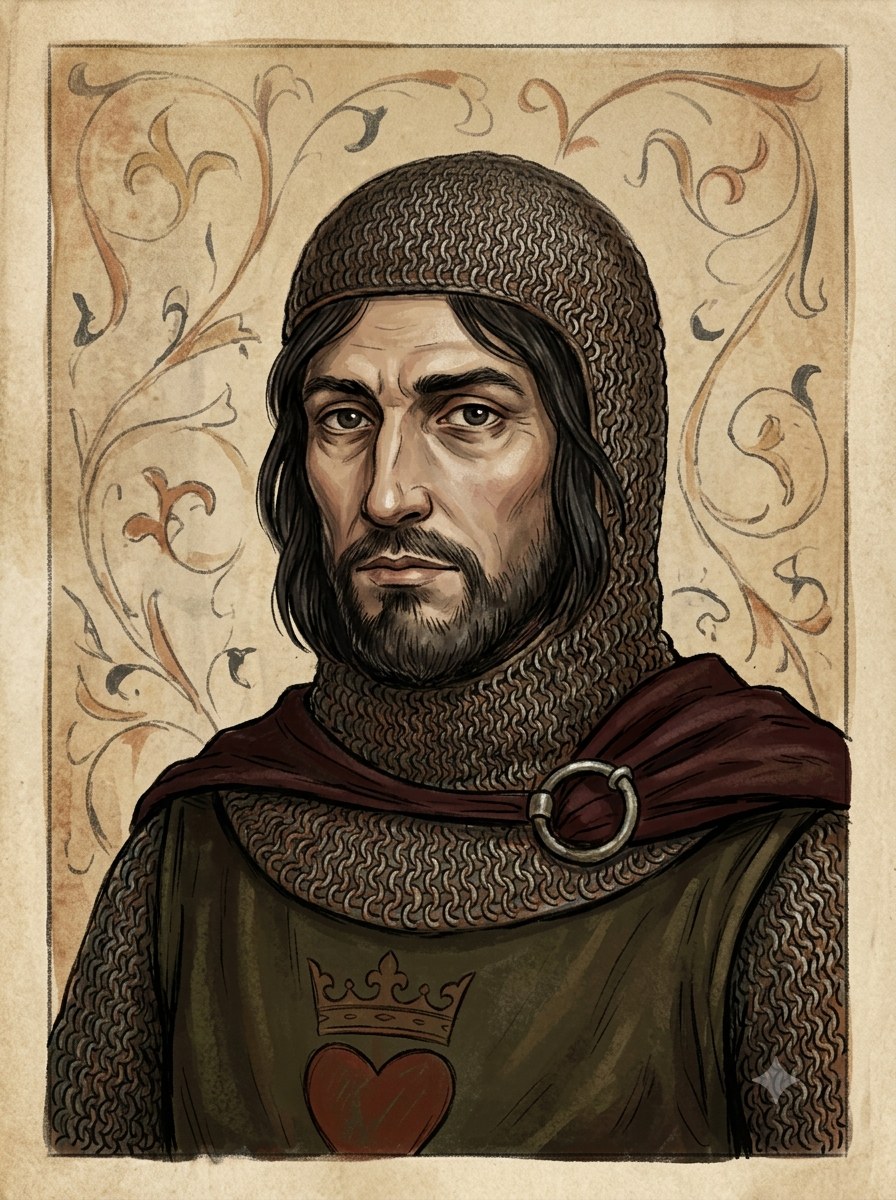
AI-assisted Portrait of James Douglas
The Name That Hushed Children
English mothers on the northern border were said to quiet their crying children with a single threat: the Black Douglas would get them. The man behind the legend was Robert the Bruce's most trusted and most feared lieutenant—a raider who moved by night, struck without warning, and vanished before the alarm could be raised. He was not a strategist plotting campaigns over maps. He was the blade that executed them, faster and more ruthlessly than any enemy could anticipate.
Born around 1286, James Douglas grew up dispossessed—his family lands seized by the English crown—and he made the recovery of them a personal war. He took his own castle back not by siege but by stealth and slaughter, leaving behind the grisly scene the chroniclers called the Douglas Larder. He fought at Bannockburn in 1314, led raids that carried fire deep into northern England, and helped batter the English into terms. When the Bruce died in 1329, Douglas honored a dying wish that would carry him to Spain and to his own end. He is the ESTP as warrior—all daring, all motion, all nerve.
Douglas was the ESTP raider distilled to a single instinct: read the ground, find the weakness, and move before anyone else can. The king supplied the vision; Douglas supplied the terror.
The Audacity of the Raider
Se — dominant
Dominant Se lives in the immediate physical world—the terrain, the moment, the opening that exists for only a few seconds before it closes. Douglas had it in its most dangerous form. His recapture of his own castle is the purest expression: rather than wait out a siege, he disguised his men, slipped them inside during a feast day, and fell on the unprepared English garrison. The slaughter that followed—bodies, salted provisions, and broken wine casks left heaped together in what became known as the Douglas Larder—was a deliberate act of physical theater, calculated to make the place ungarrisonable and the next occupant terrified.
This was the engine of his whole career. While slower minds planned, Douglas was already across the border, burning, seizing cattle, and melting back into the hills before any relief force could form. At Bannockburn in 1314 he was in the thick of the fighting, and afterward he turned northern England into his hunting ground, riding hundreds of miles to strike where he was least expected. The English could never pin him down because he never stood still long enough to be pinned. Se does not deliberate; it acts, and it trusts the body and the eye to find the answer in real time.
The Douglas Larder was Se as statement: not a tactical necessity but a physical message, written in the wreckage of an enemy garrison, that this castle could not be held.
The Cold Logic of the Ambush
Ti — auxiliary
Pure Se would make a brave fool. What made Douglas lethal was the auxiliary Ti that governed the daring—a cold, internal calculus of where an enemy was weakest and how little force was needed to break him. He understood, with a clarity ahead of his age, that a smaller army wins not by meeting a larger one head-on but by refusing the pitched battle entirely: deny the enemy supply, exhaust him with raids, and pick off the isolated and the careless. His warfare was a logical system, and every raid was a problem solved in favor of maximum damage at minimum cost.
The disguised assault on his own castle shows the same calculating mind. He did not waste men on walls; he found the one day the garrison would be distracted and unarmed, and he used it. This is Ti in service of Se—the strategist's eye fused to the raider's reflex, so that the audacity always landed where it would do the most harm. The English came to dread him not because he was reckless but because he was precise: a man who seemed to know their vulnerabilities better than they did.
The Loyalty Sealed in Silver
Fe — tertiary
Tertiary Fe in an ESTP rarely looks like soft warmth. In Douglas it took the form of a ferocious, total devotion to one man: Robert the Bruce. He bound himself to the Bruce's cause in its darkest hour, when the king was a hunted fugitive with a price on his head and almost no army, and he never wavered. His loyalty was not abstract principle but personal bond—a fierce attachment to his king and the brotherhood of men fighting beside him, the kind of belonging that an action-oriented temperament feels in the gut rather than reasons toward.
That bond produced the most famous gesture of his life. When the dying Bruce asked that his heart be carried on crusade toward Jerusalem, Douglas took the charge as a sacred debt. He had the king's heart embalmed and set in a silver casket, hung it around his neck, and rode south. In Spain in 1330, fighting the Moors, he is said to have flung the casket ahead of him into the enemy ranks—“forward, brave heart”—and charged after it, cutting his way toward it until he was cut down. It is Fe at its most extreme: a man who could not separate his devotion to his king from his own life, and who spent the second to honor the first.
The Vision Borrowed From a King
Ni — inferior
Inferior Ni is the ESTP's blind spot: the long arc, the single unifying purpose, the future seen whole rather than moment by moment. Douglas did not generate that vision himself. The grand design of the war—when to strike, when to wait, how to grind a richer enemy into negotiating—belonged to the Bruce. Douglas was the instrument of a strategy he did not author, and he was content to be exactly that. His genius was tactical and immediate; the larger meaning came from his king.
Where inferior Ni surfaced was in his end. The crusade with the heart was a single fixed idea pursued past all reason—a symbolic mission that swallowed the rest of his life and led him to charge a casket of silver into a wall of enemies. The man of constant motion finally fastened himself to one transcendent purpose, and it killed him. It is the classic shape of the inferior function: long suppressed, it erupts at last as a fixation so total that it overrides the very instincts for survival that had carried him through a hundred raids.
Why ESTP Over ENTJ
Why not ENTJ?
The ENTJ is the long-range commander—the mind that conceives the whole campaign, sees the war as a multi-year structure, and bends events toward a planned end. That was the Bruce, not Douglas. Douglas was the brilliant tactical instrument of someone else's strategy: a man of action who executed the design with terrifying audacity but did not author it. His gift was the raid, the ambush, the seized moment—Se and Ti—not the strategic vision (Ni-Te) that an ENTJ supplies. The daring was his; the plan was his king's.
The distinction is the difference between the architect and the blade. An ENTJ would have wanted to run the war; Douglas wanted to win the next encounter, and trusted his king to run the war. That subordination was not weakness—it was the perfect fit of a dominant-Se temperament to its role. Bruce needed a man who could turn vision into violence faster than the enemy could react, and Douglas was that man. He did not need to see the whole board. He only needed to know where to strike next, and no one in Scotland struck better.
Connected Figures
Further Reading
- Robert Bruce and the Community of the Realm of Scotland — G. W. S. BarrowThe definitive scholarly account of the war, and the best context for Douglas's role beside the king.
- Robert the Bruce: King of the Scots — Michael PenmanThe leading modern biography of the Bruce; authoritative on the dying request and the fate of the heart.
- The Bruce — John BarbourThe fourteenth-century verse chronicle that fixed the legend of the Good Sir James — the closest thing to a contemporary epic of the war.
