 Historical Figure MBTI
#474 · 4-15-26 · The Wars of Scottish Independence
Andrew Moray
Co-Commander at Stirling Bridge
c. 1270 — 1297
7 min read
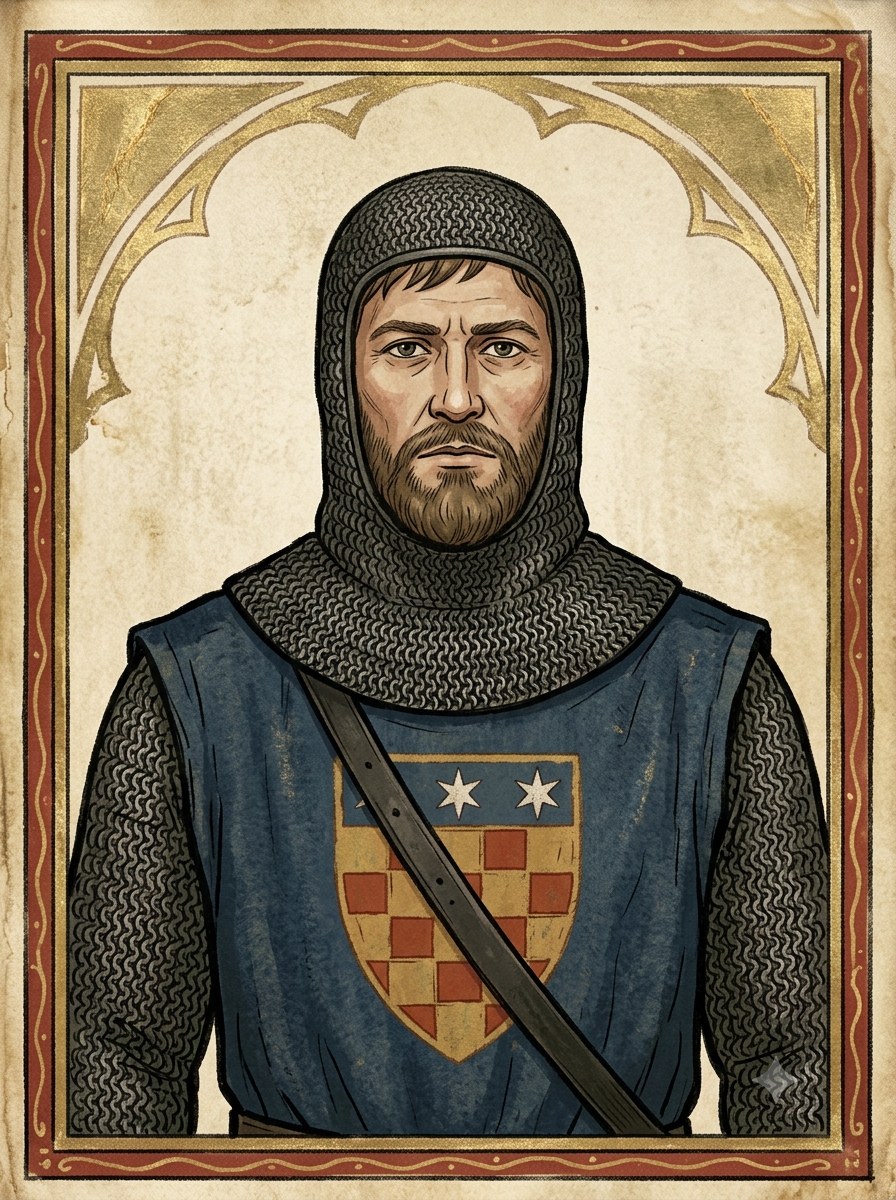
AI-assisted Portrait of Andrew Moray
The Other Man at Stirling Bridge
History remembers the rising of 1297 as William Wallace's war. It was, just as much, Andrew Moray's. While Wallace raised the south of Scotland, Moray — a young noble of the north, heir to lands in the province of Moray that gave his family its name — raised the country above the Forth, and he did it not in a single spectacular gesture but castle by castle, garrison by garrison, in a disciplined, methodical campaign that pried the English occupation loose piece by deliberate piece.
He captured no headlines doing it, and posterity has obliged by half-forgetting him. Yet a number of historians, weighing the two commanders, judge Moray the more substantial soldier of the pair: the steadier organiser, the more careful planner, the one who methodically secured a whole region while the legend gathered around the other man. The two joined their forces and won, together, the great Scottish victory at Stirling Bridge in September 1297 — and in that same battle Moray was mortally wounded. He died of those wounds within weeks, leaving Wallace as sole Guardian of Scotland. He was perhaps twenty-seven.
Moray was the quiet competence behind the rising — an ISTJ in the field, winning a country back by careful, dutiful, methodical work, and dead before the work was done.
Castle by Castle
Si — dominant
Dominant Si is the function of the patient accumulator — the mind that holds its ground, works through a problem in concrete, sequential steps, and trusts thorough execution over the bold improvisation. Moray's northern campaign reads as Si in the field. He did not gamble the rising on one pitched encounter. He took the occupation apart methodically: reducing the English-held strongpoints of the north one after another, consolidating each gain before reaching for the next, until a whole region that had been pacified was, garrison by garrison, no longer the king of England's.
This is unglamorous warfare, and it is exactly the kind that wins. Where the Si-blind commander craves the decisive stroke, the Si-dominant one understands that a country is taken the way a wall is built — course by course, each laid true before the next goes on. Moray's discipline was a temperament before it was a tactic: a steadiness under the long grind of a campaign that has no single dramatic moment, only the slow, verifiable progress of one secured position after another. It is the competence that does not photograph well and does not need to.
The Organiser of the Rising
Te — auxiliary
If Si gave Moray his patience, auxiliary Te gave him his command. Te is the executive function — the drive to organise people and resources toward a result, to impose order on a body of men and make it act efficiently. A rising in the north of Scotland in 1297 was not a mob with grievances; it had to be supplied, marshalled, and pointed. Moray turned a regional revolt into a working military instrument, and the effectiveness of that instrument is the measure of the function.
The proof is in the partnership. When Moray brought his northern army to join Wallace's southern one, the two forces fought at Stirling Bridge as a coordinated whole — the Scots choosing their ground and timing the destruction of an English army caught crossing a narrow bridge. That this assembled, irregular force could be made to hold its discipline and strike as one is the Te signature: a command competent enough that the result looks inevitable in hindsight. Wallace supplied the fire of the thing; Moray, by most accounts, supplied a good part of its order.
The Loyalty He Did Not Advertise
Fi — tertiary
Tertiary Fi in the ISTJ is a private conviction rather than a worn one — a sense of right and allegiance that the person acts on quietly and rarely explains. Moray had every worldly reason to sit the rising out. He was a young man of property with a great deal to lose; his own father had been captured fighting the English. He rose anyway, in the name of a captive king and a kingdom under occupation, and he committed his lands and his life to it without the rhetoric that made Wallace a legend.
That is the tertiary function's register: a loyalty felt deeply and demonstrated in conduct rather than declared in speeches. Moray fought as one held to a cause by personal duty — not the cooler, purely strategic calculation of a man choosing a winning side, but the inward conviction of someone who has decided where he belongs and acts on it to the end. He spent himself for it. The cause kept him; he did not bargain with it.
The Future He Never Improvised Toward
Ne — inferior
Inferior Ne is the ISTJ's least native ground — the realm of open-ended possibility, of the leap into the untried. The Si-dominant commander is at his strongest reducing the known problem in front of him and at his weakest when the situation demands sudden, speculative reinvention. Moray's war was, fittingly, a war of concrete objectives: this castle, then that one, each a definable thing to be taken. It played to everything he was.
The poignancy is that his story stops precisely where the inferior function would have been tested. Stirling Bridge was a defensive masterpiece of timing and terrain — Si-and-Te work. What came after, with the English certain to return in force under Edward, would have demanded a more improvisational, open-field campaign of the kind that later broke Wallace at Falkirk. We will never know how Moray's steadiness would have fared in that wider, more fluid war, because the wound he took at the bridge closed the question. The methodical man was killed at the high point of the methodical victory, before the unpredictable part began.
Why ISTJ Over ESTJ
Why not ESTJ?
The ESTJ shares Moray's love of order and result, but leads from the front and outward — projecting command, marshalling people by visible force of personality, taking the room. That is the mode of his great adversary Edward I, the dominant-Te warrior-king. Moray reads as the reverse: a reserved organiser who worked through quiet, systematic campaigning, whose strength was steadiness rather than charisma. His authority came from competence patiently demonstrated, not presence loudly asserted — the inward Si lead, not the outward Te one.
The distinction is in where the order comes from. The ESTJ imposes structure on the world as an extraverted act of command; the ISTJ builds it inwardly first — a methodical, sequential picture of how the thing must be done — and then executes it without fanfare. Moray was the man the rising relied on precisely because he did not need to be its face. He cleared the north because it had to be cleared, in the order it had to be cleared, and let the legend belong to someone else.
Connected Figures
Further Reading
- William Wallace — Andrew FisherThe standard modern biography of Wallace; clear-eyed on Moray's parallel northern campaign and his importance to the 1297 rising.
- Robert Bruce and the Community of the Realm of Scotland — G. W. S. BarrowThe classic scholarly account of the wars of independence — essential for the political world Moray rose within and the cause Bruce later carried.
- Under the Hammer: Edward I and Scotland — Fiona WatsonThe English occupation and its undoing seen from the documentary record — the system Moray methodically dismantled in the north.
