 Historical Figure MBTI
#884 · 6-26-26 · The American Civil War
Edwin Booth
Shakespearean Actor · John's Brother · The Family's Unionist
1833 — 1893
8 min read
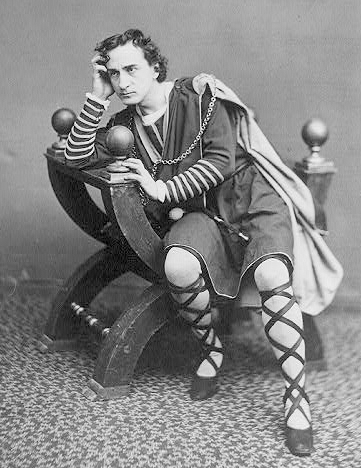
Portrait of Edwin Booth
The Prince of Players
For nearly thirty years, Edwin Booth was the American theater's most trusted authority on grief, doubt, and the unbearable weight of a mind that will not stop thinking. His Hamlet — first performed in 1861, revived for a legendary hundred consecutive nights on Broadway in 1864-65 — was not a role he inhabited so much as a private country he had already been living in for years. Audiences who came expecting spectacle left describing something closer to a confession: a prince who seemed to be working out, in real time and in front of strangers, whether his own suffering was bearable. That interior register was Edwin's whole method, and it set him apart from nearly every actor of his generation, including his own father and his own brother.
He was born into America's first theatrical dynasty, the son of the brilliant and erratic Junius Brutus Booth, and by his twenties he had already spent a childhood absorbing the trade from the wings — nursing his father through drink and breakdown, learning every line by proximity rather than instruction. What he built from that inheritance was distinctly his own. Where Junius had thundered and John Wilkes would later court the gallery with showman's flourish, Edwin worked from the inside out: he asked first whether a reading felt true to him, and only then whether it would land. It made him, by consensus, the finest Hamlet America ever produced. It also made him a man INFP to the marrow — an artist whose authority came not from command but from the depth and honesty of his own private feeling.
Edwin Booth did not perform Hamlet's doubt. He recognized it — and every performance was Fi checking the reading against a truth he had already paid for in his own life.
A Truth He Had to Feel First
Edwin's Fi showed most plainly in what he refused to do. Fellow actors of the period built Hamlet around set gestures — a clutched brow at "To be or not to be," a rehearsed collapse at the ghost's appearance — inherited business passed down like stage directions. Edwin discarded most of it. He insisted on reading each scene against his own sense of what a grieving, doubting man would actually do, and he would rather underplay a famous moment than perform an emotion he had not personally verified. Critics of the day remarked on how quiet his Hamlet could be — how he trusted stillness and a lowered voice at moments where his predecessors reached for volume. That trust was not restraint for its own sake; it was fidelity to an internal standard that outranked the audience's expectations.
The same private conviction ran through his life off the stage. Edwin was famously melancholic — prone in his younger years to heavy drinking and depressive withdrawal, especially after the early death of his first wife, Mary Devlin, in 1863. He did not perform his grief publicly the way the era's sentimental culture often invited; he absorbed it, turned it over privately, and let it surface only where he judged it belonged — on stage, filtered through a role, or in his own guarded correspondence. Founding The Players club late in life and building Booth's Theatre were not campaigns for influence; they were attempts to build a private sanctuary for the craft as he understood it, insulated from the commercial theater's cruder appetites.
Nowhere is that inward moral compass clearer than in his response to April 1865. When his brother John Wilkes Booth shot Abraham Lincoln, Edwin did not organize a public defense, seek out sympathetic crowds, or attempt to manage his reputation through spectacle. He withdrew. He wrote a private letter of shame to the newspapers, then retreated from the stage altogether for months, wrestling alone with a guilt that had nothing rational to do with him. It was the reaction of a man whose sense of right and wrong lived entirely inside himself — not the reaction of someone waiting to see how the public would judge him.
Reading the Ghosts Between the Lines
If Fi told Edwin what he believed, Ne is what let him find so many different ways to say it. He was renowned for finding psychological shading in roles that other actors had played as flat archetypes for a generation. His Iago was not a simple villain but a man who seemed to relish his own cleverness a beat too long; his Richard II found self-pity and genuine pathos in a king most actors treated as merely weak. Edwin's gift was for turning over a familiar text and noticing the interpretive possibility no one else had bothered to look for — not by research or method, but by imaginative leap.
That same Ne showed in the sheer range he sustained across a single career: Hamlet, Lear, Shylock, Richard III, Brutus — a repertoire built less on typecasting than on Edwin's restless interest in inhabiting different possible selves. He was known to alter his interpretation of Hamlet across different runs of his life, never settling on a single "correct" reading, always circling the role again to see what new angle it might yield. It is the pattern of a mind that treats a great text as inexhaustible rather than fixed — each production another pass at possibilities the last one hadn't tried.
The Weight of What Came Before
Edwin's Si surfaced as a deep, almost reverent loyalty to inherited craft and personal precedent. He had learned the trade literally at his father's side, escorting the volatile Junius Brutus Booth to engagements and absorbing an apprenticeship no formal school could have offered, and he carried that lineage forward with genuine care rather than resentment — mounting revivals, preserving costumes and texts, treating the Booth theatrical tradition as something to be tended rather than escaped. Founding The Players club in New York was itself an act of institutional memory: a physical space meant to preserve and dignify the profession's history for actors who came after him.
That same backward-looking steadiness explains the specific shape of his post-assassination paralysis. Edwin did not merely fear the public's anger; he was haunted by the collision between a settled personal history — a staunch Unionist, a man who had by his own account helped save Robert Todd Lincoln from falling under a train in Jersey City only months earlier — and the unbearable new fact that his own brother had murdered the president that son's father. The dissonance was not abstract to him; it violated a coherent private narrative he had built his whole life around, and Si is exactly the function that feels such violations most acutely.
The Return He Didn't Choose
Te is where Edwin was least fluent, and its inferior position is visible in exactly how his career survived 1865. He did not return to the stage with a strategy — no calculated campaign to rehabilitate the Booth name, no shrewd management of public opinion. He returned, by his own account and his associates', largely because he needed the income and had no other trade, and because the alternative — permanent retirement, silence, brooding indefinitely on his brother's crime — felt worse than facing an audience again. It was a decision forced by circumstance rather than engineered by design.
Later in life he did manage practical affairs competently enough — running Booth's Theatre, later organizing The Players as a functioning institution with real finances and a real building — but even there, contemporaries described him as reluctant, more comfortable delegating the theater's business side than commanding it himself. Te, for Edwin, was a function he used only when the alternative was worse: a tool of last resort for an artist who trusted his own private judgment far more than he trusted organized action in the world.
Why INFP Over INFJ
Why not INFJ?
An INFJ's artistry organizes outward, around a vision of moral order it wants the world to recognize — a mission with an audience built into its structure. Edwin's did not. His standard for a performance was fidelity to his own felt sense of the role, checked against nothing but his private conscience, and when that conscience was tested most severely — his own brother's act of political murder — he did not issue any public reckoning or moral verdict on what had happened. He went silent and withdrew. That is Fi protecting its own interior territory, not Fe reaching for a wider judgment to share.
The distinction matters because Edwin's entire theory of acting depended on it. He never claimed his interpretations were correct for everyone, only that they were true to what he privately found in the text — an INFJ's insistence would more often have been that his reading revealed something the audience collectively needed to see. Edwin wanted no such collective claim. He wanted only to have been honest, alone, first.
Connected Figures
Further Reading
- Edwin Booth: Recollections by His Daughter — Edwina Booth GrossmannAn intimate 1894 memoir by Edwin's daughter, drawing on his letters and her own recollections of his temperament.
- American Tragedian: The Life of Edwin Booth — Daniel J. WatermeierThe definitive modern biography, tracing his stagecraft, his melancholy, and his response to the assassination.
- Fortune's Fool: The Life of John Wilkes Booth — Terry AlfordA biography of the brother that also reconstructs the Booth family dynamics and Edwin and John's political estrangement.
