 Historical Figure MBTI
#883 · 6-26-26 · The American Civil War
Lewis Powell
Conspirator · Seward's Attacker
1844 — 1865
6 min read
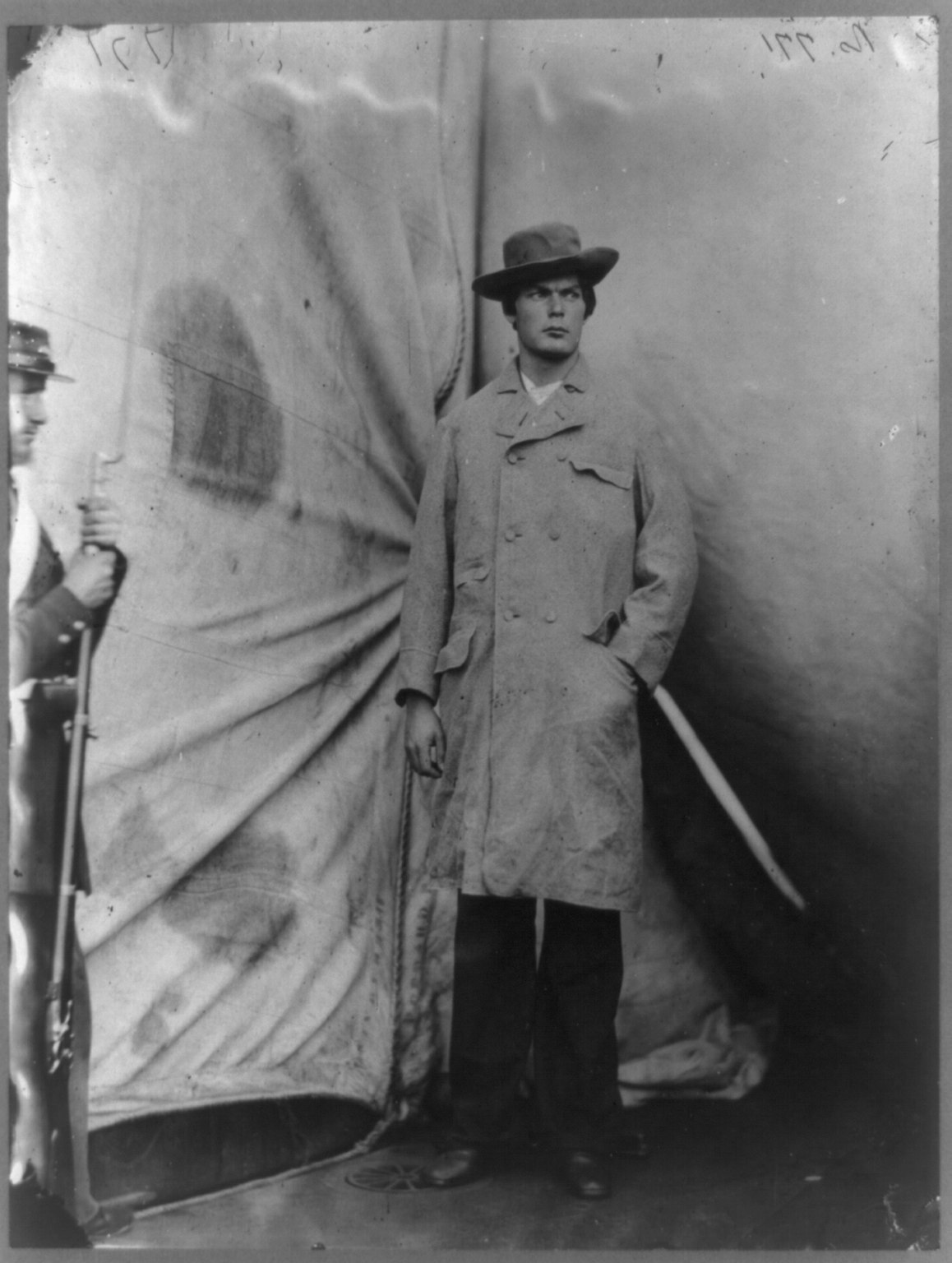
Portrait of Lewis Powell
The Knife in the Dark
Of the four people hanged for conspiring to kill Abraham Lincoln, Lewis Powell is the one history remembers least and fears most. He said almost nothing at his trial, and almost nothing in the weeks before it — not out of cunning, but because there was, by every surviving account, very little in him that wanted saying. What there was instead was a body: enormous for the era, calm under pressure, and willing, on the night of April 14, 1865, to walk into a stranger's house and start cutting.
Powell's assignment from John Wilkes Booth was to kill Secretary of State William Seward the same hour Booth shot Lincoln at Ford's Theatre. He talked his way past a servant with a story about medicine, forced his way upstairs when a son intervened, pistol-whipped a State Department messenger nearly to death, and reached Seward's bed — only to find the plan already fraying, people everywhere, no clean line to the target. He stabbed Seward repeatedly anyway, in the face and neck, and fought his way back out past everyone still standing between him and the door. Seward lived, saved in part by a surgical neck brace from a recent carriage accident. Powell rode into the dark, was captured within days, tried, and hanged on July 7, 1865, at twenty years old.
This is a ISTP profile, and an ugly one to write, because the same cognitive machinery that makes ISTPs excellent field medics and mechanics — cool hands in a crisis, total absorption in the task at hand — is exactly what made Powell so effective. There was no theater in it, no monologue, none of Booth's need for the world to watch him become history. There was only the job, and a body built to finish it.
Powell's ISTP mind ran on dominant Ti and auxiliary Se — a private, almost silent logic that asked only whether the next move worked, wired to a body that could execute that move instantly, without flinching, when the plan around him had already come apart.
A Private, Working Logic
Introverted Thinking doesn't need an audience, and Powell never gave it one. Where Booth performed his convictions in letters and stagey last lines, Powell left almost no record of interior life — no manifesto, no confession beyond the bare mechanics of what he'd done. That silence is not absence of thought; it's the signature of Ti held privately, tested only against itself. He seems to have reasoned the plot through in purely functional terms: does this action accomplish the goal, yes or no. Whether the goal was righteous he treated as someone else's question.
Under interrogation and at trial, witnesses described him as strange only in his flatness — polite, direct, oddly untroubled, volunteering nothing. That is dominant Ti stripped of the warmth an Fe-user would reach for automatically: no attempt to explain himself sympathetically, no visible need to be understood or forgiven. He had assessed the situation, acted on it, and felt little pull to relitigate it in front of people who could hang him.
The Room That Didn't Go to Plan
The Seward assignment was, on paper, simple: get inside, kill one man, leave. It fell apart within seconds of the door opening. A son blocked the stairs; a nurse and a bodyguard were in the room; Seward's family fought back with whatever was at hand. None of that was in Booth's plan, and none of it stopped Powell. This is auxiliary Se doing exactly what it does best — reading a physical situation in real time and adapting through the body rather than freezing to reconsider the strategy. He clubbed the messenger with his pistol until it broke, drew a knife, and kept moving forward through a house that had turned into a brawl.
It is worth being plain about what that competence produced: a bedridden man stabbed repeatedly, a household terrorized, a young soldier permanently injured. Se in the moment doesn't pause to weigh consequence — it registers threat and opportunity and acts, which is precisely why Powell, alone among the conspirators, fought his way out of a collapsing plan by main force instead of freezing at the first obstacle. The same trait that would make an ISTP indispensable pulling a friend from a wrecked car made him, that night, the only conspirator who actually completed physical contact with his target.
The Missing Register
What is most chilling in the surviving record is not any single act but the near-total absence of visible emotional performance around it — no expressed remorse, no defiance either, no bid for sympathy from the court or the public. That absence is where inferior Fe sits in an ISTP: it is the function least available to Powell under pressure, and its underdevelopment shows precisely where a more Fe-fluent conspirator would have improvised. Mary Surratt pleaded her innocence to the end; Booth wrote himself into martyrdom in his diary. Powell mostly just answered questions.
Guards who watched him in the weeks before his execution described a young man courteous and even gentle in small interactions, but strikingly unreadable — as if the social calculus of how to be perceived simply wasn't running. Not coldness by intention, but a genuine blind spot for the register that might have won him mercy, had he known how to reach for it.
Why ISTP Over ISTJ
Why not ISTJ?
An ISTJ conspirator would have followed Booth's assignment by the book — enter, strike, exit, adhering to the plan regardless of what changed around him. That is not what happened inside the Seward house. The moment a son blocked the stairs and the job turned into a brawl, Powell abandoned any script and fought through in real time, reading and reacting to bodies and obstacles as they appeared. That is Se-driven improvisation under pressure, not Si-anchored procedure.
The distinction matters because Powell is so often flattened into a single word — brute — when the record shows something more specific: a mind that worked in private, technical certainties (Ti) and a body that could translate those certainties into instant, adaptive action (Se) even as the plan disintegrated. An ISTJ would have needed the plan to hold. Powell didn't.
Connected Figures
Further Reading
- Manhunt: The 12-Day Chase for Lincoln's Killer — James L. Swanson2006 — the definitive narrative account of the conspiracy and its aftermath
- American Brutus: John Wilkes Booth and the Lincoln Conspiracies — Michael W. Kauffman2004 — the most thorough scholarly reconstruction of the plot's planning and participants
- Trial of the Conspirators for the Assassination of President Lincoln — National ArchivesOriginal transcripts and testimony from the 1865 military commission
