 Historical Figure MBTI
#880 · 6-26-26 · The American Civil War
John Wilkes Booth
Actor · Assassin · Confederate Sympathizer
1838 — 1865
10 min read
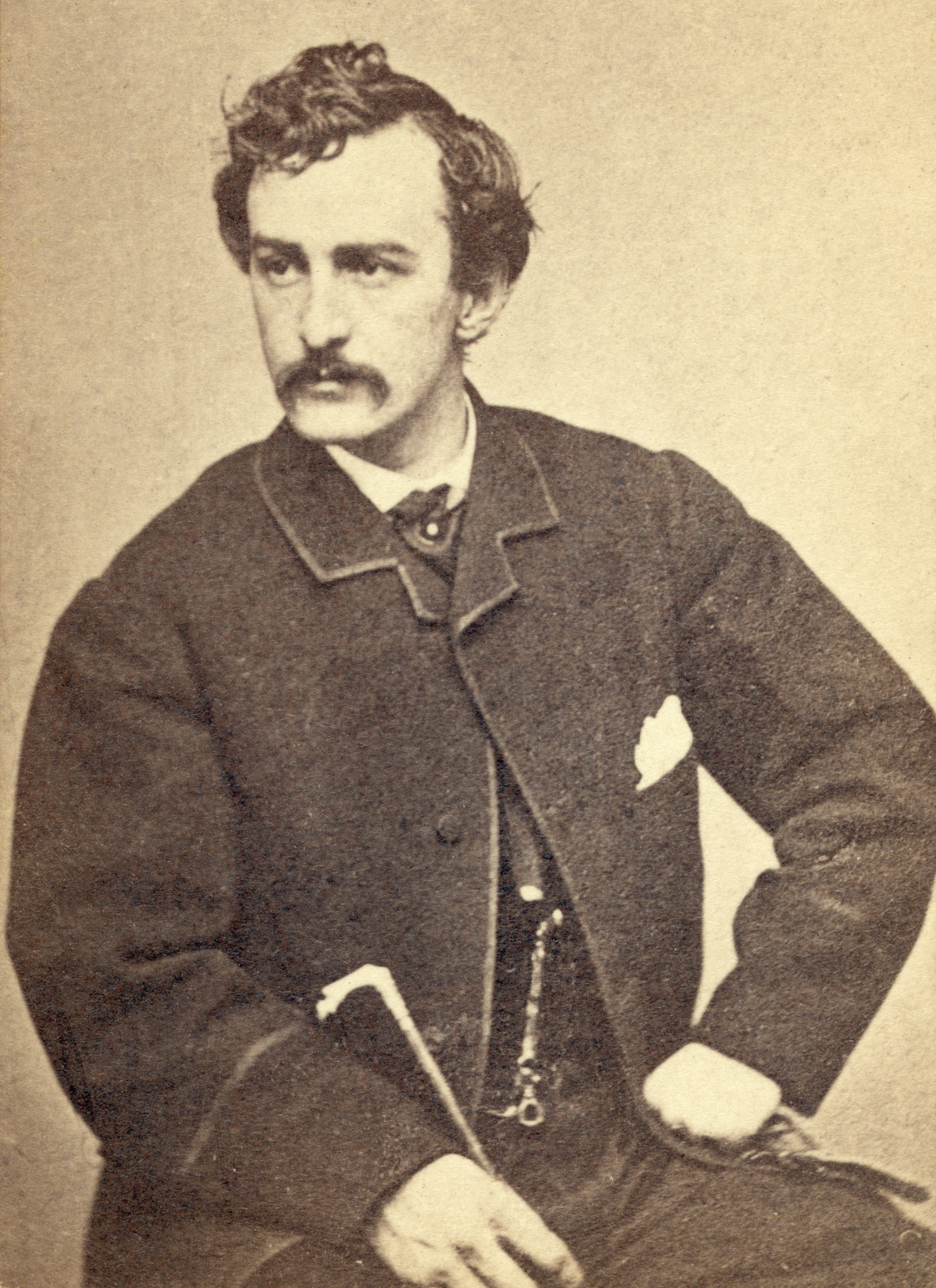
Portrait of John Wilkes Booth
The Last Scene He Would Ever Play
On the night of April 14, 1865, the most famous face in American theater walked into a private box at Ford's Theatre carrying a single-shot derringer and a knife, and did what he had spent his entire adult life training to do: he seized a moment, in front of an audience, and made it irreversible. John Wilkes Booth was twenty-six years old, a matinee idol from the country's most celebrated acting dynasty, and by the time he leapt from the presidential box to the stage below — breaking his leg on the landing, shouting the Virginia state motto Sic semper tyrannis to a theater full of witnesses — he had converted an assassination into a performance and a performance into a legend, at least in his own accounting.
Booth was a ESTP, and the diagnosis is not incidental to the crime. He was a creature of the present tense: physically magnetic, restless, addicted to the electricity of a live crowd's reaction, and almost entirely unmoored from the kind of long-range political reasoning that might have told him what, precisely, killing Lincoln would accomplish for the cause he claimed to serve. What he had instead was nerve — the improvisational tactical cool to plan and execute a coordinated, three-target attack on a single night, and then to survive twelve days as the most hunted man in the country. The kidnapping plot that curdled into murder, the leap to the stage, the diary he kept scribbling in a Virginia swamp days after Lee had already surrendered — all of it reads less like ideology than like a role an actor refused to let end.
Booth was not a man executing a plan so much as a performer who had run out of stage and decided the country itself would have to serve as one — an ESTP whose dominant Se turned an audience's gasp into the only proof of meaning he ever fully trusted.
The Matinee Idol's Body
By the time the war ended, Booth was already a star in his own right, touring the country as a leading man whose athletic swordplay and dark good looks filled houses independent of his famous surname. He was the youngest son of Junius Brutus Booth, the era's most storied tragedian, and the younger brother of Edwin Booth, whose Hamlet was considered definitive — but John Wilkes built a following on something more physical than either of them: leaps across the stage, real cuts in his fencing scenes, a swagger that read as danger even from the cheap seats. Se, dominant and unmediated, was the engine of that career. He did not analyze a role from the inside; he inhabited it kinetically, trusting his body to find the gesture the moment demanded.
That same sensory command is what let him do, on the night of April 14, what no theory of the crime fully explains: walk into a box he had scouted and rehearsed access to that afternoon, wait for the single line in Our American Cousin guaranteed to draw the loudest laugh — covering the sound of a single pistol shot — fire at point-blank range, fight off Major Henry Rathbone with a knife, and clear a twelve-foot drop to the stage on a leg that would turn out to be broken, all without hesitation. It is a sequence built entirely out of trained physical reflex and split-second read of a live room, the same faculty that had served him as an actor now serving him as a killer.
Se also explains what came after the shot: not concealment, but display. He did not slip quietly into the wings. He stood, delivered his line to an audience of hundreds, and ran — as if the manhunt that followed were simply the next act, and his job was still to be watched.
A Conspiracy, Revised on the Fly
What Booth had was not a strategist's mind but a tactician's — and the distinction matters. His first plan, assembled over the winter of 1864 – 65 with a rotating cast of Confederate sympathizers including David Herold, was to kidnap Lincoln and ransom him for Confederate prisoners of war, a scheme with a logic, however thin, tied to a still-living Confederacy. Ti, his auxiliary function, is visible in the mechanics of that plot: routes scouted, a getaway rehearsed, contacts cultivated in southern Maryland, a boarding house — Mary Surratt's — used as a safe address for arms and messages.
When Richmond fell and Lee surrendered on April 9, the entire premise collapsed, and it is here that Ti shows its limits as well as its use. Booth did not retreat from the ruin of his plan; he restructured it, in days, into something far more radical — a coordinated strike on Lincoln, Vice President Andrew Johnson, and Secretary of State William Seward on the same night, meant to decapitate the Union government in one stroke. He assigned Lewis Powell to Seward's house and George Atzerodt to Johnson's hotel, secured his own theater access through his celebrity, and executed his portion with total precision even as his accomplices' nerve failed around him. It was real logistical competence, deployed in the moment and improvised under pressure — Ti in service of Se, not Ti in service of a plan built to survive contact with tomorrow.
The escape that followed shows the same pattern. For twelve days Booth and Herold moved through southern Maryland and Virginia with genuine tradecraft — a sympathetic network, false trails, a physician (Samuel Mudd) to set his broken leg — outrunning the largest manhunt in American history until cavalry finally cornered them in a Virginia tobacco barn on April 26. It was tactical brilliance with no destination. Booth never had anywhere to go once the running stopped, because the running itself had become the only remaining plan.
Playing to a Southern Gallery
Booth's Confederate sympathies were genuine, but they arrived through an emotional, socially mediated channel rather than a reasoned political one — the hallmark of a tertiary Fe reaching for a cause large enough to match his sense of his own importance. He had never enlisted; his war was fought from theater green rooms and hotel bars, in the company of men who told him what he wanted to hear and applauded the telling. He absorbed the white Southern grievance around him the way he absorbed an audience's mood on stage — as ambient feeling to reflect back, amplified.
That same hunger for an audience's validation shaped the conspiracy's inner circle. Booth recruited less on ideological compatibility than on personal charisma and loyalty — young men like Herold and Powell who were drawn into his orbit and stayed there past the point of good sense, and a boarding house proprietor, Surratt, whose fate would be bound to his regardless of how much she actually knew. He needed accomplices who believed in him specifically, not merely in the cause, and he got them.
Even his justification for the killing was composed for an imagined public. In the diary he kept during the manhunt, he complained, astonished, that the newspapers were calling him a coward and a common murderer rather than the man who had struck down a tyrant — as though the nation's applause were a debt owed him. Fe, in Booth, was never really about others' wellbeing; it was about others' verdict on him.
A Myth Written in the Present Tense
Ni sits at the bottom of Booth's stack, and its absence is the clearest thing about him. There was no coherent vision of what killing Lincoln would actually produce — no plan for a Confederate government that no longer existed, no theory of what a leaderless Union would do next, no accounting for the fact that the war he claimed to be avenging had already been lost days earlier. The act was conceived and reconceived in the space of a week, driven by the collapse of everything Booth had staked his self-image on, and it stopped at the moment of the deed itself, as though the shot were the entire argument.
The diary entries he wrote while hiding in the Virginia woods are the clearest evidence of that foreclosed horizon. Rather than reasoning forward — what happens now, what does this mean in five years — Booth wrote backward, defensively, insisting that history would vindicate him even as the countryside filled with soldiers hunting him down. It is not the writing of a man with a long-range plan; it is the writing of a performer trying, too late, to control the reviews.
He got twelve days of flight and a barn in Virginia, not a legacy of the kind he imagined. Cornered by cavalry on April 26, 1865, he was shot — by a soldier acting against orders, or by his own hand; the record has never fully settled it — and died on the porch of the farmhouse asking to see his hands, which he could no longer move. It is a small, terrible irony that the man whose entire identity had been physical command ended asking only to feel his own body again.
Why ESTP Over ENFP
Why not ENFP?
An ENFP's grandiosity runs on Ne-fed possibility and idealistic advocacy — a conviction that some better, unrealized world is reachable through inspired persuasion. Booth's grandiosity ran on nothing so abstract: it was a performer's literal hunger for a final unforgettable scene, staged with a trained body and executed with cold, in-the-moment tactical logic rather than improvised inspiration. He did not dream up a cause and chase it; he found a cause already collapsing and used it as a stage for a role he had been rehearsing his whole career.
Every diagnostic marker points the same direction. The dominant function is sensory and immediate, not intuitive and expansive — Booth read a room, a box, a single sentence in a comedy timed to a gunshot, not a distant political horizon. The follow-through was tactical improvisation under pressure, not the enduring architecture of belief an ENFP sustains for years. And the payoff he sought was not a better world but a verdict on himself, delivered by an audience he could still, even fleeing through the Virginia dark, half-believe was watching.
Connected Figures
Further Reading
- Manhunt: The 12-Day Chase for Lincoln's Killer — James L. SwansonA minute-by-minute account of Booth's flight and capture.
- American Brutus: John Wilkes Booth and the Lincoln Conspiracies — Michael W. KauffmanThe definitive study of the conspiracy's planning and evolution.
- Fortune's Fool: The Life of John Wilkes Booth — Terry AlfordA biography tracing Booth's acting career and psychology from childhood.
