 Historical Figure MBTI
#794 · 6-12-26 · The American Civil War
William H. Seward
The Rival Who Became the Right Hand
1801–1872
11 min read
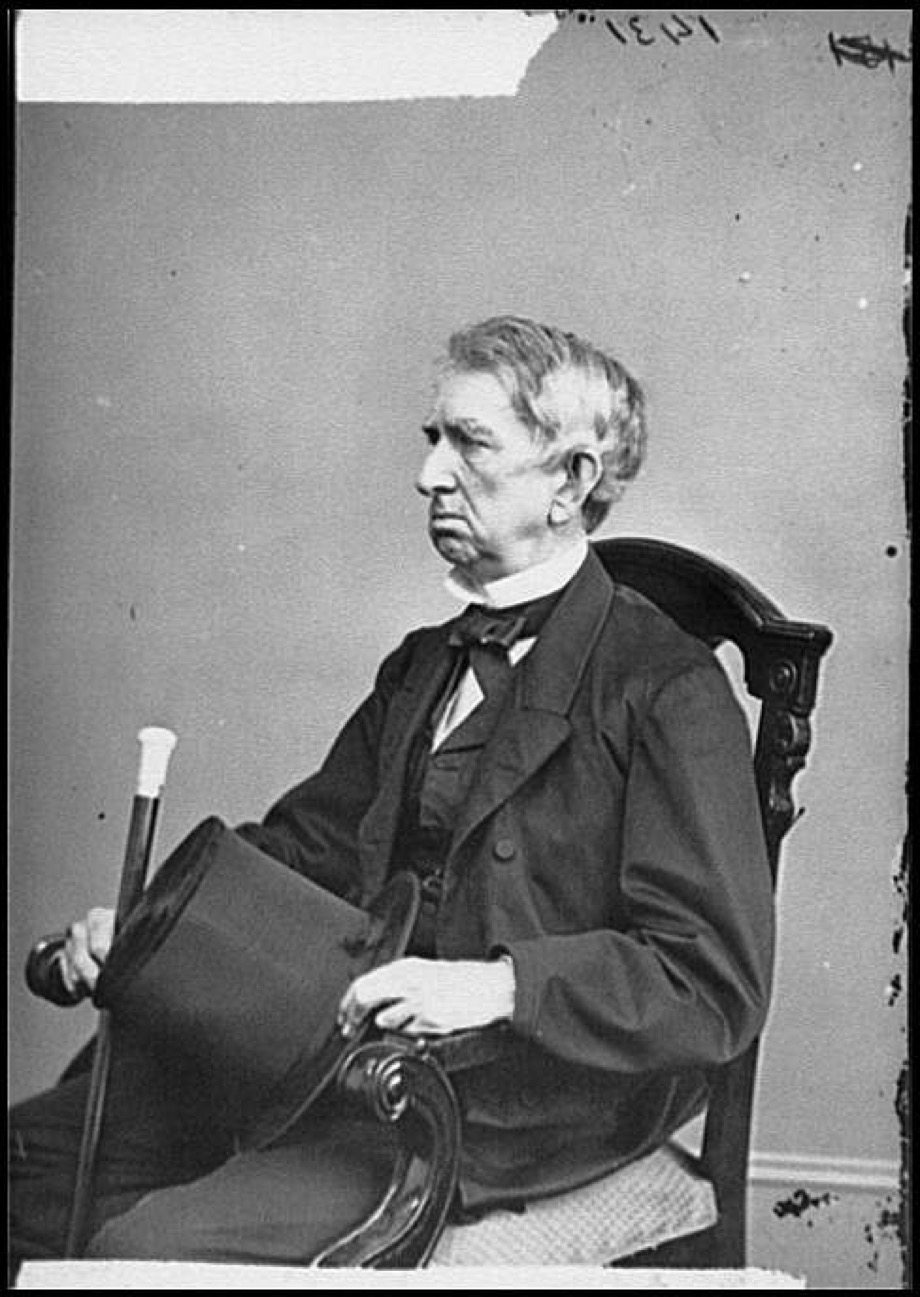
Portrait of William H. Seward
The Man Everyone Expected
In the spring of 1860, if you had asked almost anyone in the American North who would lead the Republican Party into the presidency, the answer came without hesitation. William Henry Seward of Auburn, New York — former governor, sitting senator, the man who had told the Senate in 1850 that there was “a higher law than the Constitution” and warned the country in 1858 that it faced an “irrepressible conflict” — had been the movement’s voice for a decade. He was witty, restless, endlessly quotable, forever with a cigar in his hand and a scheme in his head. He had made the argument that everyone else was still catching up to. He went to Chicago that May as the presumptive nominee, and lost on the third ballot to a one-term congressman from Illinois whose chief qualification was that he had said less.
What happened next is the part of Seward’s life that actually reveals him. He took the State Department believing the office made him prime minister to a figurehead — and said so, in writing, on the first of April 1861, in a memorandum proposing that the administration provoke a war with Spain and France to shock the seceded states back into the Union, and that Lincoln delegate the whole business to someone who could pursue it energetically. He meant himself. Lincoln replied the same day, quietly, without leaking a word of it, and Seward never raised the idea again. Within a year he was the president’s closest ally in the cabinet, and by 1863 the two men were spending evenings together while Salmon Chase wrote letters about how the Secretary of State was ruining the country.
That arc — brilliance, overreach, correction, loyalty — is the signature of a mind that generates possibilities faster than it commits to them. Seward was an ENTP: dominant Extraverted Intuition, always three moves out and four options wide; auxiliary Introverted Thinking that could dismantle a constitutional argument like a lawyer taking apart a bad contract; tertiary Extraverted Feeling that made him the most charming man in Washington and the most useful; and an inferior Introverted Sensing that gave him almost no instinct for what was actually, presently true about the man sitting across the table from him — until the evidence became impossible to ignore, at which point he simply revised.
The ENTP’s great gift is not being right first. It is being able to stop being wrong without being broken by it.
Ne — The Irrepressible Conflict
Seward’s two most famous phrases were both acts of reframing. In March 1850, arguing against the Compromise then being assembled by Henry Clay, he refused to fight on the ground everyone else had chosen — the text of the Constitution, the arithmetic of free and slave states — and instead moved the whole dispute somewhere the other side could not follow: the national domain was held under a higher law than the Constitution, and no clause could license what that law forbade. It was politically reckless and it defined him for a decade. Eight years later at Rochester he did it again, telling an audience that the collision between free labor and slave labor was not the work of agitators or accidents but an irrepressible conflict between two incompatible systems, and that the United States would sooner or later become entirely one thing or entirely the other. Neither speech reported a fact. Each supplied a lens, and the country adopted both.
This was how his mind ran on every subject. As governor of New York in the late 1830s he proposed public funding for schools that taught immigrant children in their own languages, which was so far ahead of the Whig consensus that it nearly cost him his party. As senator he was forever sketching continental futures — Pacific railroads, telegraph lines to Asia, an American commercial empire reaching across the water. Long after the war his appetite for the grand geopolitical scheme produced the purchase of Alaska, mocked at the time as an icebox bought with public money by a man who could not stop acquiring things. The mockery missed the point: Seward was not acquiring territory, he was acquiring options.
Dominant Ne also explains the failure. The April 1861 memorandum — “Some Thoughts for the President’s Consideration” — is a document of pure possibility unchecked by any sense of the actual. Provoke Spain and France; convert a civil war into a foreign one; let the shared enemy do what argument could not. As a piece of lateral thinking it is genuinely ingenious. As a reading of the world in April 1861 it was fantasy, and it arrived with an offer to run the government on Lincoln’s behalf. The idea was too clever and too fast, which is the characteristic way this function fails.
Ti — The Lawyer’s Knife
Beneath the improviser was a working attorney of real technical severity. In 1846 Seward defended William Freeman, a Black man of shattered mind who had murdered four members of a family near Auburn, and did it in a town that wanted him hanged within the week. He took no fee and built the defense on a proposition the common law had barely begun to accommodate: that criminal responsibility requires a mind capable of knowing what it does, and that the question before the jury was therefore medical before it was moral. He lost the verdict. The appellate court later agreed with him. The whole performance was Ti in its purest form — an argument built to be internally correct whether or not anyone was persuaded by it.
The same faculty disciplined his diplomacy. When the Union navy seized two Confederate commissioners from the British mail steamer Trent in November 1861 and the northern public celebrated, Seward saw that the celebration was the danger. Britain was arming. He spent weeks working the problem down to its legal joints and then wrote a dispatch that released the prisoners while conceding nothing — Captain Wilkes had acted without instruction, and the seizure was invalid precisely because he had failed to bring the ship before a prize court, which is to say that the United States was surrendering the men in defense of the very neutral-rights doctrine it had asserted against Britain since 1812. The Americans got to be right about the principle and rid of the crisis at once. It is a lawyer’s solution, and it kept the Royal Navy out of the war.
Ti is also why his charm never curdled into sentiment. Seward talked constantly and gave away very little; colleagues who left his study delighted often noticed afterward that they had learned nothing. He held the framework privately and spent the words freely, which is the standard ENTP arrangement and the reason so many people found him impossible to pin down.
Fe — The Cigar and the Open Door
Seward was the most sociable man in wartime Washington, and he used it as an instrument. His house on Lafayette Square kept an open table where senators, generals, and the entire diplomatic corps were fed and flattered and gently sounded out; the British minister Lord Lyons, who had every reason to distrust him after the bluster of 1861, came to regard him as a man he could do business with. Foreign policy in those years was conducted less through notes than through evenings, and the evenings were Seward’s. Tertiary Fe of this kind is not warmth exactly — it is a finely calibrated read of the room, deployed on purpose.
It is also what made the recovery after April 1861 possible. A man with a colder relation to other people would have nursed the humiliation of that memorandum and gone to war with the president who had absorbed it. Seward did the opposite: he attached himself. He came to like Lincoln enormously, told his wife Frances so, and spent the rest of the war as the one cabinet officer who could walk into the president’s office at any hour with a joke and leave having settled something. John Hay, who watched all of them daily and was generous to almost none of them, thought Seward the ablest and the most companionable of the lot.
The cost of tertiary Fe is that it wants to be central. Much of Seward’s early trouble came from an assumption that his indispensability was obvious to everyone; in December 1862 a Senate caucus, egged on by allies of Chase, demanded his removal, and he resigned at once rather than be fought over. Lincoln extracted a matching resignation from Chase, held both, and returned them — a maneuver that would not have worked if Seward had not been willing to be sacrificed. He wanted to be needed, and he was, and he knew the difference between the two.
Si — The Thing In Front of Him
Inferior Si shows up as a persistent failure to see what is plainly there. Seward arrived in the cabinet with a settled picture of Lincoln — provincial, untried, lucky, a man who had won a nomination that belonged to someone else — and that picture was assembled entirely from inference. He had barely observed the man. The April memorandum is what happens when a mind that reasons brilliantly from possibility never checks the possibility against the room. It took months of daily contact, of watching Lincoln handle Fort Sumter and the border states and his own generals, before Seward wrote home that the president was the best of them and had no equal in the government.
The same blind spot ran through his politics. He had spent the 1850s predicting the conflict and almost nothing of the 1850s preparing for it; in the secession winter of 1860–61 he assured audiences that the crisis would pass in sixty days, because his sense of the country was built from arguments rather than from anything he had counted. He underrated the Confederacy’s staying power well into the war, and his early bluster toward Britain — the threat that a foreign power recognizing the South would be wrapping the world in flames — nearly produced the catastrophe he was trying to prevent.
But the inferior function is not only a wound, and Seward’s handling of his was unusually healthy. He did not defend the memorandum. He did not build a faction to prove he had been right. He absorbed the new data, revised the model, and redirected the whole apparatus of his intelligence toward making the corrected picture work. That is Ne functioning as it should — not clinging to the first idea because it was his, but abandoning it the instant a better one is available, even when the better one costs him the premiership he came to Washington to hold.
Why ENTP Over INTP
Why not INTP?
The legal precision of the Freeman defense and the Trent dispatch can look like dominant Ti, and Seward had more analytical rigor than his reputation as a talker suggests. But an INTP leads with the framework and reaches outward for possibilities to test against it; Seward led with the possibility and built the framework afterward, sometimes days afterward, sometimes never. The “higher law” and “irrepressible conflict” speeches were launched before their implications were worked out, and both had to be walked back under fire — an INTP would have anticipated the objections first and published second. And the energy is wrong: Seward thought out loud, in company, with a cigar going and a room to try it on, and grew visibly duller when left alone with a problem.
The tell is the recovery itself. A dominant thinker who had staked his standing on a plan as public as the April memorandum would have needed the plan to be defensible; the framework, once built, is the thing an INTP protects. Seward protected nothing. He dropped the scheme the way an ENTP drops any hypothesis that stops earning its keep, kept the relationship, and turned the same generative intelligence to a different problem — how to keep Britain and France out of a war the Confederacy needed them to enter. He solved that one. The man who lost the presidency in 1860 spent the next four years being more useful than most of the people who beat him, which is the ENTP’s peculiar consolation: the ideas were never the point of him, the capacity to keep producing them was.
Connected Figures
Further Reading
- Seward: Lincoln's Indispensable Man — Walter StahrThe standard modern biography, and the fullest account of the April 1861 memorandum and its aftermath.
- Team of Rivals: The Political Genius of Abraham Lincoln — Doris Kearns GoodwinPlaces Seward inside the cabinet alongside Chase and Stanton; strongest on the 1860 convention and the December 1862 crisis.
- William Henry Seward: Lincoln's Right Hand — John M. TaylorA compact narrative life, useful on the New York years and the wartime diplomacy.
- One War at a Time: The International Dimensions of the American Civil War — Dean B. MahinDetailed treatment of the Trent Affair and the campaign to keep Britain and France from recognizing the Confederacy.
