 Historical Figure MBTI
#1126 · 8-21-26 · The Fall of the Han
Emperor Ling of Han
The Boy-Emperor · Palace Bazaar · The Throne That Sold Itself
156 – 189 CE
8 min read
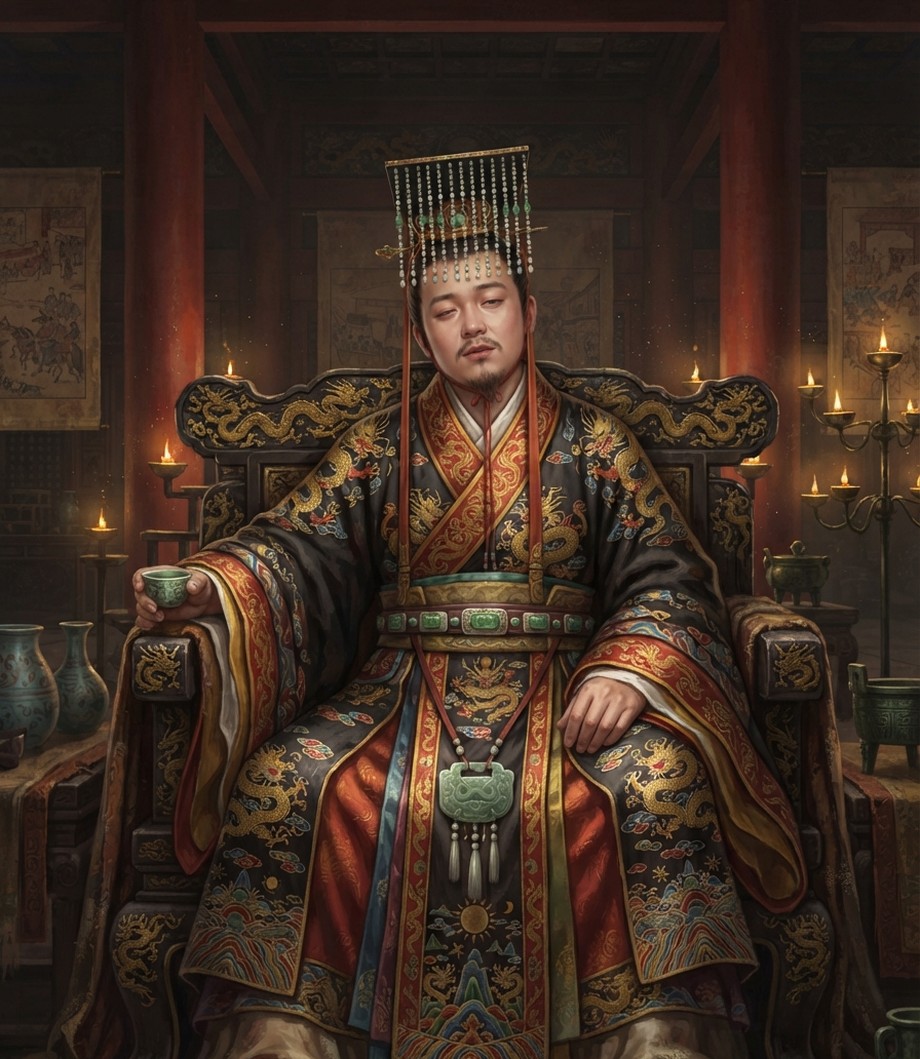
AI-assisted Portrait of Emperor Ling of Han
The Emperor Who Built a Market Inside His Own Collapse
Picture the throne room of the Later Han not as a seat of policy but as a stage set, dressed and redressed for whatever amused the man sitting on it that week. Emperor Ling was installed as a teenager by a court faction after his predecessor died heirless, handed an empire already buckling under drought, famine, and a tax burden the countryside could no longer absorb — and he responded to all of it by turning the palace grounds into a toy bazaar. He had stalls built. He had palace women dress as merchants and shoppers. He haggled, in character, over pretend goods, while officials outside the walls wrote memorial after memorial describing real granaries standing empty.
That single image — an emperor playing shopkeeper while his empire starved — is the whole man in miniature, and it is why ESFP fits him more precisely than any grander diagnosis of tyranny or incompetence. He was not building an ideology or hoarding power for its own sake. He was chasing the immediate, textured pleasure of the present moment, and he built the machinery of the state to deliver it to him faster.
Ling governed the way an ESFP shops — for the feeling of the transaction, not the thing it buys — and he sold the price list for the whole dynasty to keep the feeling going.
The Bazaar in the Palace
No other detail in Ling's reign does as much work as the mock marketplace. This was not a metaphor invented by later historians to condemn him — it was a physical structure, built to his specification, stocked and staffed so that he and his consorts could act out buying and selling for the sheer sensory pleasure of it: the haggling, the coin changing hands, the performance of ordinary commerce turned into court entertainment. It is Se in its purest form — attention riveted to the concrete, textured, immediate present, with no interest in what the activity means or where it leads.
The same appetite drove the office-selling scheme that made his court notorious. Ling did not merely tolerate corruption — he formalized it, posting an actual price list scaling the cost of a governorship or a ministerial seat to its rank, and pocketing the proceeds to fund his own extravagance. Read as policy, it is disastrous; read as psychology, it is consistent. He converted an abstract, future-facing asset — institutional legitimacy, the loyalty of a competent bureaucracy — into cash he could spend on pleasure he could feel that afternoon. A dominant Se user discounts the future automatically, not out of malice but because the present is simply where all the reality lives.
Even his neglect of the Yellow Turban warnings fits this pattern better than simple stupidity does. Rural rebellion is slow, diffuse, statistical — the kind of threat that only registers to a mind willing to sit with abstraction and project consequence forward in time. Ling had neither the instinct nor the interest. Zhang Jiao's movement grew for years in plain sight of officials who begged the court to act; Ling kept redecorating his bazaar.
Loyalty to Faces, Not to Office
Ling's reliance on a small eunuch faction, above all Zhang Rang, is often read as simple manipulation — cunning courtiers exploiting a weak ruler. But the relationship reads just as plausibly the other way around: Ling favored the men who were personally, physically present to him, who had earned his private trust across years of proximity, over the abstract, credentialed authority of the Confucian scholar-officials he barely knew. That is auxiliary Fi doing its ordinary work — anchoring loyalty in individual, felt bonds rather than in institutional role.
It is a decent instinct pointed at a catastrophic target. Fi asks "do I trust this person," not "does this system function," and Ling kept answering the first question in favor of Zhang Rang's household while the second question — whether the empire's administrative machinery still worked at all — went unasked for a decade. He was capable of real, warm attachment; he simply never extended it to people he did not personally know, which meant the millions of tenant farmers filing petitions about famine and taxation had no purchase on him at all. Zhang Rang had a face. The rural poor, to Ling, did not.
The scholar-officials who tried repeatedly to warn him about the Yellow Turban movement's growth were, from Ling's seat, exactly the wrong kind of messenger — formal, censorious, appealing to duty and precedent rather than to any bond he actually felt. He did not so much refute their warnings as fail to register them as coming from anyone who mattered to him.
The Price List
The one piece of genuine administrative competence in Ling's reign is, damningly, the office-selling scheme itself. It was not casual graft — it was organized. A schedule existed, prices scaled deliberately to rank, the whole apparatus run with enough consistency that historians can still reconstruct roughly what a governorship cost versus a ministerial seat. That is tertiary Te surfacing exactly where an ESFP's Te tends to surface: not as a governing philosophy, but as an efficient, results-oriented system built in service of something the dominant function already wanted.
It is worth noticing how narrow that competence was. Ling never applied the same organizing energy to famine relief, to tax reform, or to the provincial garrisons that might have blunted the Yellow Turban rising before it became an existential threat. Te for the ESFP tends to arrive as a burst of practical follow-through in service of an immediate goal, not as sustained institutional stewardship — and selling offices for cash he could enjoy now was, for Ling, the immediate goal that got the machinery built.
The Succession He Never Named
Inferior Ni is the function that should have told Ling what came next, and it is the function that failed him most completely, twice over. First with the Yellow Turbans: the movement built for years under conditions — chronic disaster, unaddressed famine, an untaxable peasantry pushed past endurance — that were visible to any observer willing to project a pattern forward across time. Ling was not that observer. The rebellion did not arrive as a surprise to his court; it arrived as a surprise to him, because he had never let the warning signs cohere into a picture of the future.
Second, and more fatally, with his own succession. A ruler with any working long-range function does not die without a clear, uncontested heir — the single most foreseeable catastrophe available to a monarch is the vacuum his own death creates. Ling let that vacuum open anyway, and the empire fell straight through it: his sons' rival claims handed the field to He Jin's regency, the eunuch massacre that followed, and Dong Zhuo's seizure of the capital. It is the ESFP's characteristic blind spot rendered at the largest possible scale — a mind built for the vivid present, standing at the one moment in his life when only the future mattered, and finding nothing there.
Why ESFP Over ESTP
Why not ESTP?
An ESTP reading captures the impulsiveness — the same appetite for present-tense sensation, the same disregard for delayed consequence — but misses what made Ling's indulgence specifically social rather than solitary. The palace bazaar was not a private thrill; it was theater, staged for an audience of his own court, and it required willing performers dressing the part alongside him. His governance ran the same way, built around maintaining a warm, personally loyal inner circle rather than the colder, transactional competence a Ti-backed ESTP brings to manipulating a system for advantage. Ling did not out-maneuver his court. He surrounded himself with people he liked.
The distinction is Se-Fi against Se-Ti, and it is the difference between a man chasing a feeling and a man chasing an edge. Ling's court was never a game he was trying to win — it was a room he was trying to enjoy, furnished with people who made him feel comfortable and cash he could spend on making the room more enjoyable still. That is a recognizably ESFP failure mode, not an ESTP one: the empire did not fall to a schemer. It fell to a host who never stopped throwing the party.
Connected Figures
Further Reading
- Fire over Luoyang: A History of the Later Han Dynasty — Rafe de CrespignyThe standard account of Emperor Ling's court and its collapse.
- A Biographical Dictionary of the Later Han to the Three Kingdoms — Rafe de CrespignyEntry on Emperor Ling.
- Everyday Life in Early Imperial China — Michael LoeweBackground on Han court and provincial administration.
