 Historical Figure MBTI
#1125 · 8-20-26 · The Mauryan Empire
Nagarjuna
Buddhism's Sharpest Philosopher
c. 150 – 250 CE
5 min read
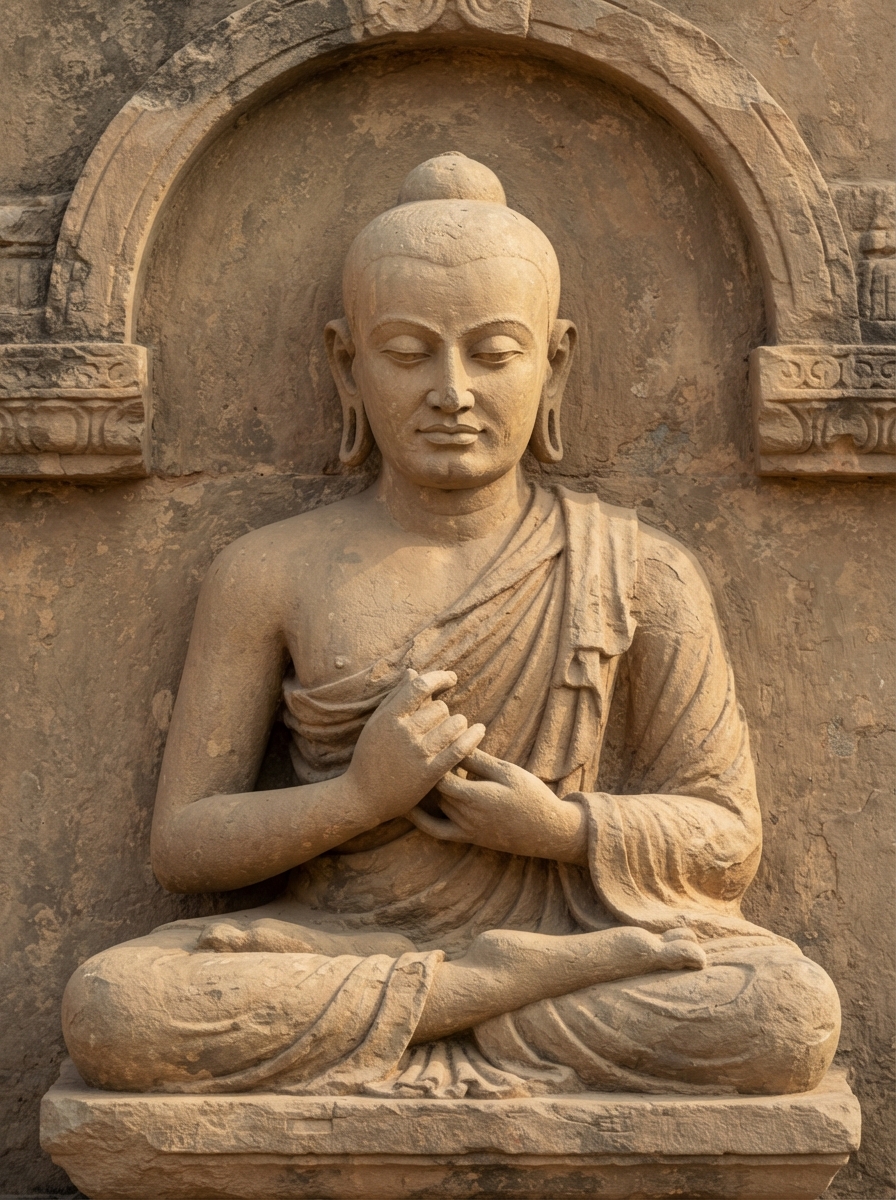
AI-assisted Portrait of Nagarjuna
The Monk Who Argued Everything Down to Nothing
Somewhere in southern India, centuries after the Buddha's death, a monk sat down to finish an argument the tradition had left half-made. The Buddha had taught that the self was not a fixed, independent thing — that what we call "I" is a shifting bundle of conditions, arising only in relation to other conditions. Generations of scholastic Buddhist philosophers, the Abhidharma schools, had taken that insight and quietly rebuilt a metaphysics on top of it: a universe of discrete, momentary, ultimately real building blocks (dharmas) out of which the illusion of self was constructed. Nagarjuna looked at this tidy inventory of ultimate particles and did something almost nobody in the tradition had dared — he turned the Buddha's own logic against it.
His weapon was not mysticism or revelation but argument, relentless and symmetrical. In the Mulamadhyamakakarika, verse after verse, he takes up cause and effect, motion, time, the self, even the Buddha and nirvana themselves, and shows that each concept collapses under its own claim to independent, "own-being" existence (svabhava). Nothing exists in itself; everything exists only interdependently, which he called shunyata — emptiness. It is one of the most demanding philosophical performances to survive from the ancient world, and it reshaped Mahayana Buddhism, in India, Tibet, China, and beyond, for the next two thousand years.
Nagarjuna was an INTP, and the Mulamadhyamakakarika reads like Ti dominance given scripture: a mind that will not let a single concept stand until it has been tested, taken apart, and shown its own contradiction.
The Dialectic That Spared Nothing, Not Even Itself
Nagarjuna's signature move is the tetralemma: for any proposition, he shows it cannot be affirmed, cannot be denied, cannot be both affirmed and denied, and cannot be neither. Applied to causation, this dismantles the idea that an effect could arise from itself, from something wholly other, from both, or from neither — leaving only dependent origination, causation without any fixed, self-existing cause. It is a formal, almost mathematical method, indifferent to which school it wounds. Rival Buddhist Abhidharma metaphysicians, who had spent centuries cataloguing the ultimate constituents of reality, found their entire system treated the same way he treated a Hindu logician's argument for a permanent self: taken apart clause by clause until nothing was left standing.
What marks this as Ti rather than mere polemics is that Nagarjuna turns the blade on his own conclusions too. Emptiness, he insists, is not itself a thing to grasp, not a new ultimate substance replacing the old ones — to reify shunyata as some final truth would be to commit exactly the error he had just diagnosed in everyone else. He calls his own method a "raft," useful for crossing, not a possession to be carried on the far shore. That is dominant introverted thinking at its most severe: a system built not to arrive at a doctrine but to keep testing every doctrine, including its own, against the standard of internal consistency.
Chasing the Argument Wherever It Led
Where Ti supplied the rigor, Ne supplied the reach. Nagarjuna did not confine his method to one target; he ran it across the entire philosophical map of his day — causation, time, motion, perception, the self, karma, even nirvana and the Buddha's own status — treating each as a fresh instance of the same underlying pattern. That willingness to keep generating new applications of a single insight, rather than settling for having refuted one rival school, is the auxiliary function's exploratory signature: possibilities multiplying outward from a core principle.
It shows too in how unafraid he was of paradox as a teaching tool. Later tradition remembers him less as a systematizer laying brick on brick than as a wandering interlocutor — debating, provoking, reframing — willing to let a startling formulation (nirvana and samsara are, in the end, not different) sit unresolved if that was where the logic actually pointed. A more closed, judging mind would have smoothed the paradox into a tidier conclusion; Nagarjuna let the tension stand, trusting the reader to work through it rather than be told the answer.
Why INTP Over INTJ
Why not INTJ?
An INTJ philosopher builds — a dominant Ni vision compressed by Te into a single systematic doctrine, meant to be applied and defended. Nagarjuna does the opposite. His primary mode is deconstruction for its own sake: he dismantles every fixed position he encounters, including the provisional conclusions of his own method, and refuses to let emptiness harden into a new metaphysical stronghold. That refusal to settle into a final architecture, that insistence on testing rather than building, is dominant Ti working through concepts, not Ni-Te building a system to stand on.
The tell is what Nagarjuna does with his own conclusions. An INTJ treats a conclusion as a foundation for the next tier of the system; Nagarjuna treats every conclusion, including "all things are empty," as itself subject to the same corrosive analysis, a raft to be abandoned rather than a wall to build on. That is the mark of a mind organized around internal logical consistency (Ti) restlessly generating new applications (Ne), not one organized around a single unfolding vision.
Connected Figures
Further Reading
- The Fundamental Wisdom of the Middle Way: Nagarjuna's Mulamadhyamakakarika — trans. Jay L. GarfieldThe standard English translation, with a philosophical commentary that walks through the argument chapter by chapter.
- Nagarjuna's Madhyamaka: A Philosophical Introduction — Jan WesterhoffA rigorous modern analytic reconstruction of the core arguments and their logical structure.
- Empty Words: Buddhist Philosophy and Cross-Cultural Interpretation — Jay L. GarfieldEssays situating Madhyamaka thought against Western philosophical traditions.
- The Central Philosophy of Buddhism: A Study of the Madhyamika System — T. R. V. MurtiA classic, if now-contested, survey of the school's place within Indian philosophy.
