 Historical Figure MBTI
#1123 · 8-20-26 · The Mauryan Empire
Ashoka
The Conqueror Who Renounced War
c. 304 – 232 BCE
11 min read
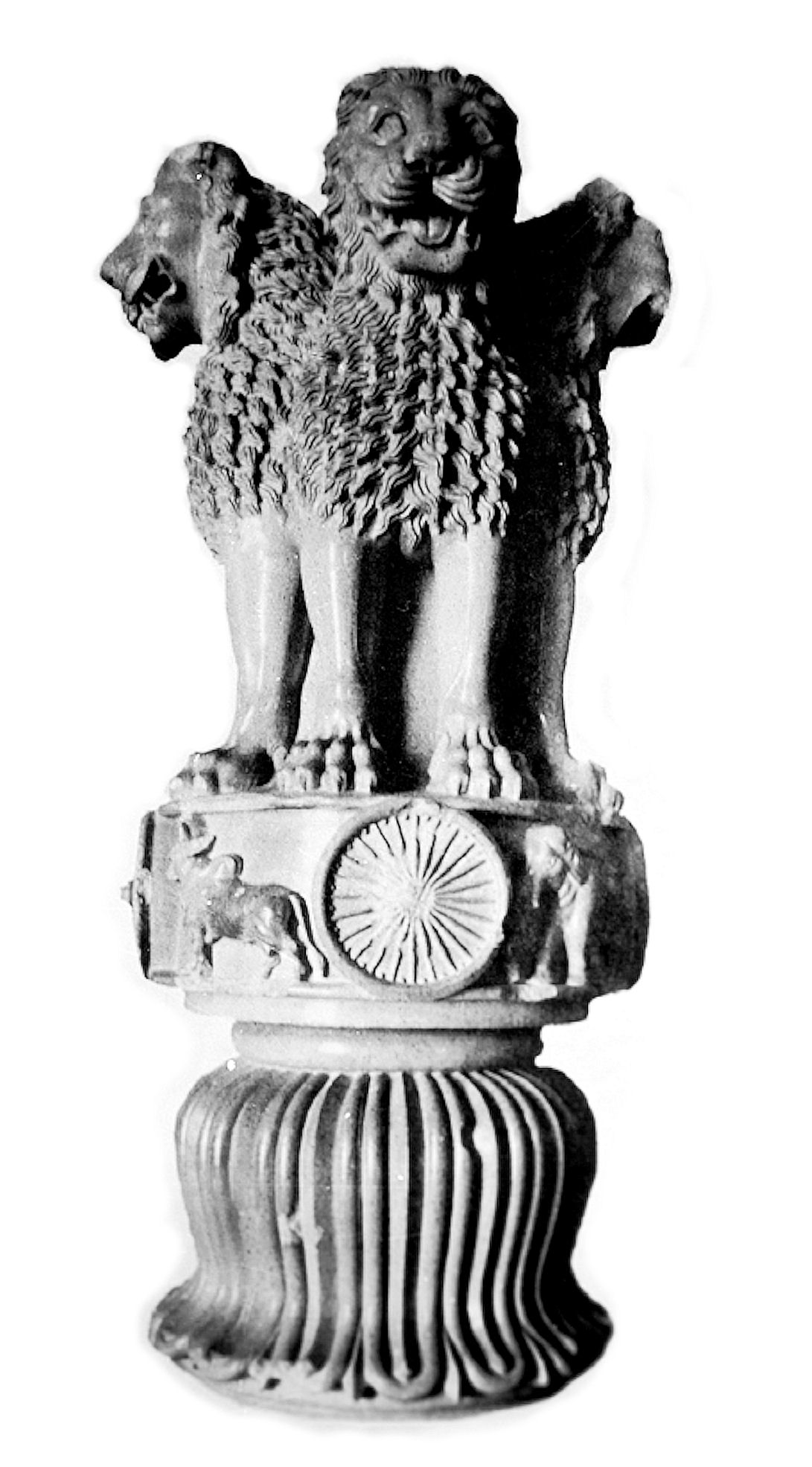
Lion Capital of Ashoka, Sarnath (3rd century BCE)
The Only King Who Published His Own Guilt
Almost every ancient monarch left behind a record of victories. Ashoka left behind a confession. Carved into a rock face at Girnar, and repeated across a subcontinent, the Thirteenth Major Rock Edict states that in the conquest of Kalinga one hundred and fifty thousand people were deported, one hundred thousand were killed, and many times that number perished afterward — and that the king, having done this, felt remorse. No Assyrian relief says such a thing. No Roman triumphal arch. Rulers of the ancient world commissioned stone to make their killing permanent; Ashoka commissioned stone to make his shame permanent, and then to bind his successors to a policy of not repeating it.
He had not begun as a moralist. The Mauryan throne he inherited around 268 BCE was the largest political machine India had ever produced — assembled by his grandfather, extended by his father, administered by a bureaucracy of spies, tax assessors, and provincial governors that a Greek ambassador had once described with something close to alarm. Later Buddhist tradition, writing centuries after the fact and with obvious relish for the contrast, remembered a young prince who fought his way to the succession over the bodies of his brothers and earned the name Chandashoka — Ashoka the Cruel. The tradition is almost certainly exaggerated. But the shape of the story survives even after the exaggeration is subtracted: a competent, conventionally ambitious emperor who kept doing what Mauryan emperors did, until Kalinga.
What happened afterward is the genuinely strange part, and it is not adequately explained by the word "conversion." Ashoka did not retire to a monastery. He stayed emperor. He kept the army, kept the treasury, kept the roads. What he changed was the answer to the question of what all of it was for — and then, with an administrator's thoroughness and a preacher's urgency, he rebuilt the state's public voice around that answer and had it inscribed in stone in three scripts so that Greek-speaking subjects in Kandahar and Prakrit-speaking farmers in Bihar would each hear it in their own language.
Ashoka is the ancient world's clearest case of dominant Fe in possession of an army: a ruler whose deepest instinct was to reshape how an entire population felt and behaved, and who, once his conscience turned, turned the whole apparatus of empire with it.
The Conscience That Outranked the Crown
Extraverted Feeling is not gentleness. It is the compulsion to take responsibility for the emotional and moral condition of other people — and in a man holding absolute power over perhaps fifty million subjects, it becomes something closer to a governing philosophy. The proof of it in Ashoka is not that he felt bad about Kalinga. Conquerors have regrets. The proof is what he did with the feeling: he made it public, official, and binding, and he addressed it to the people he had harmed rather than to posterity. The Thirteenth Edict explicitly says that what weighs on him is the suffering of the innocent — householders, ascetics, the friends and relatives of the dead. He was not mourning a strategic error.
The policy that followed reads like Fe institutionalized. He planted shade trees and dug wells along the highways, at intervals, for travelers and animals. He established what the Second Rock Edict calls medical treatment for humans and for beasts, and had healing herbs imported and planted where they did not grow. He restricted the royal kitchen's slaughter of animals and published the reduction. He instituted the dhamma-mahamatras — officers whose entire brief was the moral welfare of the population, including the welfare of prisoners, and who were told to look after the aged, the destitute, and the families of the condemned. He granted three days' reprieve to those sentenced to death so their relatives could plead for them or so they could prepare their minds. These are not the acts of a man optimizing a state. They are the acts of a man who cannot stop caretaking.
And the caretaking extended pointedly to people who did not share his beliefs. The Twelfth Rock Edict is one of the earliest surviving statements of religious tolerance anywhere, and it is not a bland one: Ashoka orders that all sects be honored, forbids the praise of one's own sect and the disparagement of others, and argues that a man who exalts his own faith by condemning another's injures his own faith most of all. He was a declared Buddhist endowing Brahmins, Jains, and Ajivikas. That is Fe's characteristic move — the harmony of the whole community weighted above the vindication of one's own position — executed at imperial scale.
Dharma as a Total Replacement Theory of Empire
Remorse alone produces abdication, or penance, or nothing. What made Ashoka's remorse historically consequential was that it fused, in his mind, into a single unifying vision: that the purpose of the state was not extent but ethical cultivation, and that a king's real conquest was the conquest of hearts. He gave it a name — dhamma, dharma, the moral law — and the Thirteenth Edict makes the substitution explicit, declaring dhamma-vijaya, conquest by righteousness, to be the only conquest worth having, and stating that he considers it the chief conquest even when won in distant lands.
Introverted Intuition shows in the totalizing coherence of the thing. His dhamma is not sectarian Buddhist doctrine transplanted onto statecraft; scholars have long noted that the edicts avoid the technical machinery of Buddhist philosophy almost entirely. What he distilled instead was a portable ethical core — obedience to parents, generosity to Brahmins and ascetics, restraint in speech, moderation in expenditure, non-injury to living things — designed to be intelligible and adoptable by a Greek, a Jain, a Brahmin, or a forest tribe alike. That is a synthesizer's abstraction, not a proselytizer's. He looked at a plural empire and saw beneath its religions a single moral pattern he believed could hold it together.
He also thought in centuries rather than reigns. The edicts repeatedly address the future: he asks that his sons and great-grandsons refrain from new conquests, that if they must conquer they show mercy and light punishment, and — most tellingly — he chose rock and pillar as his medium precisely so the message would outlast him. The Seventh Pillar Edict states outright that he had the dhamma inscribed on stone pillars and rock so that it might endure long. Ni is the function that treats the present as raw material for a foreseen future, and Ashoka was legislating for readers he would never meet. He was right to: the empire dissolved within about fifty years of his death, and the stones did not.
Carved Where People Actually Walked
A vision this abstract could easily have stayed abstract. Ashoka's tertiary Sensing is what dragged it into the physical world and left it there — hard, visible, and impossible to ignore. He did not write a treatise. He did not entrust dhamma to a priesthood or a manuscript tradition. He had it cut into living rock at Girnar, Dhauli, Shahbazgarhi, Kalsi, Yerragudi, and a dozen other sites, and onto monolithic sandstone pillars quarried at Chunar, polished to a mirror finish, hauled hundreds of miles, and raised at pilgrimage centers and along the great roads. The Sarnath pillar carries four lions back to back; the capitals are among the most technically accomplished stone-carving surviving from the ancient world.
The placement is the giveaway. The rock edicts cluster at the empire's frontiers and along its trade routes; the pillar edicts stand in the Gangetic heartland where population and pilgrimage were densest. The bilingual Greek-and-Aramaic inscription at Kandahar exists because the people in Kandahar read Greek and Aramaic. This is a man attending closely to the concrete facts of where his subjects were and what they could actually read — the opposite of a philosopher-king broadcasting into the void. He wanted the message to land on eyes, and he engineered for it.
Se also explains the physical restlessness of his later reign. He replaced the royal hunting tour — the vihara-yatra of Mauryan kings — with the dhamma-yatra, a touring circuit on which he visited ascetics and elders, distributed gold, and instructed the countryside in person. He records a pilgrimage to Lumbini, where the Buddha was born, and marked it with a pillar and a tax remission for the village, a stone that still stands and still says so. He wanted to be seen doing it. The tertiary function is often the showy one, and Ashoka's dhamma had a monumental, tactile, deliberately unmissable presence that no purely inward moralist would have bothered to build.
The Systematizer Under the Preacher
Inferior Introverted Thinking rarely produces elegance, but it produces effort — the laborious attempt to make a felt conviction internally consistent and mechanically enforceable. Ashoka's edicts are strikingly structured for religious pronouncements. They are numbered as a corpus, cross-referenced, revised, and audited. He specifies review cycles: officers are to tour every five years, and elsewhere every three, to instruct in dhamma. He orders the edicts read aloud on fixed calendar days. The Sixth Rock Edict establishes that reporters may bring him state business at any hour, wherever he is — eating, in the harem, in the park — because, he explains with something like exasperation, he is never satisfied with his exertion and the welfare of all is a debt he owes.
The Fifth Pillar Edict is the clearest specimen. It is a schedule of protected species — parrots, geese, bats, queen ants, tortoises, porcupines, squirrels, rhinoceroses, and more — plus rules against burning forests uselessly, against feeding animal to animal, against castration and branding on particular days, and a list of the fifty-six occasions on which fish may not be caught or sold. A man merely moved by compassion issues a sentiment. A man with inferior Ti building scaffolding under his compassion produces an itemized wildlife statute with a liturgical calendar attached.
And the effort shows its seams, as inferior functions do. The definition of dhamma drifts between edicts — sometimes a list of virtues, sometimes obedience, sometimes an almost circular self-reference. He worries aloud, in the Seventh Pillar Edict, about whether the policy is actually working, and settles the doubt by asserting that regulation accomplishes less than meditation on dhamma, which is a feeling-type's answer to a logical problem. His system was never a philosophy the way his contemporaries in Athens or the compilers of the Arthashastra built philosophies. It was a conviction wearing an administrative exoskeleton, and the exoskeleton was the part he had to build by hand.
Why ENFJ Over ESFJ
Why not ESFJ?
The Fe is not in question — the welfare officers, the shade trees, the medical provision, the three-day reprieve for the condemned all point the same way. What separates Ashoka from the ESFJ pattern is the content of what his Feeling served. ESFJ Fe stabilizes and maintains: it defends the community's existing norms, honors the received order, and measures rightness against inherited custom. Ashoka did the opposite. He took the one practice his dynasty, his caste order, and the whole political tradition of the ancient world agreed was the proper business of a king — conquest — and declared it a moral failure, in writing, permanently. He then replaced the state's legitimating ideology with an abstraction of his own construction, dhamma-vijaya, that had no established precedent and that he had to define from scratch across dozens of inscriptions. That is Ni supplying Fe with a vision to impose rather than Si supplying it with a tradition to protect.
The tolerance edicts settle it. An ESFJ ruler with a genuine religious awakening would most naturally have championed his own faith and its community — the concrete, familiar fellowship he belonged to. Ashoka, a declared Buddhist who sent missions as far as Sri Lanka and reportedly convened a council of the sangha, nonetheless legislated that all sects be honored and that disparaging another's faith injures one's own. That is not norm-keeping; it is a general principle, derived internally, applied against his own group's interest. The same is true of his address to the forest peoples in the Thirteenth Edict, where he warns them but also asks their forgiveness — an emperor apologizing to subjects nobody in his world thought were owed one. ENFJ: Fe with an idea behind it, big enough to burn down the ideology that made him.
Connected Figures
Further Reading
- Asoka and the Decline of the Mauryas — Romila ThaparThe standard scholarly treatment, with the rock and pillar edicts translated in full as an appendix — start with the Thirteenth.
- Ashoka in Ancient India — Nayanjot LahiriAn archaeologist's biography that reads the inscriptions alongside their landscapes and the physical sites they stand in.
- Ashoka: The Search for India's Lost Emperor — Charles AllenThe detective story of the nineteenth-century decipherment that pulled Ashoka back out of legend.
- The Edicts of King Asoka — Ven. S. Dhammika (trans.)A compact, accessible English rendering of the complete corpus — the primary source, in his own voice.
- The Penguin History of Early India — Romila ThaparPlaces the Mauryas in the long arc of the subcontinent and explains why the empire fragmented so quickly after him.
