 Historical Figure MBTI
#1113 · 8-19-26 · The Age of the Buddha
Siddhartha Gautama
The Buddha · Founder of Buddhism
c. 563 – 483 BCE
11 min read
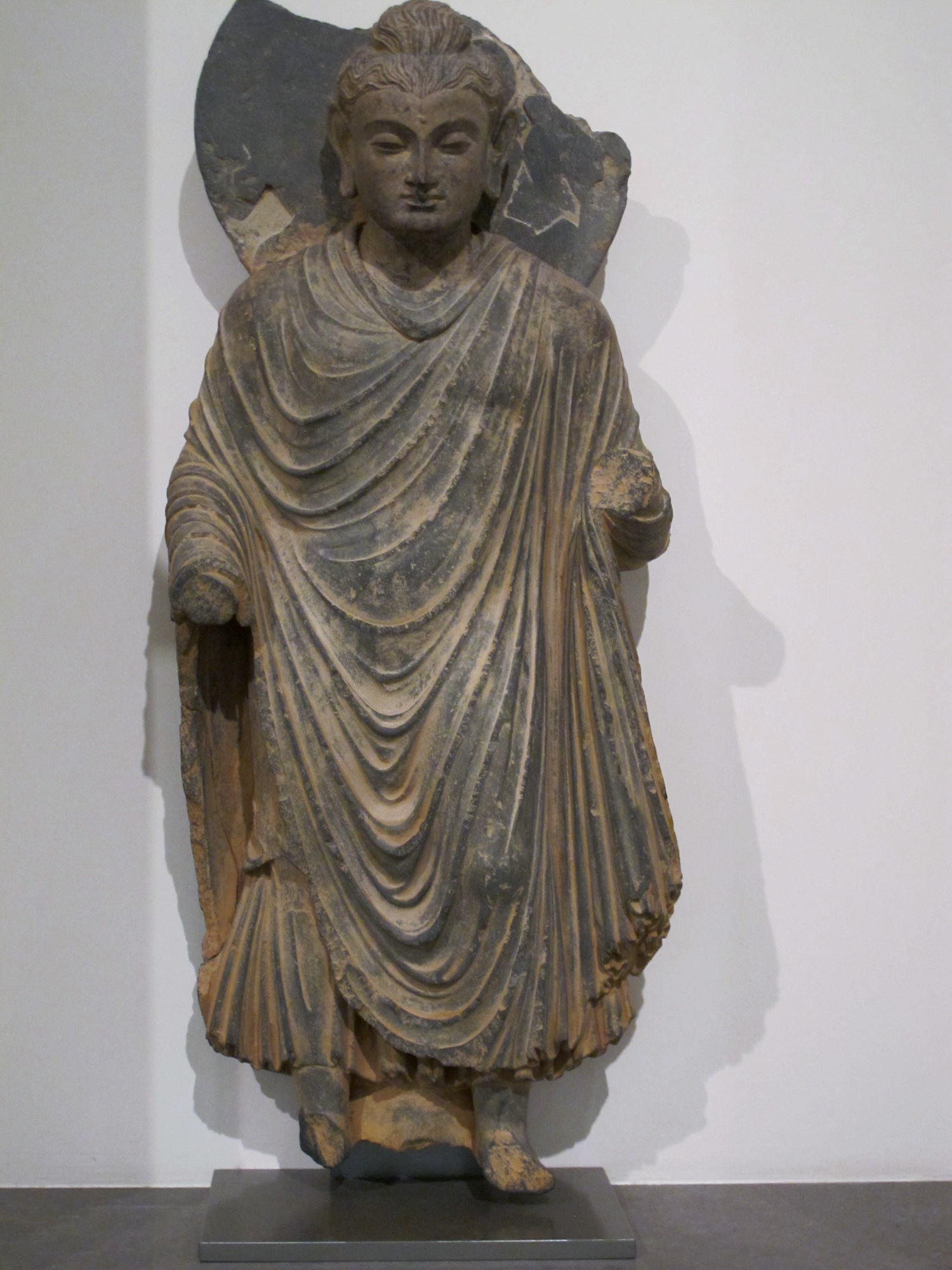
Standing Buddha, Gandhara sculpture (Musée des arts asiatiques Guimet)
The Prince Who Walked Out of the Palace
Almost everything about the historical Siddhartha Gautama is contested — the century of his birth, the size of his father’s kingdom, whether the Shakya clan was a monarchy at all or a small oligarchic republic tucked against the Himalayan foothills. What is not contested is the shape of the decision that made him. A man raised in comfort looked at old age, illness, and death, concluded that the entire arrangement of ordinary human life was built on a concealed catastrophe, and walked away from a wife, an infant son, and an inheritance to find out whether the catastrophe could be undone. He was twenty-nine. He did not come back for six years, and when he did, he came back as a teacher rather than a son.
The tradition tells this as the story of the Four Sights: a sheltered prince, kept from all evidence of decay by an anxious father, is driven through the city and sees in turn an old man, a sick man, a corpse, and a wandering ascetic whose composure in the face of the first three suggests a way out. The literal version is almost certainly later devotional shaping — no one lives to twenty-nine in an Iron Age Ganges town without seeing a funeral. But as a description of an interior event it is exact. Something ordinary was seen, and seen through, and what came out the other side was not a mood but a conviction: that suffering has a cause, that causes can be removed, and that a method exists. He had no evidence for this. He staked his life on it anyway.
Then came the second decision, the one that gets less attention and reveals more. After years of self-mortification severe enough that, by his own later account in the Majjhima Nikaya, he could feel his spine through his stomach, he judged the whole project a failure — not a failure of his effort but of the premise — accepted food, and was abandoned by the five ascetics who had followed him as a backslider. To be right alone, twice, against your own past self and your only peers, is a particular kind of temperament. This is the mind of an INFJ: a private vision arriving whole, then patiently converted into a system other people can walk.
The Buddha is the archetypal INFJ — dominant Introverted Intuition that saw one thing about existence and never stopped seeing it, then spent forty-five years building a road to it that strangers could use.
One Conviction, Held Against Everything
Introverted Intuition is not a talent for prediction. It is a compulsion toward the single underlying pattern beneath a mass of surface detail, and a near-inability to let go of that pattern once it arrives. Siddhartha’s pattern was that impermanence is not an unfortunate feature of life but its structure, and that clinging to what is structurally impermanent is the mechanism of suffering itself. Everything he later taught is an unpacking of that one perception. The Four Noble Truths are not four discoveries; they are one discovery stated as diagnosis, cause, prognosis, and treatment.
The strength of the conviction is measurable by what it cost him. He left Yasodhara and the newborn Rahula — a son whose name the tradition itself glosses as “fetter,” a detail too unflattering to be invented — and forfeited a throne, on the strength of an intuition he could not yet articulate, let alone verify. That is not the arithmetic of a man weighing options. It is the behavior of someone for whom the vision had already become more real than the palace. Ni does this: it renders the invisible pattern more solid than the visible furniture, and then the person acts on the pattern.
It also explains the years under discipline. Six years of extreme austerity, then the rejection of austerity, then the night at Bodh Gaya beneath the bodhi tree — the whole sequence is one hypothesis pursued past the point where any less certain person would have gone home. And afterward, the tradition preserves a striking hesitation: having attained awakening, he doubted whether the insight could be transmitted at all, whether anyone would follow a teaching so against the grain of desire. That hesitation is the dominant function’s signature weakness. What is total inside is hard to believe translatable. He decided to try anyway, and the decision to teach was, in its way, the harder one.
Teaching Anyone Who Asked
A mystic with only Ni keeps his insight. What made the Buddha a world-historical figure rather than a footnote among the Ganges plain’s many renunciants was auxiliary Extraverted Feeling — the outward-turned instinct to shape a group, to read a listener, to meet a person where they stand. He spent forty-five years walking a circuit of northern India teaching, and the Pali suttas show him adjusting the delivery constantly: a metaphysical argument for a brahmin, a parable for a farmer, silence for a question he judged useless to answer. The content did not change; the door into it changed for each person.
The most consequential expression of that instinct was the flat refusal to police the caste of his followers. In a society organized end to end by ritual purity, he ordained barbers and merchants and outcastes alongside brahmins and princes, and told them that within the Sangha their prior rank had dissolved — a position with no obvious precedent and considerable social cost. He held it for four and a half decades. He was also, eventually, moved to admit women: pressed by his aunt and foster-mother Mahapajapati Gotami, and — Ananda intervening on her behalf — he consented to the founding of an order of nuns, which tradition holds Yasodhara herself later joined. The hedging conditions he attached are historically messy and much argued over. The decision itself was radical for the sixth century BCE.
Fe also shows in how he handled attack. His cousin Devadatta agitated to take control of the order, proposed a stricter ascetic rule designed to make the Buddha look lax, and — the texts insist — plotted his death. The response was not excommunication by decree but a public declaration that Devadatta now spoke only for himself, leaving the community to draw its own conclusion. He managed the group’s cohesion rather than his own vindication. And the person he kept closest for the last twenty-five years was Ananda, an attendant remembered less for insight than for memory and devotion — a relationship, not an apparatus.
The Middle Way as an Engineering Decision
What distinguishes Buddhist doctrine from the surrounding religious landscape of its era is how little it asks you to take on faith and how much of it is structured as argument. Tertiary Introverted Thinking is the Buddha’s instrument for turning a wordless perception into an internally consistent framework — one that holds together on its own terms and can be checked. The Four Noble Truths are laid out in the form of a physician’s report: there is suffering; it has an origin; the origin can be removed; here is the regimen. The Eightfold Path is the regimen, enumerated so it can be taught, memorized, and audited.
The Middle Way itself is the clearest case. He had run both experiments personally — the palace at one extreme, near-starvation at the other — and concluded that each failed for the same structural reason: both keep attention fixed on the body’s condition. So he defined a third path not as a compromise but as a corrected premise, and did so in the teeth of his own six-year investment and the scorn of his former companions. Ti is willing to discard a sunk cost when the reasoning no longer holds. Most people are not.
The same rigor produced his refusals. Asked whether the universe is eternal, whether the self persists after death — the metaphysical questions of the day — he declined to answer, on the stated grounds that the questions do not conduce to liberation. The parable of the man shot with a poisoned arrow, who demands to know the archer’s caste and the fletching of the shaft before permitting the arrow to be removed, is a piece of pure logical hygiene: scope discipline enforced against the pull of speculation. And in the analysis of dependent origination he built out the causal chain link by link, insisting the whole thing be tested in experience rather than believed. It is a system engineered to be verified, not obeyed.
Bowls, Robes, and the Rain Retreat
The inferior function is the least trusted and the most laboriously governed, and in the Buddha’s case that is the physical, sensory, immediate world. His entire early biography is a fight with it: pleasure as the palace’s trap, then the body as the enemy to be starved into submission. Both are the classic inferior-Se relationship — the sensory realm treated as either seduction or obstacle, never as neutral ground.
Maturity, when it came, took the form of settlement rather than escape. The Middle Way is precisely a workable treaty with the body: eat enough, sleep enough, and use the resulting steadiness as the instrument of practice. Meditation as he taught it begins with the breath and with mindfulness of the body — attention deliberately parked in immediate physical sensation, the inferior function trained rather than fought. That the great turning point in his life was accepting a bowl of milk-rice is not a small detail; it is the whole reversal in one gesture.
And it shows in what he actually built. The Sangha was not a mood. It was a functioning institution with rules about robes, begging bowls, where and when to eat, how disputes were settled, how the monsoon months were spent in fixed residence — accumulated case by case into the Vinaya as concrete situations arose. Kings such as Bimbisara of Magadha donated parks and groves for the purpose, and the order took the ground. It is a strange irony that a teaching about the emptiness of material things generated one of the most detailed codes of daily material conduct in the ancient world, and no irony at all in type terms: this is exactly how inferior Se is finally honored — by legislating it.
Why INFJ Over INFP
Why not INFP?
The renunciant who walks into the forest chasing a private vision of authenticity is the INFP silhouette, and the first act of Siddhartha’s life fits it. The remaining forty-five years do not. He did not keep the insight; he systematized it into an enumerated doctrine, taught it continuously on a walking circuit across the Ganges plain, and built a rule-governed institution designed to carry it after his death. Dominant Introverted Feeling defends the integrity of an inner value; dominant Introverted Intuition insists on a pattern and then, through auxiliary Fe, organizes people around it. The Vinaya — thousands of specific rules for communal life — is not the artifact of a private mystic.
The tell is his last recorded instruction. Dying at Kushinagar, he did not name a successor. He told the assembled monks that the teaching and the discipline would be their teacher, and that they should work out their own liberation with diligence. That is a man who trusted the system more than any personality, including his own — the endpoint of a life spent converting an unshareable perception into something transmissible. An INFP would have left an example. He left a method.
Connected Figures
Further Reading
- The Pali Canon (Tipitaka), esp. the Majjhima Nikaya — Various, trans. Bhikkhu Nanamoli & Bhikkhu BodhiThe earliest surviving discourses — including the Buddha's own first-person account of his austerities and their abandonment.
- The Buddha: A Very Short Introduction — Michael CarrithersA historian's compact reconstruction of what can and cannot be known about the man behind the tradition.
- Buddha — Karen ArmstrongA readable narrative biography attentive to the psychological logic of the renunciation.
- Buddhism: The Illustrated Guide — Kevin Trainor (ed.)Broad survey of the tradition's spread and material culture, useful for the Sangha's institutional life.
- Old Path White Clouds — Thich Nhat HanhThe canonical episodes retold as continuous narrative, drawn closely from Pali and Chinese sources.
