 Historical Figure MBTI
#1112 · 8-18-26 · The Han Dynasty
Dong Zhongshu
The Scholar Who Made Confucianism the State
c. 179 – 104 BCE
6 min read
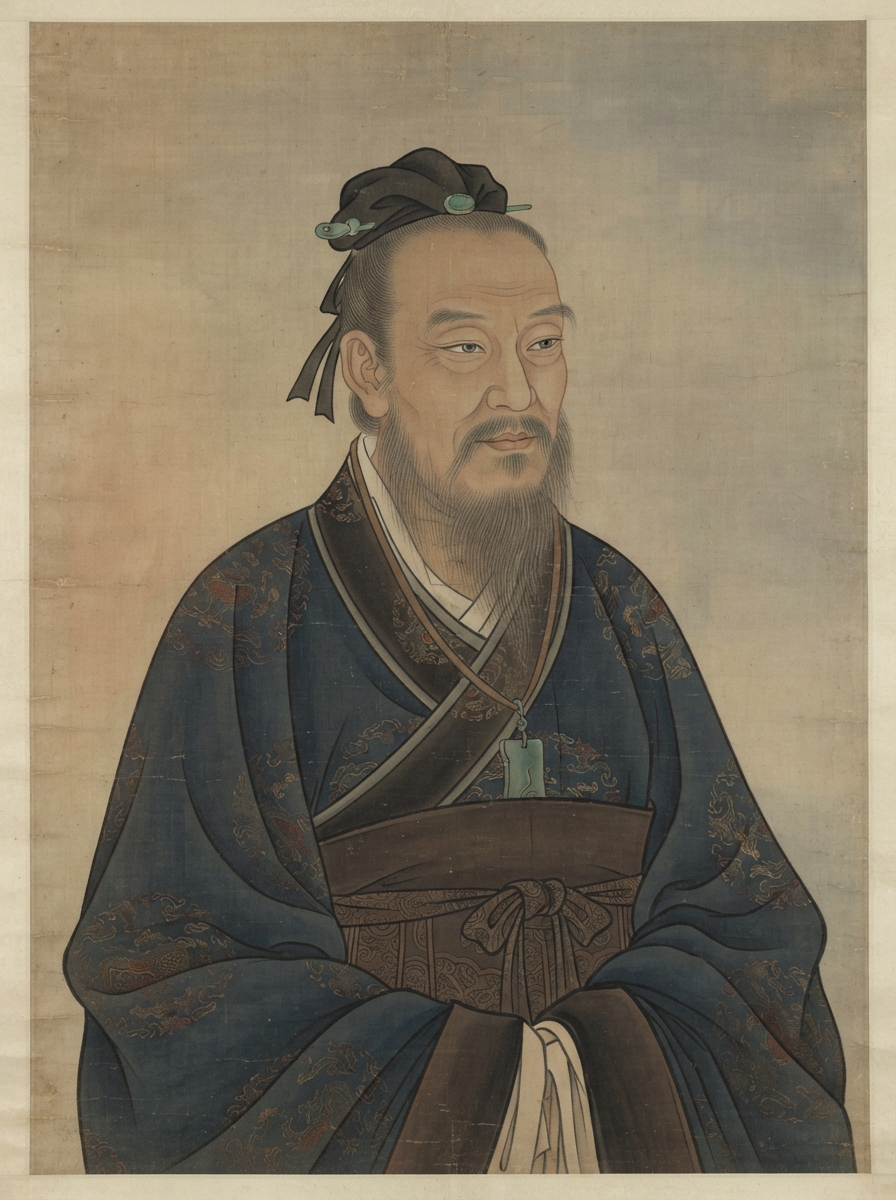
AI-assisted Portrait of Dong Zhongshu
The Grammar of Heaven
For the first sixty years of Han rule, the empire governed the way it had survived — with a suspicious, improvisational blend of Legalist bookkeeping and Daoist quietism, the leftover habits of a dynasty that had watched the Qin collapse under too much law and too little restraint. Dong Zhongshu found this arrangement intolerable not because it failed to work, but because it failed to mean anything. Somewhere had to exist a single grammar beneath the disaster reports, the court rituals, the succession crises, and the moral failures of individual emperors — and Dong spent a scholarly lifetime building it. He wove the ethics of Confucius, the mechanics of yin-yang and the Five Elements, and the old idea of a Mandate of Heaven into one interlocking system, then pressed his case in a series of memorials to the young Emperor Wu until Confucianism became, for the next two thousand years, the official language of Chinese statecraft.
This was the work of an INFJ: a mind that could not rest until the visible world — court politics, floods, eclipses, the price of grain — resolved into an unseen, unifying order, and a conscience that would not let that order stay theoretical. Dong did not merely describe how Heaven and the state connected; he insisted that the connection be enforced, that the emperor himself answer to it.
Dong Zhongshu was an INFJ whose dominant Ni built a cosmology out of Confucian ethics, Five Elements theory, and the Mandate of Heaven — not as scholarship for its own sake, but as a leash on imperial power.
One System Under Heaven
Dong's signature achievement was synthesis on a scale Chinese thought had not attempted before. Earlier Confucians had offered ethics; Five Elements theorists had offered cosmology; older tradition had offered the Mandate of Heaven as a loose, largely retrospective justification for dynastic change. Dong fused all three into a single predictive, prescriptive framework, laid out across the essays later collected as the Chunqiu Fanlu: the ruler stands at the pivot between Heaven and Earth, and the moral quality of his governance registers directly in the natural order — droughts, floods, eclipses, and comets are not random but diagnostic, Heaven's commentary on the court below.
This is Ni doing what Ni does at its most consequential — not intuition as vague hunch, but the compression of scattered, disparate material (ritual texts, omen records, cosmological speculation, the Spring and Autumn Annals themselves) into one coherent architecture that could then be applied forward, to any reign, at any moment. It was a system built to outlast its author, and it did: when Emperor Wu adopted it, Dong's synthesis became the intellectual chassis for the state itself, and eventually for the examination curriculum that selected China's officials for the next two millennia.
A Leash on the Throne
A system this elegant could have stayed a private intellectual pleasure. Dong made it public, and he made it accusatory. In his memorials to Emperor Wu he argued that Heaven communicates its displeasure through disasters and anomalies precisely so that a ruler has warning and cause to reform — which meant that every flood or eclipse became, in Dong's framework, an implicit indictment available to any official bold enough to read it aloud in court. This is Fe in its most historically load-bearing form: not warmth or crowd-pleasing, but an ethical demand that power answer to a shared, external standard, articulated on behalf of a community rather than the self.
It is easy to underrate how dangerous this was to propose to a sitting emperor. Dong was not offering Wu a decoration for his rule; he was offering him a leash, dressed as cosmology, that Confucian officials could tug for centuries afterward. That the offer succeeded — that Wu chose to institutionalize the very doctrine that constrained him — is a testament to how persuasively Dong had made accountability sound like order rather than defiance.
The Engineer Beneath the Prophet
Beneath the visionary synthesis sat a working logician. Dong's cosmology was not mystical hand-waving; it was built from precise correspondences — Five Elements mapped to seasons, directions, virtues, and organs of state — that had to be internally consistent to survive scrutiny at court, where rival advisors and rival schools were more than ready to pick it apart. Tertiary Ti shows up as the discipline that turned Ni's grand pattern into a defensible argument: exact classification, careful textual exegesis of the Spring and Autumn Annals, a doctrine rigorous enough to be taught, tested, and eventually written into the examination system as a body of technical knowledge rather than a mood.
It is this Ti scaffolding that let the system outlive Dong's own rhetorical persuasiveness. A purely Fe-driven moral appeal fades with the orator; a codified, internally logical curriculum gets copied into the next generation's textbooks. Dong built both, and the second is why the first mattered for two thousand years instead of one reign.
Why INFJ Over INTJ
Why not INTJ?
An INTJ builds a system because the system is elegant and effective; Dong built his because he believed, with real moral urgency, that rulers who ignored it would bring ruin on the people beneath them. His memorials read as ethical appeals, not strategic proposals — he is petitioning Heaven's justice through Emperor Wu, not optimizing a bureaucracy. The engine of his ambition was Fe conviction about how power ought to answer to a shared moral order, with Ti supplying only the scaffolding, not the motive.
The clearest tell is what he did with the system once it existed. An INTJ architect, having built the framework, tends to prize its coherence and defend it on logical grounds. Dong instead pushed it outward, into memorials addressed to the throne, arguing for its adoption as public policy meant to correct and restrain actual behavior — the unmistakable signature of a dominant Ni serving an auxiliary Fe conscience, not the reverse.
Connected Figures
Further Reading
- Chunqiu Fanlu (Luxuriant Dew of the Spring and Autumn Annals) — Attributed to Dong ZhongshuThe core text of his cosmological-ethical synthesis.
- From Chronicle to Canon — Sarah QueenThe standard modern study of Dong's interpretive method and influence.
- Dong Zhongshu, a 'Confucian' Heritage and the Chunqiu Fanlu — Michael LoeweA critical reassessment of what Dong actually wrote versus later attribution.
