 Historical Figure MBTI
#1111 · 8-18-26 · The Han Dynasty
Huo Qubing
The Cavalry General Who Broke the Xiongnu
140 – 117 BCE
5 min read
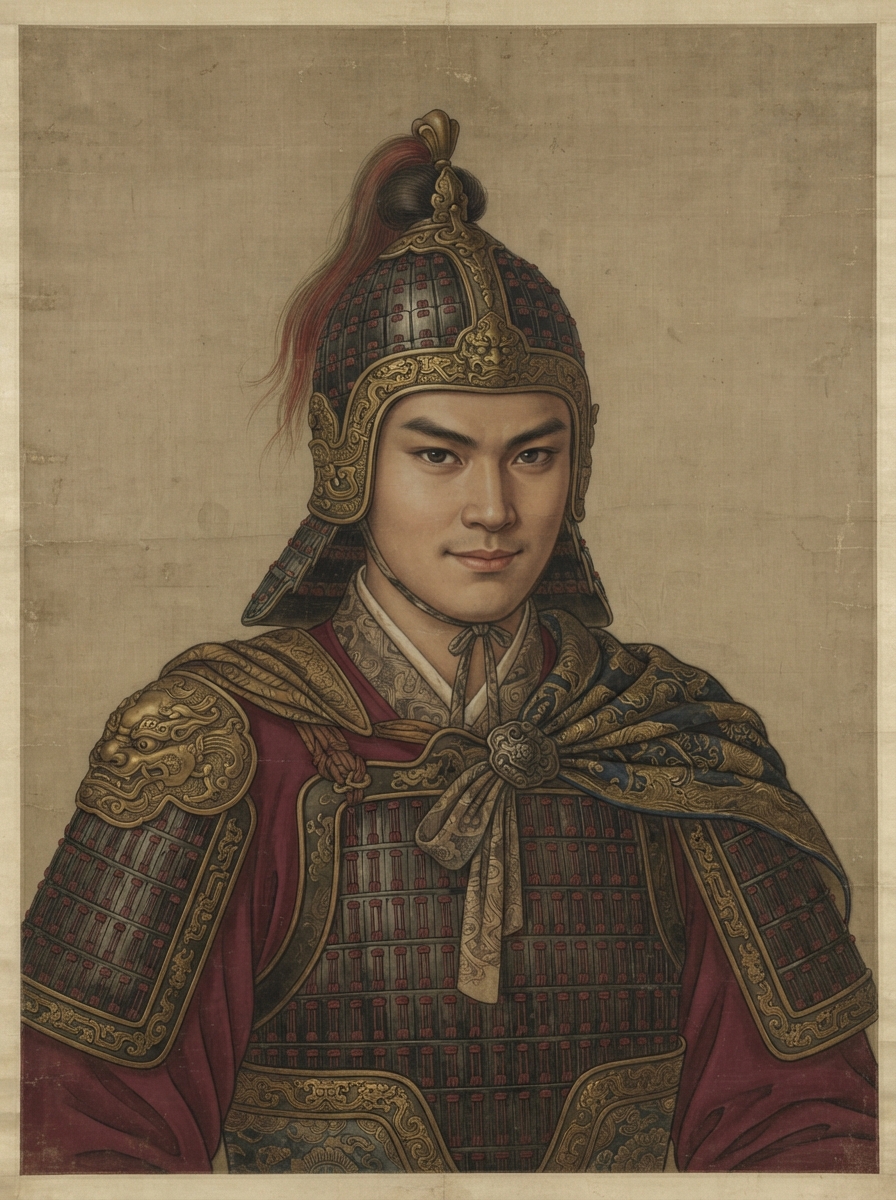
AI-assisted Portrait of Huo Qubing
A Boy General Who Outran His Own Supply Lines
Huo Qubing was eighteen when he first rode against the Xiongnu, and dead by twenty-three, and in between he rewrote what a Han general could dare to do. Nephew of the general Wei Qing and half-nephew of Empress Wei Zifu, he owed his first command to family connection — but he kept it, and expanded it, on nothing but nerve. Where Han doctrine called for slow, provisioned advances that held the steppe corridor mile by cautious mile, Huo Qubing simply rode past all of that: fast cavalry columns driven hundreds of miles beyond any friendly supply line, living off captured Xiongnu grain and livestock as he went, striking before word of his approach could outrun him. It was reckless by any textbook standard. It also worked, repeatedly, and by 121 BCE had put the strategically vital Gansu Corridor — the future spine of the Silk Road — into Han hands.
This is the signature of an ESTP: a mind built to read a fast-moving, physical situation in real time and act on it immediately, trusting instinct and momentum over planning. Huo Qubing did not out-think the Xiongnu from a war-room map. He out-rode them.
Huo Qubing was Se in a saddle — a commander who trusted his eyes, his horse, and the moment in front of him more than any campaign plan drawn before the ride began.
The Deep Strike
In 121 BCE, sent west with a force of light cavalry, Huo Qubing pushed across more than a thousand li of hostile territory in a matter of days, engaging and defeating several Xiongnu forces in succession before the enemy could concentrate against him. He carried minimal supply, betting — correctly, again and again — that speed itself was the resource that would keep his men fed and alive, off whatever grain and herds he could seize on the move. In 119 BCE he rode even farther, deep into the Gobi in a campaign that reached the Xiongnu's own sacred mountain territory, a distance no Han commander before him had attempted.
This was not caution rewarded by luck; it was a style of command that treated hesitation as the greater risk. Every one of his major victories was won by arriving somewhere the enemy did not expect a Han army to be able to reach, at a speed no textbook advance could match. Se in its purest military form: read the terrain, read the moment, go.
A Code Without Elaboration
Huo Qubing's most famous line was not a strategic pronouncement but a refusal. When Emperor Wu offered to build him a grand mansion befitting his rank, he turned it down flat: he could not think of his own household, he said, while the Xiongnu remained unconquered. It reads less like a considered philosophical stance than a blunt, self-evident rule applied without exception — the kind of internal logic an ESTP's auxiliary Ti produces: not built for abstract theorizing, but sharp and immovable once a principle is set.
He is recorded as having little patience for the ceremonial and scholarly trappings expected of a Han general — he reportedly showed scant interest in studying the classic military treatises his contemporaries pored over, trusting his own read of a battlefield over inherited doctrine. That is Ti doing what it does in an ESTP: not building systems, but cutting straight to the operative rule and discarding whatever does not serve it.
Loyalty as Performance, Not Sentiment
Huo Qubing's refusal of the mansion was also, unmistakably, a public act — delivered to the emperor in terms designed to be repeated, and repeated it was, for two thousand years. Tertiary Fe in an ESTP rarely shows up as warmth; it shows up as an instinct for what a gesture will mean to the people watching. His declared devotion to the throne and to the unconquered frontier was not private reflection — it was a stance struck in front of an audience that mattered, and it worked exactly as intended, cementing Emperor Wu's favor and his own legend in the same breath.
Why ESTP Over ESTJ
Why not ESTJ?
An ESTJ general wins by securing the supply line before advancing it — methodical logistics, standing orders, an advance measured against a plan set in advance. Huo Qubing did the opposite on every campaign that made his name: he cut loose from supply, improvised off captured stores, and pressed forward on what the terrain and the moment told him, not on what a prepared campaign schedule allowed. His authority came from his own daring in the field, not from institutional command structure — the mark of dominant Se reading a live situation, not Te building and defending a system.
What makes Huo Qubing ESTP rather than ESTJ is exactly the recklessness that historians still marvel at: campaigns that should not have worked on paper, and worked anyway, because he built no paper plan to fail. He read the ground in front of him and moved — and moved again before the enemy could answer the first move.
Connected Figures
Further Reading
- Records of the Grand Historian (Shiji) — Sima QianThe primary near-contemporary account of Huo Qubing's campaigns and his refusal of Emperor Wu's mansion.
- Book of Han (Hanshu) — Ban GuThe later dynastic history that expands on the Shiji's account of the Xiongnu wars.
- The Men Who Governed Han China — Michael LoeweA modern prosopographical study situating Huo Qubing within Emperor Wu's court and military establishment.
