 Historical Figure MBTI
#1108 · 8-18-26 · The Han Dynasty
Emperor Wu of Han
The Emperor Who Opened the Silk Road
156 – 87 BCE
11 min read
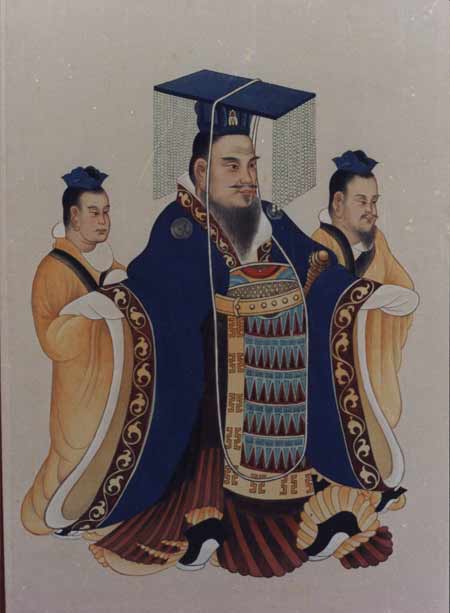
Traditional Chinese court portrait of Emperor Wu of Han
The Man Who Would Not Inherit a World He Did Not Redesign
He came to the throne at fifteen and held it for fifty-four years, and in that span he did something no Chinese ruler had attempted since the First Emperor: he took a functioning empire and rebuilt it around a single idea of what it ought to become. His predecessors had governed by restraint — light taxes, minimal interference, the Daoist-flavored quietism that let the early Han recover from Qin's collapse. Liu Che found that inheritance intolerable. The treasury was full and the frontier was humiliating; the Xiongnu confederation had been bought off with silk and princesses for seventy years. He spent the treasury, ended the tribute, and pushed the borders of China north into the steppe and west into Central Asia, and when the wars proved ruinously expensive he seized the salt and iron industries to pay for them.
Nothing about this was improvisation. The campaigns, the envoys, the state ideology, the nationalized commodities — each was a piece of the same design, and the design was not the empire he had received but the empire he intended. He installed Confucianism as sole state orthodoxy not from piety but because a unified realm needed a unified mind, and Dong Zhongshu had supplied the argument. He dispatched Zhang Qian into unmapped territory looking for military allies against the Xiongnu and got, decades later, something far larger: the trade corridor the modern world calls the Silk Road. He was not a careful administrator who happened to expand. He was a visionary who used administration as his instrument.
And he ended badly — as men of that particular architecture often do. The emperor who had spent fifty years imposing order on the outer world spent his last decade unable to impose it on his own suspicion. The witchcraft purges of 91 BCE killed thousands on the accusation of buried curse-dolls, and among the dead were his crown prince and the empress who bore him. He is said to have regretted it bitterly. Regret was the one thing his system had never made room for.
Emperor Wu is the archive’s clearest imperial ENTJ — dominant Extraverted Thinking that treated an entire civilization as a system to be restructured, and never once asked whether the structure was the point.
Salt, Iron, and the Machinery of Command
Wu’s wars against the Xiongnu were the most expensive thing the Han state had ever done, and his response to the bill was characteristic: he did not scale back the wars, he restructured the economy. Salt and iron production — the two commodities every household in China needed and could not make for itself — were taken from private merchants and placed under state monopoly. Liquor followed. New coinage was issued and minting rights pulled to the center. A tax was laid on merchant capital, with informers rewarded for reporting concealed wealth. It was fiscal engineering of a ruthlessness the empire had not seen, and it worked: the armies stayed in the field.
He applied the same instinct to the aristocracy. The old Han practice of granting large territorial fiefs to imperial kinsmen was quietly dismantled through the “decree of grace” — princely estates were required to be divided among all a prince’s sons rather than passing intact to the eldest, so that within two generations the great regional principalities had crumbled into harmless fragments without a single rebellion needing suppression. It is one of the most elegant pieces of statecraft in Chinese history, and it is pure Te: find the leverage point, apply pressure through existing rules, let arithmetic do the work that armies would have done badly.
Talent, too, was a resource to be extracted efficiently. Wu opened recruitment to men of no birth on the strength of recommendation and demonstrated ability, and he promoted them fast — Huo Qubing commanded an army before he was twenty. He was equally quick to destroy officials who failed him; his chancellors had a notoriously short life expectancy. Function, not loyalty, not sentiment, determined who stood at court. When Sima Qian defended a defeated general, Wu had him castrated. The historian went on writing anyway, which is why we know all of this.
A Single Picture of What China Was For
In 138 BCE, Wu sent a palace attendant named Zhang Qian west with a hundred men to find the Yuezhi, a people the Xiongnu had driven out of the Gansu corridor, and propose an alliance. Zhang Qian was captured almost immediately and spent more than a decade in Xiongnu hands. He escaped, continued west anyway, found the Yuezhi settled and uninterested in revenge, and came home thirteen years later with one surviving companion and no alliance. By any near-term measure the mission failed. What it produced instead was the first Chinese account of Ferghana, Bactria, Parthia and the lands beyond — and Wu, hearing it, immediately understood that he had been handed a map of a world worth reaching. The embassies and caravans that followed became the Silk Road.
That is the auxiliary function at work: an outcome nobody commissioned, recognized instantly as more valuable than the goal. The same convergence shows in his handling of ideology. Dong Zhongshu proposed that the throne suppress the competing schools and elevate Confucianism alone, binding heaven, emperor and moral order into one system in which the ruler’s legitimacy and the cosmos’s regularity were the same fact. Wu adopted it and founded an imperial academy to train officials in it. He was not a Confucian in his conduct — his methods were closer to the Legalists he officially disowned. He took the doctrine because he saw what it would do across centuries, and it did it: the examination system and the scholar-official state grew out of that decision and governed China for two thousand years.
Everything he did pointed the same direction. Push the frontier past the Ordos and into the Tarim. Plant garrison-colonies where the armies had passed. Standardize the calendar. Perform the sacrifices at Mount Tai that only a legitimate universal sovereign could perform. Fix the doctrine, fix the coinage, fix the borders. He was not accumulating achievements; he was resolving a single image of what the Han empire was supposed to be, and refusing to die before it existed.
The Appetite for the Immediate Blow
Wu’s early reign has the tempo of a young man who cannot bear to wait. The first move against the Xiongnu was an ambush at Mayi in 133 BCE — an entire army hidden in a valley around a town offered as bait, a scheme that collapsed when the Xiongnu chieftain grew suspicious and turned back. It failed, and it ended seventy years of peace policy in a single stroke, which was arguably the point. From then on the campaigns came in waves, deep cavalry raids thousands of li into the steppe, staked on speed and shock rather than attrition.
He found in Huo Qubing a general built for exactly that. Barely eighteen at his first command, Huo rode out with light columns, abandoned supply lines, lived off captured herds and struck Xiongnu encampments before word of his approach arrived. In 121 BCE he swept the Hexi corridor clear and opened the road west; by 119 he had ridden past the Gobi to the edges of Xiongnu territory. Offered a mansion by the emperor, he is said to have replied that the Xiongnu were not yet destroyed, so he had no use for a home. Wu loved him — and Huo was dead at twenty-four. The emperor built him a tomb shaped like the mountains he had conquered.
The same appetite ran through the rest of his life, sometimes usefully and sometimes not. He hunted obsessively, expanded the imperial parks, collected exotic animals and the “heavenly horses” of Ferghana — for which he launched a war across the Pamirs when the city of Dayuan refused to sell them. He pursued immortality with the same literalism, funding magicians and alchemists and expeditions to islands in the eastern sea, and executed several of them when the elixirs failed to arrive. He wanted results he could see, and he wanted them now.
Buried Dolls
The inferior function is the one a person cannot examine, and in Wu it went septic. He had spent his life certain that reality was legible — that campaigns could be planned, ministers audited, doctrines chosen. His inner life received none of that scrutiny, and by his sixties it had curdled into a private, unarguable conviction that he was being murdered by sorcery. Wooden figures buried under the palace, curses spoken at night: the charge was unfalsifiable, and he believed it absolutely.
The purges of 91 BCE — the wugu zhi huo, the disaster of the witchcraft curse — began with the investigator Jiang Chong digging up the imperial residences and finding, invariably, what he had brought with him. Thousands were executed. When figures were produced from the crown prince’s palace, Liu Ju could not get a hearing from a father who had withdrawn to a summer retreat and was reachable only through the accusers. He raised troops in desperation, was declared a rebel, fought a five-day battle in the streets of Chang’an, and hanged himself in flight. His mother, Empress Wei Zifu, who had been Wu’s consort for nearly fifty years, took her own life the same season.
What follows is the strangest thing about him. Once the fever broke, Wu grasped what he had done, executed the accusers, built a palace called Longing for the Returned Son, and in 89 BCE issued the Repenting Edict of Luntai — publicly rejecting further war, halting the westward garrisons, and turning the state back toward agriculture and rest. An emperor apologizing to his empire in his own voice was close to unprecedented. It is inferior Fi arriving all at once and far too late: a man who had never located a private value discovering one only after it had cost him his son, his wife, and the argument for everything he had built.
Why ENTJ Over ESTJ
Why not ESTJ?
The monopolies, the audits, the informer system and the disposable chancellors are all Te, and an ESTJ reading of Emperor Wu gets that much right. What it cannot absorb is that he did not administer an inherited China — he replaced it. Borders, economy, coinage, calendar and the official philosophy of the state were all remade inside one reign, against the settled policy of three previous emperors, on nobody’s authority but his own. Se-Ti pragmatism works within a given frame; Wu spent fifty years imposing a frame that did not yet exist, and accepted the ruin of the treasury to get there.
The tell is Zhang Qian. An ESTJ sovereign, told that a thirteen-year mission had returned without the alliance it was sent to obtain, would have counted the cost and closed the file. Wu heard a description of countries he would never see and reorganized his western policy around them. The same forward-projecting instinct installed Confucianism as orthodoxy for reasons that would not pay out for generations, and it is what separates him from a superb manager. He was an architect who happened to be superb at management — and the failure mode confirms it, because it was not overwork or overreach that broke him at the end but a buried, unexamined inner certainty, the classic collapse of a Te dominant with Fi in the basement.
Connected Figures
Further Reading
- Records of the Grand Historian (Shiji) — Sima QianThe contemporary account, written by a man Wu had mutilated — indispensable and pointedly unflattering.
- Book of Han (Hanshu) — Ban GuThe later dynastic history, with the fullest treatment of the economic monopolies and the witchcraft purges.
- The Men Who Governed Han China — Michael LoeweModern scholarship on how the Han bureaucracy actually worked under and after Wu's centralizing reforms.
- Courtier and Commoner in Ancient China — Burton WatsonTranslations from the Hanshu that put Wu's court, its officials and its purges into readable English.
