 Historical Figure MBTI
#1109 · 8-18-26 · The Han Dynasty
Sima Qian
The Historian Who Wrote Through Humiliation
c. 145 – c. 86 BCE
8 min read
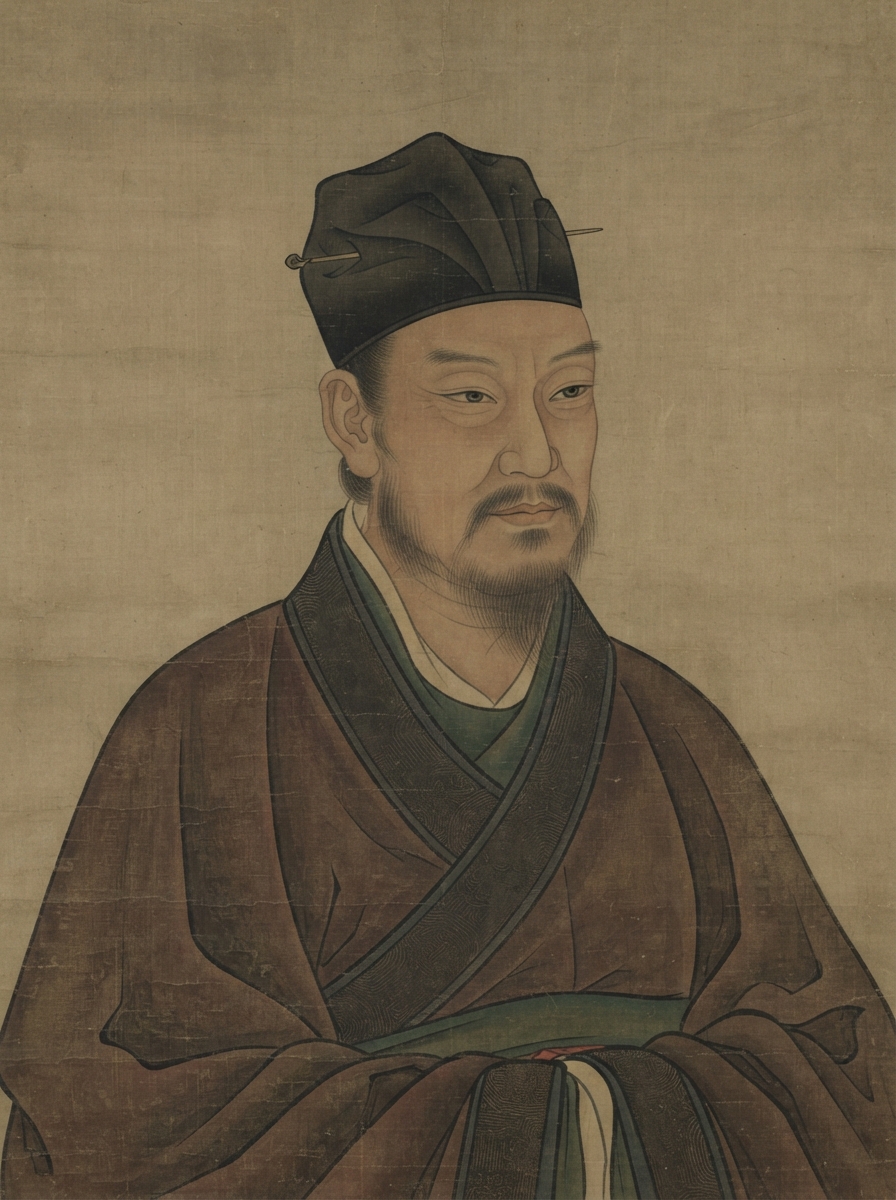
AI-assisted Portrait of Sima Qian
The Man Who Chose Disgrace Over Silence
In 99 BCE a court astronomer with no military standing stood up in front of the most powerful man in the world and said something true about a defeated general. The general, Li Ling, had taken five thousand infantry against the Xiongnu, fought until his arrows were gone, and surrendered rather than watch the last of his men die for nothing. The court, reading the emperor’s mood, called him a traitor. Sima Qian — whose job was records, calendars, and omens, not strategy — told Emperor Wu that the man had done more with five thousand than most commanders do with fifty, and that his surrender was arithmetic, not cowardice.
He was sentenced to death. Han law allowed two escapes: a ransom he could not afford, or castration. Castration was not simply mutilation; it was civic annihilation. A gentleman so punished was expected to kill himself, and the expectation was so total that choosing to live was itself read as a second, worse disgrace. Sima Qian chose to live. He explained why years later, in the letter to his friend Ren An that is one of the most naked documents to survive from the ancient world: he had a book to finish, and a dead man cannot finish a book. “If it may be handed down to men who will appreciate it,” he wrote, then “though I should suffer a thousand mutilations, what regret should I have?”
That sentence is the whole psychology in miniature. Not defiance, not martyrdom, not the pride that would have made suicide easy — but a vision of a finished object, existing in a future he would not see, weighed against every present humiliation and found heavier. He spent the rest of his life as a eunuch functionary in the palace of the man who had ordered it, writing.
An INFJ whose dominant Ni fixed on a single object — the complete record of the Chinese past — and then measured his own body, honor, and death against it.
A Book Seen Whole Before It Was Written
The vision was inherited, but not in the way a trade is inherited. His father, Sima Tan, held the office of Grand Historian and had begun assembling material for a history of everything — not a chronicle of one reign, but the whole span from legendary antiquity to the living present. Dying, Sima Tan took his son’s hand and made him promise to finish it. Sima Qian recorded the scene himself, and what he recorded was not a bequest of documents but the transfer of an image: a single work that would hold all of it. He took up the office in 108 BCE and never afterward behaved like a man doing a job.
Ni is the function that treats an unbuilt thing as already real, and Sima Qian’s conduct only makes sense if the Shiji was, for him, more real than his career or his person. He had traveled in his twenties — south to the Yangtze, to the site of Qu Yuan’s drowning, to the ruins of Confucius’s home state of Lu, to old battlefields — not as a tourist but as a man collecting the physical residue of stories he would later need. Decades before he could write a line of it, he was already gathering for a shape he could see and no one else could.
That is also why the punishment did not stop him. To a person whose center of gravity sits in an imagined completed future, the present self is instrumentally valuable — useful because it holds the pen. He wrote to Ren An that he had endured because the work was “not yet complete,” that he would rather be buried in filth than let the thing go unfinished. The vision was the client; the man was the servant.
Speaking for a Man Nobody Would Speak For
He was not close to Li Ling. He says so plainly: they served in the same palace, never shared a cup of wine, were not friends. That is precisely what makes the intervention diagnostic. What moved him was watching a room of officials who had toasted Li Ling a month earlier turn on him in a single afternoon because the emperor’s face had darkened — the spectacle of a collective moral judgment being falsified in real time. He stood up to correct the record of a human being, out loud, in the only forum that counted.
This is Fe in its severe register: not warmth, not accommodation, but an intolerance for a shared verdict that is wrong. Auxiliary Fe gives the introverted visionary a channel out into other people, and Sima Qian’s came out as advocacy for someone who could not advocate for himself. It cost him everything, and he never claimed the calculation had been sound — he said he had spoken because he could not bear to hold it in.
The same faculty organized the book. The Shiji’s astonishing innovation is that it gives chapters to assassins, merchants, jesters, wandering knights, physicians and fortune-tellers — people no dynastic record was obliged to notice. He wrote of the loyal retainer and the betrayed minister with a moral attention that reads as personal. Having been abandoned by an entire court, he built a book in which no one worth remembering would be.
Five Frames for Two Thousand Years
Vision alone produces a heap. What Sima Qian produced was an architecture. The Shiji’s roughly 130 chapters divide into five deliberate kinds: basic annals for the ruling houses, chronological tables that let a reader see rival states running in parallel, treatises on institutions — ritual, music, the calendar, waterworks, currency — hereditary houses for the feudal lineages, and biographies for individual lives. Each answers a different question about the same past. Together they make a matrix rather than a story.
The tables in particular are a piece of pure structural thinking, and they solve a problem narrative cannot: how to hold a fragmented, multi-state history in one visual field without pretending it was a single line. The treatises do something equally cold and clever — they extract institutions from events, so that the reader can follow how a currency or a canal system behaved across dynasties. This is a mind building an instrument, testing it against the material, and keeping only what carries load.
Ti in the tertiary slot also shows in his handling of sources. He quotes documents at length, names his informants, flags where accounts diverge, and appends signed judgments — “the Grand Historian says” — that are marked as opinion rather than smuggled in as fact. He was capable of recording what he doubted, which is a harder discipline than it sounds and the reason his critics for two millennia have had to argue with him using his own evidence.
The Body as the Cost of the Work
Inferior Se in an INFJ shows up as a relationship to the physical world that is either unusually vivid or unusually disregarded, and Sima Qian gives both. The vivid side is his youthful travel — walking the ground where things happened, standing at the river where Qu Yuan drowned — and it feeds his prose, which is full of gesture and object: a sword drawn, a bowl of wine refused, the exact words a condemned man said at the gate. He is the best scene-writer in early Chinese literature because he understood that a concrete act carries a judgment no adjective can.
The disregarded side is the sentence he accepted. He wrote to Ren An about the body of a mutilated man with unbearable specificity — the sweat that soaked his back whenever he thought of it, the impossibility of visiting his parents’ graves, the way he could not be alone without his mind going to it. He did not intellectualize the physical horror away. He simply overruled it, year after year, and the letter is the record of what that overruling cost.
It is a life lived almost entirely in the wrong hemisphere of himself: a man of interior vision whose defining experience was inflicted on his flesh, and who converted it into sentences.
Why INFJ Over INFP
Why not INFP?
The suffering, the private conviction, the letter of wounded conscience — all of it reads INFP until you look at what he actually built. An Fi-dominant writes to render an inner truth; Sima Qian wrote to construct a public instrument. The Shiji is systematic to the point of coldness: five formal categories, cross-referenced tables, institutional treatises, signed judgments kept separate from evidence — a design meant to serve a state and a posterity he would never meet. He also did not withdraw into his grievance; he kept the office, served the emperor who broke him, and used the archives. That is Ni building toward an external artifact with Ti scaffolding it, not Fi expressing itself.
The Li Ling episode reinforces it rather than undercutting it. An Fi reflex would have been to refuse complicity and withdraw — or, having been disgraced, to take the exit the culture offered and preserve the integrity of the self. What he did instead was speak on behalf of someone else’s reputation in public (Fe), then subordinate his own honor entirely to a future object (Ni). The self was the one thing he was willing to spend.
Connected Figures
Further Reading
- Records of the Grand Historian — Sima Qian, trans. Burton WatsonThe standard English selection from the Shiji; the Han chapters are the essential entry point.
- Letter to Ren An — Sima Qian (various translations)His own account of the Li Ling affair and why he chose mutilation over death.
- Worlds of Bronze and Bamboo: Sima Qian’s Conquest of History — Grant HardyThe best modern study of how the five-part structure actually works as an argument.
- The Cambridge History of China, Vol. 1: The Ch’in and Han Empires — Denis Twitchett & Michael Loewe, eds.Institutional context for the Han court Sima Qian served and documented.
- The Grand Scribe’s Records — William H. Nienhauser Jr., ed.The ongoing complete annotated translation, for readers who want the chapters Watson omits.
