 Historical Figure MBTI
#1110 · 8-18-26 · The Han Dynasty
Zhang Qian
The Envoy Who Opened the Silk Road
c. 195 – 114 BCE
4 min read
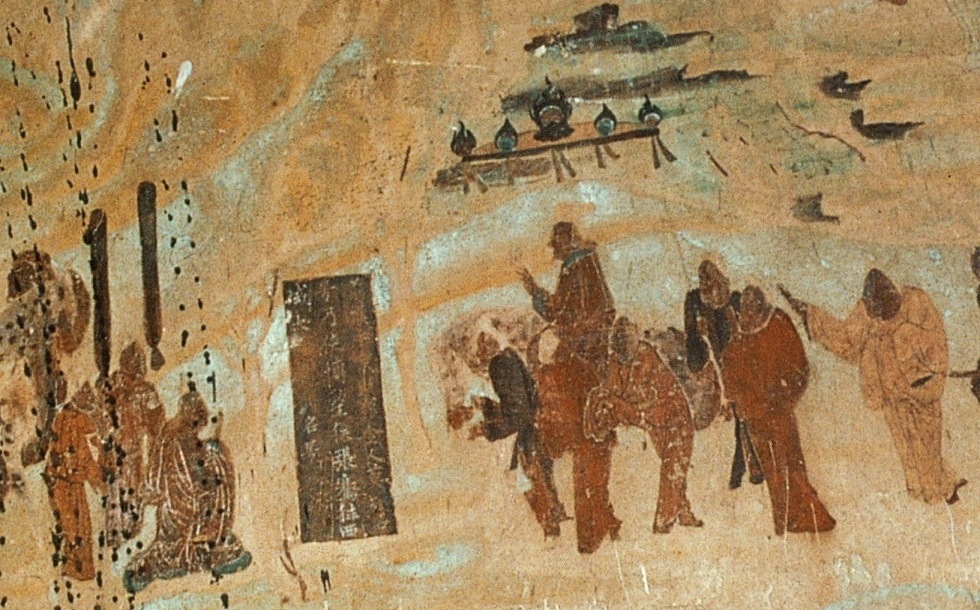
Traditional Chinese depiction of Zhang Qian
The Prisoner Who Kept Walking West
Around 138 BCE, Emperor Wu handed a minor court official an assignment with no precedent: cross the deserts and mountain passes beyond the Han frontier, find a people called the Yuezhi, and talk them into an alliance against the Xiongnu. Zhang Qian got barely past the border before the Xiongnu took him prisoner. He would not see Han China again for thirteen years.
What happened in between is the whole of his character. He did not sit out his captivity waiting for rescue, nor did he abandon the mission once free to. He married a Xiongnu woman, raised children, and built a life inside the very power he had been sent to outmaneuver — and when the chance to slip away finally came, roughly a decade later, he did not run home. He kept going west, toward a mission that everyone, himself included, might reasonably have written off as dead. This is the signature of an ISTP: not a grand strategist executing a plan, but a man who solves the problem directly in front of him, over and over, until the original problem is somehow still solved at the end.
Zhang Qian was not driven by vision. He was driven by what was true, what was in front of him, and what he could still do about it — the whole of ISTP's Ti-Se engine, ten years and a thousand miles from home.
A Registry of Things Actually Seen
What Zhang Qian brought back was not a theory of the western world — it was an inventory of it. His report to Emperor Wu, later preserved by Sima Qian in the "Shiji," reads like a field notebook: the walled cities of Dayuan, the irrigated farmland of Bactria, the alfalfa the Ferghana horses fed on, the market goods moving between kingdoms no Han scribe had ever named. He did not speculate about what lay beyond what he had walked; he reported precisely what he had verified with his own eyes, and no further.
That discipline — trust only what has been directly tested — is Ti at its most concrete. Zhang Qian was uninterested in impressing the court with sweeping claims about the western regions. He was interested in getting the facts of routes, distances, and goods exactly right, because a wrong fact would get the next envoy killed. His famous account of the "heavenly horses" of Ferghana wasn't poetry; it was a logistics note that changed Han military policy for a generation.
Ten Years a Captive, Still Moving
Captured almost as soon as he left Han territory, Zhang Qian spent roughly a decade a prisoner of the Xiongnu. He did not treat this as an interruption to be endured in stasis. He adapted to it completely — took a Xiongnu wife, had children, learned to live inside the world of his captors rather than against it. It was not surrender of purpose; it was Se doing what Se does, meeting the actual conditions in front of him rather than the conditions he had planned for.
And when the opportunity to move came, he moved — not backward toward safety, but forward, resuming a mission a decade cold as though no time had passed at all. He crossed into Dayuan, then Bactria, regions no Han official had ever reached, navigating unfamiliar terrain, languages, and courts entirely by improvisation. There was no map to follow because he was making the first one. Han China's knowledge of the world beyond its borders exists because one man refused to let ten years of captivity become the end of the story.
Why ISTP Over ISTJ
Why not ISTJ?
An ISTJ envoy given the same charge would have followed the plan Emperor Wu handed him, and when captivity broke that plan, an ISTJ profile offers no ready account of what comes next. Zhang Qian's actual record is the opposite of procedural: an improvised decade of survival inside an enemy court, an escape undertaken with no fixed route, and a westward push into kingdoms no briefing had described. He adapted the mission on the fly to conditions no plan anticipated, again and again, rather than executing a fixed one. That is Se meeting the moment, guided by Ti, not Si holding the line.
Nothing in Zhang Qian's record suggests a man following instructions. It suggests a man solving whatever problem was directly in front of him — captivity, an unmapped continent, a court that had never heard of Han China — with whatever tools were at hand, and reporting back only what he had verified himself.
Connected Figures
Further Reading
- Shiji ("Records of the Grand Historian"), Account of Dayuan — Sima QianThe primary ancient source for Zhang Qian's journey, drawn directly from his own report to the Han court.
- The Silk Road: A New History — Valerie HansenTraces how Zhang Qian's reconnaissance became the trade and diplomatic network historians later named the Silk Road.
- The Cambridge History of China, Vol. 1: The Ch'in and Han Empires — Denis Twitchett and Michael Loewe (eds.)Places Zhang Qian's mission within Han Wudi's broader strategy against the Xiongnu.
- Empires of the Silk Road: A History of Central Eurasia — Christopher I. BeckwithContextualizes the Central Asian kingdoms — Dayuan, Bactria — that Zhang Qian was first to report on.
