 Historical Figure MBTI
#1115 · 8-19-26 · The Age of the Buddha
Ananda
The Cousin Who Remembered Every Word
c. 5th century BCE
5 min read
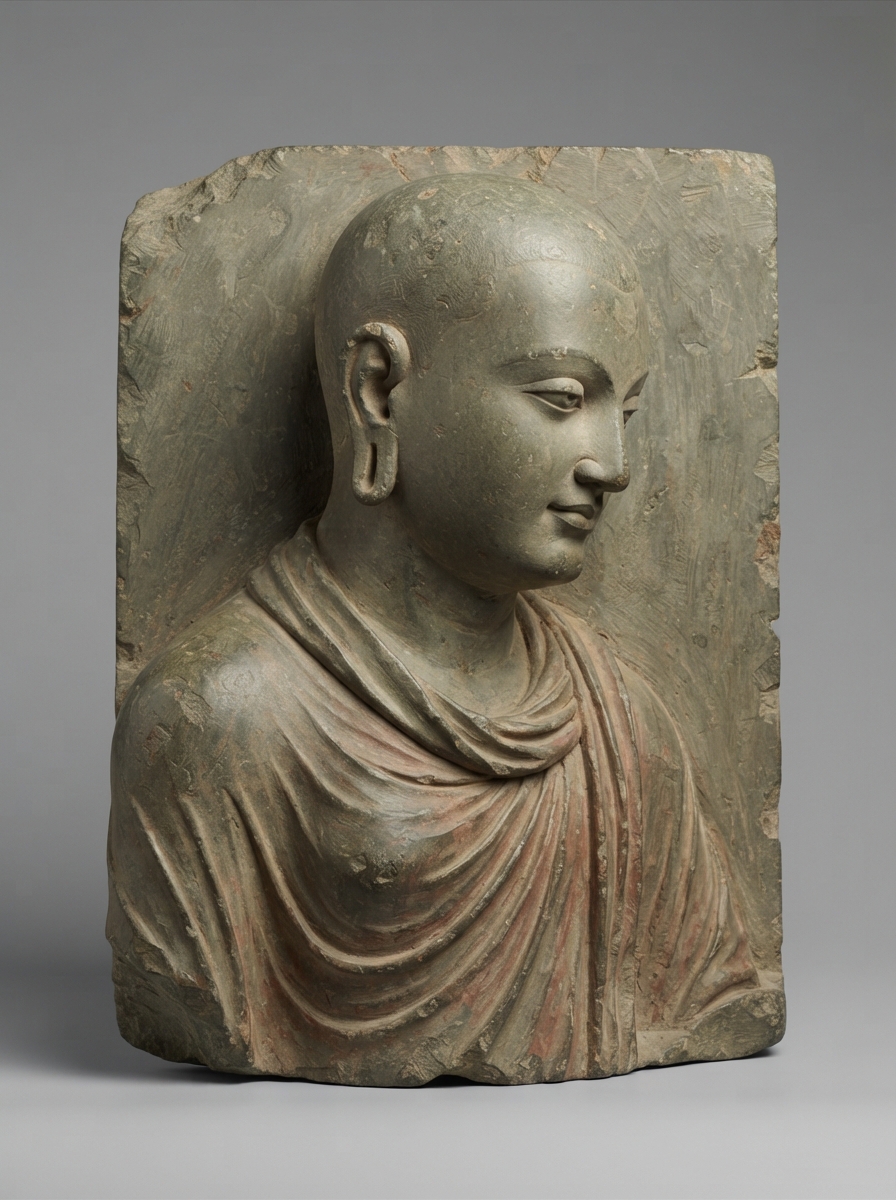
AI-assisted Portrait of Ananda
The Attendant Who Never Sought the Cushion
For twenty years after his awakening, the Buddha had no fixed attendant — monks took turns carrying his bowl, fetching his robe, standing at his door. It was an unstable arrangement for a wandering teacher entering old age, and eventually the community asked him to choose one man for the post permanently. He chose his cousin Ananda. Ananda accepted on one condition, characteristically modest in its asking: he wanted no special privilege from the arrangement — no better robe, no better food, no separate lodging — only the right to bring visitors to the Buddha at any hour and to hear again any teaching he happened to miss. He wanted access to the work, not the perks of proximity to power.
That request tells you almost everything about him. For roughly the next twenty-five years, Ananda managed the Buddha's daily life down to its logistics — his water, his robe, his correspondence with kings, the endless queue of the curious and the grieving who wanted an audience — while quietly absorbing, word for word, teaching after teaching. He is remembered less for insight of his own than for a near-total fidelity to what he was given to hold, and for a memory so exact that the entire early canon rests, structurally, on his having been in the room. He was an ISFJ: a temperament built to serve a structure larger than itself, to store its details with obsessive accuracy, and to advocate, when it mattered, for the people the structure was inclined to overlook.
Ananda's genius was retention in service of others — an ISFJ's introverted sensing holding the Buddha's exact words for a community that could not yet write them down.
The Recitation That Became Scripture
Tradition holds that Ananda could reproduce nearly every sermon the Buddha ever gave, in the order it was given, with the circumstances that prompted it intact. This was not performance memory — a trick for an audience — but the quiet, cumulative retention of introverted sensing: a mind that files lived experience precisely and returns to it unaltered, rather than reworking it into new shapes. In a culture with no fixed scripture, that faculty was infrastructure. Every discourse anyone wanted to hear again, they asked Ananda.
The proof came at Rajagaha. Months after the Buddha's death, five hundred senior monks convened the First Council under the patronage of King Ajatashatru to fix the teaching before it could scatter into competing memories. Ananda was asked to recite. What he produced — reportedly discourse after discourse, recalled whole — became the Sutta Pitaka, the basket of teachings that is still read today. He did not compose the doctrine; he preserved it, exactly, at the one moment preservation mattered most. That is dominant Si doing the work no other function in the room could have done.
Pleading a Case He Believed In
Ananda's Fe rarely appears as warmth for its own sake; it appears as advocacy for people the community was prepared to leave out. When his aunt and foster-mother, Mahapajapati Gotami, walked barefoot for days to ask that women be allowed to join the Sangha as ordained nuns, the Buddha initially declined, more than once. Ananda took up her case directly, pressing the question repeatedly until the Buddha relented and the Bhikkhuni Sangha was founded. He was not the petitioner with a personal stake; he was the intermediary who felt the injustice of a closed door on someone else's behalf and would not let the matter drop.
That same instinct shaped his whole tenure as attendant: managing the flow of visitors so the Buddha was neither overwhelmed nor inaccessible, smoothing disputes among monks, making sure the community's needs reached the one man who could resolve them. It is telling that at the First Council, Ananda was the only senior figure present who had not yet attained arahantship — enlightenment. He had spent his three decades of practice attending to others rather than perfecting his own liberation, and reportedly broke through only on the council's eve, driven by the practical need to be qualified to sit among the assembly he had served for so long.
Why ISFJ Over ISFP
Why not ISFP?
An ISFP's Si sits low in the stack, subordinate to a dominant Fi that pursues its own inner values and aesthetic experience, often at some remove from institutional life. Nothing about Ananda fits that shape. His significance is entirely relational and institutional — he mattered because he attended, remembered, and advocated on behalf of others, not because he pursued a private path of feeling or experience. He was also the one senior disciple at the First Council who had not yet reached enlightenment, having poured his energy into service rather than solitary inner cultivation — the opposite of an Fi-dominant trajectory.
ISFJ fits because the two functions that explain Ananda's entire historical footprint — flawless retention of the Buddha's words, and quiet, dutiful advocacy for people like Mahapajapati — are exactly dominant Si and auxiliary Fe. Take either away and there is no Sutta Pitaka, and no nuns' order founded on his insistence.
Connected Figures
Further Reading
- The Pali Canon: Cullavagga (Vinaya Pitaka) — trans. I.B. HornerThe monastic-code account of the First Council and Ananda's recitation.
- The Buddha: A Very Short Introduction — Michael CarrithersConcise scholarly overview of the Buddha's life and inner circle, Ananda included.
- Great Disciples of the Buddha — Nyanaponika Thera and Hellmuth HeckerBiographical portraits of the Buddha's closest followers, including a full chapter on Ananda.
- Old Path White Clouds — Thich Nhat HanhA narrative retelling of the Buddha's life that dramatizes Ananda's role as attendant.
