 Historical Figure MBTI
#1117 · 8-19-26 · The Age of the Buddha
Mahavira
Founder of Jainism · Radical Non-Violence
c. 599 – 527 BCE
10 min read
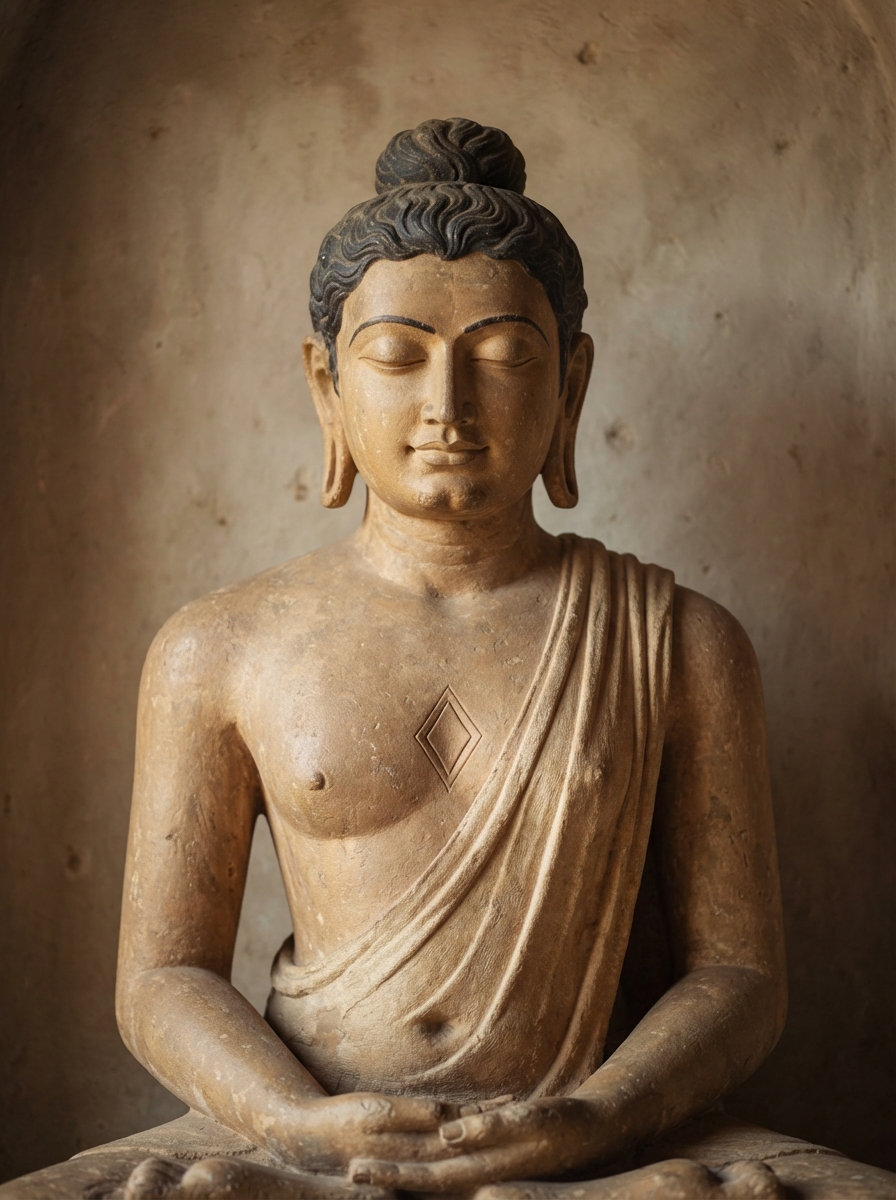
AI-assisted Portrait of Mahavira
The Man Who Swept the Road Before He Walked On It
On the Ganges plain in the sixth century BCE, two princes gave away their inheritances within a generation of each other and walked out into the forest to solve the same problem. One of them, Siddhartha Gautama, came back with a Middle Way — a path calibrated between indulgence and self-torture, softened for human capacity, designed to be walkable. The other came back with something harder. Vardhamana of the Vaishali region, remembered as Mahavira, "the great hero," concluded that the problem of suffering could not be negotiated down. If harm bound the soul, then harm had to go — all of it, everywhere, without exception, down to the organisms in a cup of water and the insects under a bare foot.
So he filtered his drinking water. He swept the ground ahead of each step. He walked only by daylight, so as not to crush what he could not see. He ate only food prepared for others, never for himself, so that no life would be taken on his account. He renounced his clothing — not as theatre, but as the last item on a list of possessions that his own logic had steadily shortened to zero. Tradition names him the twenty-fourth and final Tirthankara, the last of a succession of ford-makers who build the crossing over the river of rebirth; Jainism holds that he did not invent the teaching so much as recover and systematize it. The systematizing is the part that gives him away.
What is striking about Mahavira is not the severity — the Ganges plain was thick with ascetics outdoing one another in severity — but the architecture. His austerity was not an outpouring of pity. It was a deduction. Given a premise about karma and the soul, every physical act in a human day was audited for its consequences and assigned a rule, and the rules were then followed with a consistency that did not bend for weather, hunger, hostility, or company.
Mahavira was an INTJ whose dominant Ni built a complete theory of bondage and release, then refused to let a single footstep fall outside it.
A Cosmology Built Backward From Its Conclusion
Mahavira's karma is not the loose moral bookkeeping the word usually implies. In the Jain scheme it is nearly physical — a fine matter that adheres to the soul through action and passion, weighing it down, keeping it in the cycle of birth. Liberation is therefore not a reward granted but a residue removed: stop the influx, burn off what has already stuck, and the soul rises of its own nature. Everything else in the system — the vows, the fasts, the filters, the nakedness — follows from that single image with an almost geometric inevitability.
That is dominant introverted intuition doing what it does: converging, over years of solitary work, on one unifying picture and then treating it as the fixed point around which the rest of life must be arranged. He is said to have spent roughly twelve years wandering in silence and fasting before he taught anything at all. Nothing in the tradition suggests he was collecting data or testing options during that period. He was waiting for the picture to complete, and when it did — as omniscience, in the tradition's language, kevala jnana — he did not revise it afterward.
The same faculty shows in the doctrine of anekantavada, the many-sidedness of reality: the insistence that any single statement about a thing captures only one standpoint, and that the blind men each honestly describing a different part of the elephant are all correct and all insufficient. It is an extraordinary move for a man otherwise so absolute — and characteristically Ni, which holds that the underlying reality is real and singular while every articulation of it is partial. He was rigid about conduct and epistemologically humble about assertions, which is exactly backward from most zealots and exactly right for this type.
The Vision Converted Into Procedure
A vision that stays a vision changes nobody. Mahavira's auxiliary extraverted thinking is the machinery that turned a metaphysics of karmic matter into an operating manual. The five great vows — non-violence, truth, non-stealing, chastity, non-possession — are stated as absolutes for mendicants and then graded down into a workable lay version, so that merchants and householders could participate at a defined and honest fraction of the discipline. That two-tier design is why Jainism survived: it built a lay community whose obligations were real but achievable, supporting an ascetic core whose obligations were not.
He then organized his followers into a fourfold order — monks, nuns, laymen, laywomen — a structure with explicit categories and explicit duties for each. The inclusion of nuns as a formal estate, in numbers the tradition records as substantial, was an organizational decision as much as a spiritual one; it doubled the renunciant base. He is credited with dividing his senior disciples, the ganadharas, into teaching lineages so the doctrine would propagate through named channels rather than by rumor. This is the same instinct that filters water: identify the leak, install the mechanism, verify it holds.
Te also explains the texture of Jain ethics, which reads less like scripture than like a code. Occupations are ranked by the harm they entail — hence the historical concentration of Jains in trade, finance, and stonework rather than agriculture, which turns the soil and kills what lives in it. Fasting is specified, not merely encouraged. Even the final act attributed to him, sallekhana, the ritual fast unto death undertaken with full deliberation when the body can no longer support the vows, is a procedure with conditions, not a despairing gesture.
The Private Conviction Underneath the Code
Strip away the architecture and what remains is a single feeling held with total seriousness: that every living thing, however small, has a soul that does not want to be harmed. Jainism extends jiva — life, soul — not only to animals but to plants and to elemental bodies of earth, water, fire, and air. Nothing in the intellectual climate of the time compelled that extension. It is a value Mahavira arrived at inwardly and then refused to trim, and tertiary introverted feeling is precisely this: a conviction that is not argued into existence and cannot be argued out.
Its signature is that he applied it to himself first and hardest. The traditions of his wandering years dwell on his refusal to defend himself — enduring insult, dogs, stones, and expulsion from villages without retaliation, on the reasoning that a violent response would be his karma and no one else's. He is not recorded as denouncing his persecutors or building a case against them. The account is internal throughout: what matters is what he did, not what was done to him.
The nakedness of the Digambara ascetic belongs to the same register. It was never a display; the point was that a robe is a possession, a possession is an attachment, and an attachment is influx. A man reasoning from social effect would have kept the robe, since public opinion on the Ganges plain was mixed on the practice and it later split his community in two. Mahavira reasoned from his own premises and let the consequences fall where they fell.
The Body as an Instrument to Be Overruled
Inferior extraverted sensing does not mean a person ignores the physical world. It means the physical world is approached through the vision rather than for itself — an object of control, discipline, and occasionally punishment. Mahavira's relationship to his own body is almost purely instrumental. He fasted for extended periods; the tradition records his heaviest austerities as lasting months, taking food rarely and in trivial quantity. Heat, cold, and rain were to be borne unmoved. Sleep was minimized. The senses were not sources of information to be enjoyed but avenues of influx to be sealed.
Yet the discipline demanded acute physical attention, which is the paradox of an inferior function pressed into service. To avoid crushing an insect you must actually look at the ground. To avoid harming water-bodied beings you must attend to how you pour, drink, and strain. Jain monastic rules on careful walking, careful speaking, careful placing and lifting of objects are, functionally, a training in continuous sensory vigilance — but vigilance conscripted by doctrine, never sensory pleasure. The world is watched closely and given nothing.
The endpoint is consistent. At Pavapuri, around 527 BCE, he is said to have ended his life by fasting — the body finally released once it could no longer serve the vows. The night of that death is the night Jains still mark at Diwali, lighting lamps because, the tradition says, the light of his knowledge had gone out of the world.
Why INTJ Over INFJ
Why not INFJ?
The INFJ reading is tempting — a visionary founder preaching universal compassion is the archetype. But INFJ compassion works through relationship: it reads the person in front of it, adjusts the message, meets the listener where they stand. That is the Buddha's method, and it is why the Middle Way is calibrated to human capacity. Mahavira did the opposite. His ahimsa arrived as a closed system of rules covering every physical act without exception, applied identically regardless of circumstance, audience, or feeling. He did not soften the discipline for a sympathetic follower or harden it for a hostile one. Fe adapts the standard to the room; Mahavira's Te-Fi axis fixed the standard and let the room adapt.
The distinction is visible in what each man built. The Buddha's order absorbed and adjusted, taking in kings, courtesans, and bandits and meeting each at his level. Mahavira's order sorted people into defined categories with defined obligations and required exactness within them, and rather than blur a rule to preserve unity it eventually split over whether a monk might wear clothes. That is not coldness — the conviction under the code is as deep as any in religious history — but it is conviction expressed as system rather than as persuasion.
Connected Figures
Further Reading
- The Jain Agamas (Acaranga and Kalpa Sutras) — Jain canonical traditionThe oldest surviving strata of Jain scripture, including the earliest accounts of Mahavira's wandering years and monastic rules.
- The Jains — Paul DundasThe standard modern survey — history, doctrine, and the Digambara–Svetambara split, with careful handling of the dating problem.
- The Jaina Path of Purification — Padmanabh S. JainiThe clearest exposition of Jain karma theory and how the vows follow from it.
- Jainism: An Indian Religion of Salvation — Helmuth von GlasenappA classic scholarly overview, still valuable on ritual practice and the structure of the fourfold community.
- The Genesis of Ahimsa — Hermann Jacobi (trans., Sacred Books of the East)Jacobi's translations and prefaces established that Jainism predates and is independent of Buddhism.
