 Historical Figure MBTI
#1118 · 8-19-26 · The Age of the Buddha
King Bimbisara
The King Who Sheltered the Buddha
c. 558 – 491 BCE
5 min read
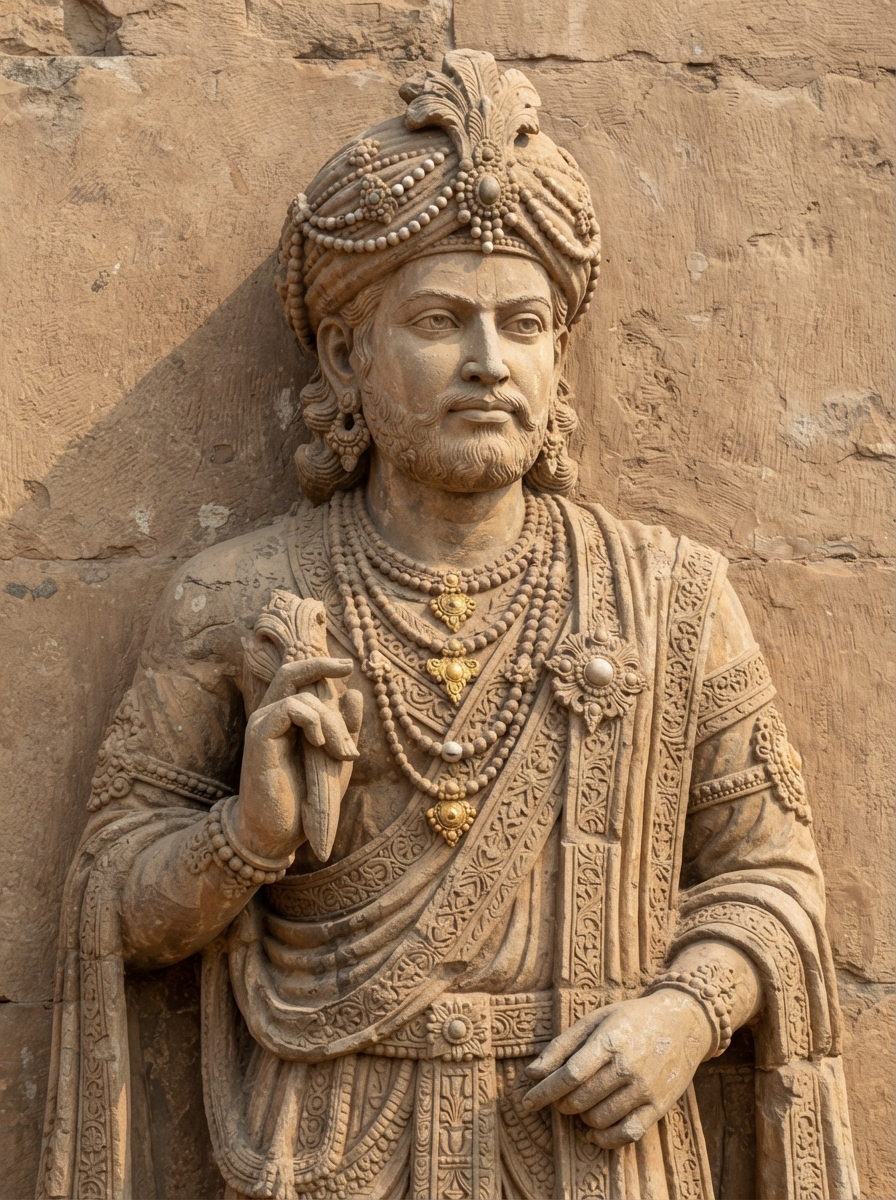
AI-assisted Portrait of King Bimbisara
A Kingdom Built on Handshakes
Bimbisara inherited a kingdom and turned it into a network. By the time he had consolidated Magadha into the dominant power of the Ganges plain, he had married into the royal houses of Kosala and Vaishali, absorbed the rival principality of Anga, and built a capital, Rajagaha, ringed by hills and threaded with roads meant to be traveled by envoys, merchants, and pilgrims alike. He was not a conqueror in the mold of a man who prized the battlefield for its own sake; he was a man who understood that a kingdom is held together by relationships, and who worked those relationships with tireless, personal attention.
That same instinct drew him to Siddhartha Gautama. According to the Pali Canon, Bimbisara had met the young ascetic years before his awakening, on the road outside Rajagaha, and had offered him half his kingdom on the spot — an offer as characteristic as it was impulsive, the gesture of a man who collected remarkable people the way other kings collected territory. When Gautama returned as the Buddha, Bimbisara became his first royal convert and his most consistent patron, donating the Veluvana — the Bamboo Grove — as one of the earliest permanent dwelling places the wandering Sangha had ever been given. He is, by most accounts, the reason the Buddhist monastic order first had a roof.
He was an ESFJ through and through — a dominant Fe that read a room, a rival teacher, or an entire kingdom the way other rulers read a treasury ledger.
The Patron Who Collected Teachers
Bimbisara's Fe shows most clearly in what he refused to do: pick a side. Rajagaha under his rule became a magnet for wandering ascetics of every stripe — not just the Buddha's Sangha, but Mahavira's Jain followers and a whole marketplace of rival sramana teachers besides. Bimbisara extended royal favor to nearly all of them, visiting their groves, funding their retreats, and treating spiritual rivalry as something to be hosted rather than adjudicated. A more private, principle-driven king might have picked the doctrine that made the most logical sense and funded that one exclusively. Bimbisara instead built relationships across the entire field, as though the point of patronage were the patronage itself.
The Veluvana gift captures this instinct at its most concrete. Rather than leave the Buddha and his monks to the makeshift shelters and borrowed groves that had served the wandering Sangha until then, Bimbisara handed over a pleasure park just outside his own capital — walking distance from the palace, easy to visit, easy to supply. It was patronage designed for ongoing contact, not a one-time act of piety filed away and forgotten. The Samannaphala Sutta shows him visiting personally, asking questions, listening to answers at length; this was a king who wanted the relationship kept warm, not a transaction he could consider closed.
Fifty-Two Years of Steady Ground
Underneath the patronage sat an auxiliary Si that made Magadha the era's most stable kingdom rather than merely its most fashionable one. Bimbisara reigned for roughly five decades — an extraordinary span for the period — and used the time to build the unglamorous machinery of a functioning state: a standing administration, a network of roads and garrisons, and marriage alliances with Kosala and Vaishali that removed his two most dangerous neighbors from the list of active threats. None of this made for dramatic storytelling. It made for a kingdom that could absorb the shock of religious upheaval, dynastic rivalry, and constant royal travel without coming apart.
That same groundedness explains why his generosity never tipped into recklessness. He gave Veluvana away, but he did not give away the kingdom's stability along with it; the Sangha's growing presence in Rajagaha was absorbed into an already orderly capital rather than allowed to destabilize it. Even his early, half-serious offer of half his throne to the unenlightened ascetic on the road reads less as impulsiveness than as a wealthy, settled man's confidence that he had plenty to spare. Si gave Fe's warmth a floor to stand on.
Why ESFJ Over ISFJ
Why not ISFJ?
An ISFJ king would have kept his kingdom stable and quietly cared for his own household, but he would not have gone looking for a marketplace of rival ascetics to host. Bimbisara actively sought out multiple competing teachers — the Buddha's Sangha, Mahavira's Jains, and others besides — cultivating each relationship in public and in person, and used that outward-facing generosity to expand Magadha's reach across the Ganges plain. That is dominant Fe organizing a social and political world outward, not introverted Si duty tending a settled one.
The distinction matters because Bimbisara's reign is so often flattened into a single image: the pious king who gave the Buddha a garden. He was that, but he was also a builder of alliances, a collector of remarkable people, and a ruler who measured his own success by the warmth of the relationships he could sustain — an ESFJ's instincts, applied at the scale of a kingdom.
Connected Figures
Further Reading
- The Samannaphala Sutta — Pali Canon, Digha NikayaBimbisara's own account of visiting the Buddha and questioning him on the fruits of monastic life.
- The Pali Canon Vinaya accounts — trans. variousRecords the donation of the Veluvana (Bamboo Grove) and Bimbisara's ongoing support of the Sangha.
- A History of Ancient and Early Medieval India — Upinder SinghStandard modern survey covering Magadha's rise and Bimbisara's reign in political context.
- The Buddha and His Teachings — Nyanaponika Thera / Bhikkhu Bodhi (eds.)Anthology situating Bimbisara among the Buddha's earliest lay patrons.
