 Historical Figure MBTI
#1122 · 8-20-26 · The Mauryan Empire
Bindusara
The Emperor Between Two Legends
c. 320 – 273 BCE
6 min read
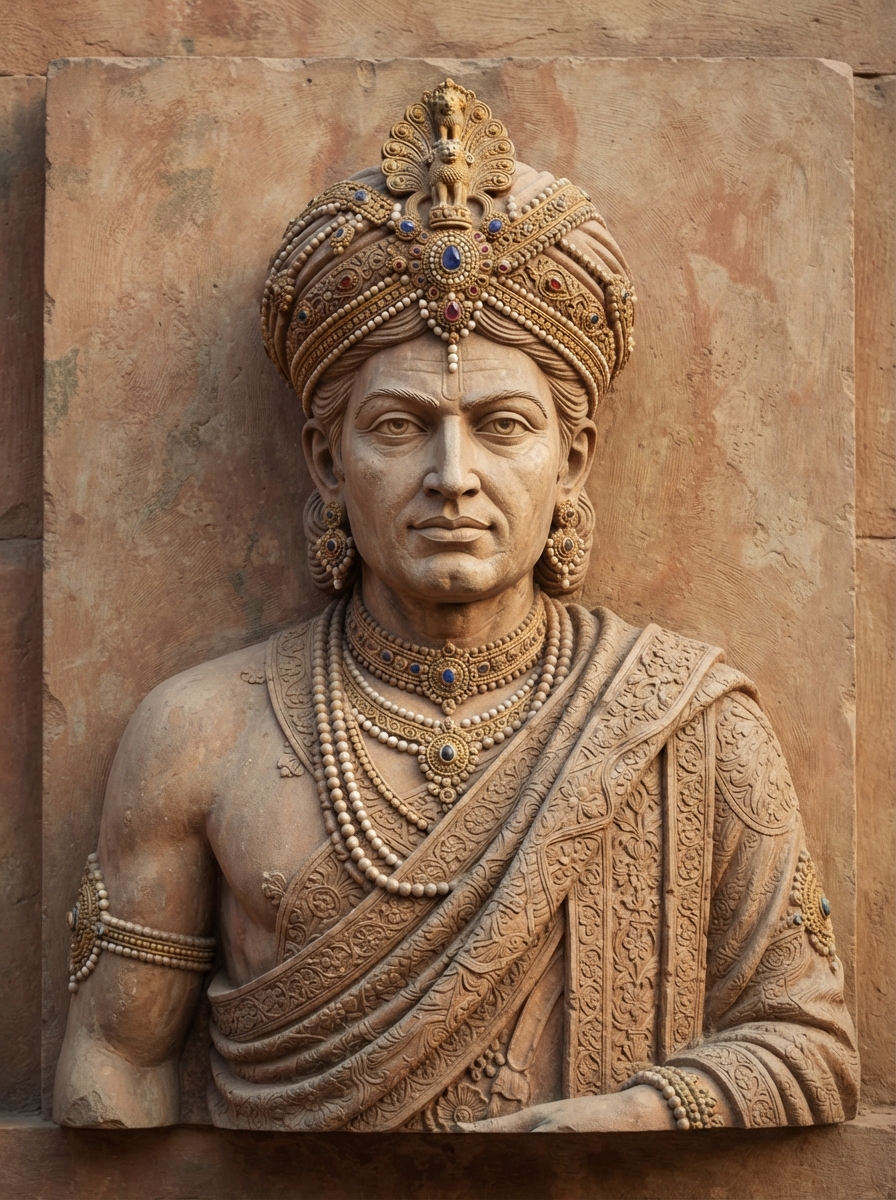
AI-assisted Portrait of Bindusara
Twenty-Five Years of the Unspectacular
History remembers founders and revolutionaries; it is far less generous to the men who simply keep the machine running. Bindusara inherited an empire his father had carved out of chaos — a subcontinental power stretching from the Hindu Kush to the Deccan, forged in war and consolidated through Chanakya's ruthless statecraft — and he handed it, larger and undiminished, to a son who would go on to renounce war altogether and reinvent what an Indian emperor could be. Between those two thunderclaps, Bindusara reigned for roughly a quarter of a century, and the classical and Indian sources alike can barely be bothered to describe how.
That silence is itself the clue. A ruler who governs by dramatic gesture leaves behind dramatic records — edicts, conquests, conversions, ruptures. A ruler who governs by maintaining what already works leaves behind almost nothing, because nothing needed fixing loudly enough to write down. Bindusara continued his father's diplomatic marriage to the Seleucid Empire, continued the machinery of provincial administration Chanakya had designed, and by most later accounts pushed Mauryan authority further into the Deccan without anyone bothering to name the campaigns. He was, in other words, exactly what a vast and fragile new empire needed after its violent birth: someone who would not break it.
Bindusara was an ISTJ down to the marrow — a dominant-Si custodian who measured his reign not by what he began, but by what he refused to let slip.
The Custodian's Inheritance
Dominant Si reads the present through the precedent of the past, and no act of Bindusara's reign illustrates this more precisely than his handling of the Seleucid relationship. His father Chandragupta had ended a border war with Seleucus I not through further conquest but through a negotiated peace sealed by intermarriage and the exchange of ambassadors — Megasthenes among them. Bindusara did not renegotiate this arrangement or seek to outdo it. He simply kept it running, corresponding directly with Seleucus's son and successor, Antiochus I, as though the channel his father had opened were now a permanent fixture of how the Mauryan court did business.
The one vivid fragment that survives from his reign captures this instinct almost comically well: Bindusara wrote to Antiochus requesting sweet wine, dried figs, and a Greek sophist be sent to his court. It is a small, domestic, almost bureaucratic request — a man extending an established supply line rather than making a grand statement — and it is telling that Antiochus reportedly sent the wine and the figs but demurred on the philosopher, noting that such men were not commodities for export. Bindusara's request was not for glory; it was for the steady accumulation of what a well-run court already knew it wanted.
This same instinct shaped his approach to the vast administrative apparatus Chanakya had designed under his father — the provincial governors, the tax structure, the espionage network described in the *Arthashastra*. Bindusara is not credited with reforming any of it. He is credited with nothing dramatic at all, which for a system that size, over twenty-five years, without a single recorded succession crisis or major revolt, is itself the achievement.
Expansion Without Announcement
If Si told Bindusara what to preserve, Te told him what to execute — and auxiliary Te in an ISTJ shows up not as flair but as results delivered through existing chains of command. Later Indian tradition credits him with military campaigns that pushed Mauryan control further south into the Deccan, expanding an empire that under Chandragupta had already reached most of the subcontinent's north and center. What is striking is how little ceremony survives around these campaigns. There is no Bindusara equivalent of Ashoka's Kalinga edicts, no monument boasting of the achievement. The expansion reads, in the fragmentary record, less like a personal crusade and more like a logistics problem that got solved.
That is Te operating in service of Si's inherited framework rather than Te operating for its own sake — the difference between an ESTJ who expands to prove something and an ISTJ who expands because the existing system's logic demands it, then moves on without fanfare. Bindusara's court apparently earned the nickname "Amitrochates" among Greek writers, a garbled rendering of a Sanskrit epithet meaning something like "slayer of enemies" — evidence that outsiders registered him as a formidable, functioning ruler even as the internal record stayed nearly silent on how.
Why ISTJ Over ESTJ
Why not ESTJ?
An ESTJ inheriting Chandragupta's empire would have made outward, assertive marks of his own — new campaigns launched on his own initiative, new titles claimed, a reign shaped to announce itself. What the sparse record of Bindusara shows instead is a ruler content to let dominant Si's fidelity to the existing framework do the governing, executing through Te only where the inherited system already pointed. The Deccan campaigns and the Seleucid correspondence read as continuation, not proclamation — a quieter, more internally-oriented relationship to authority than ESTJ's outward command presence would produce.
The distinction matters because it explains why Bindusara's twenty-five years are so easy to overlook and so essential to the story. An empire that had just been assembled by force needed, more than anything, someone who would not tinker with it — who would treat what existed as a trust to be maintained rather than a draft to be revised. That is the quiet, procedural signature of ISTJ, and it is precisely the chapter that made Ashoka's later, far louder transformation possible.
Connected Figures
Further Reading
- Deipnosophistae — AthenaeusPreserves the fragment of Bindusara's letter to Antiochus I requesting wine, figs, and a sophist.
- Asoka and the Decline of the Mauryas — Romila ThaparThe standard scholarly account of the Mauryan dynasty, situating Bindusara's reign between his father's and son's.
- A History of Ancient and Early Medieval India — Upinder SinghPlaces Bindusara's Seleucid diplomacy and southern campaigns within the broader Mauryan administrative record.
