 Historical Figure MBTI
#1120 · 8-20-26 · The Mauryan Empire
Chanakya
Kautilya · Architect of the Mauryan Empire
c. 375 – c. 283 BCE
5 min read
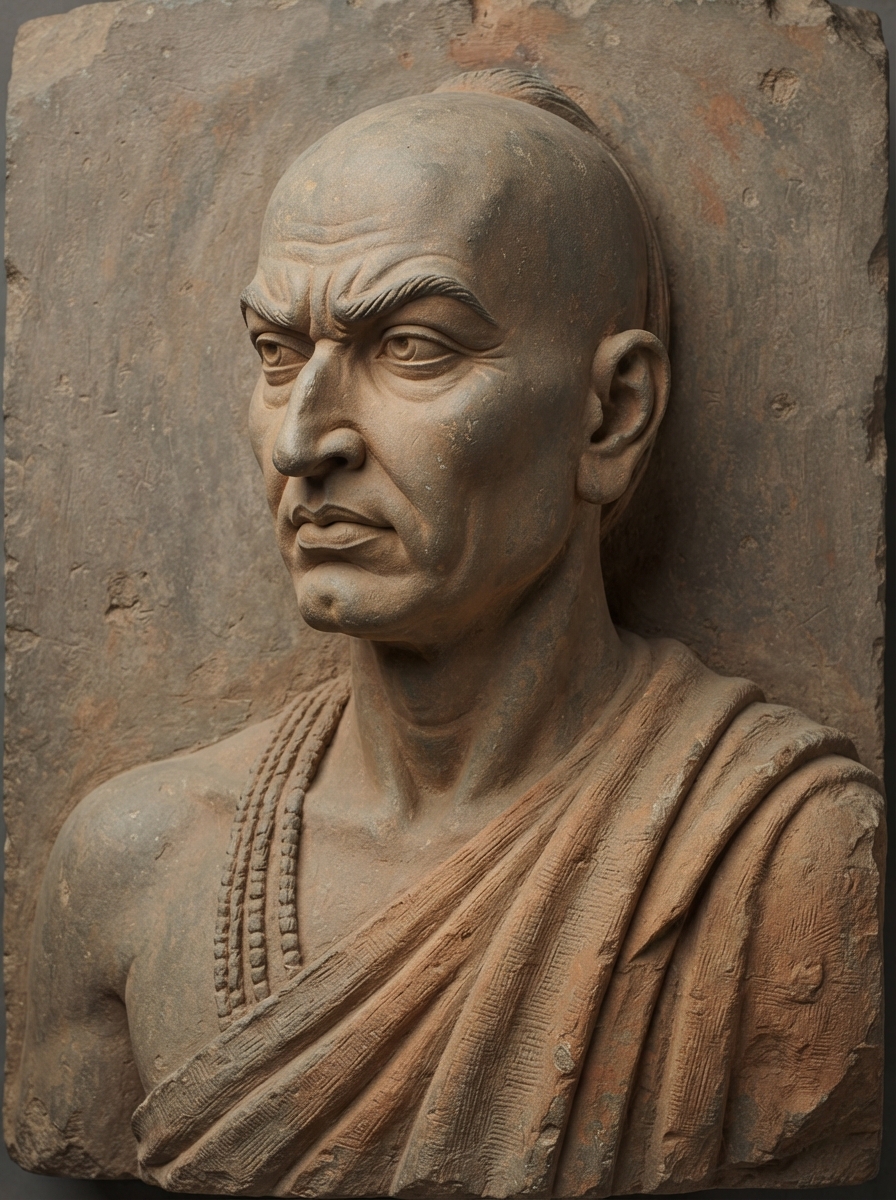
AI-assisted Portrait of Chanakya
The Insult That Built an Empire
A Brahmin scholar with a reputation for a mind too sharp for court manners, Chanakya was, by tradition, humiliated at the hall of the reigning Nanda king — thrown out, his topknot pulled loose in front of the assembly. He did not draft a complaint. He did not seek redress. He simply resolved, in that instant, that the Nanda dynasty would end, and set about it with a patience that outlasted the insult by decades. He found a boy named Chandragupta Maurya, trained him in secret, built the coalitions and covert networks needed to topple a throne, and when the throne finally fell around 322 BCE, he did not sit on it. He wrote the manual instead — the Arthashastra, a treatise on statecraft so exhaustively practical it reads less like philosophy than like an operations handbook for running a kingdom.
That arc — private vision, absolute patience, systems built to outlive the man who built them — is the signature of an INTJ. Chanakya belongs to the small class of historical figures who translated a single interior conviction into a functioning state, then documented the method so thoroughly that it survived him by two millennia.
Chanakya was an INTJ whose dominant Ni turned a single act of public humiliation into a decades-long architecture for dismantling a dynasty.
The Long Design
Ni does not react to a slight; it metabolizes it into a plan with a horizon of decades. Chanakya's response to the Nanda court was not an outburst but a design: identify a vessel for the vision — a young man of promise from outside the existing power structure — and shape him from adolescence into a ruler capable of executing what Chanakya himself, as a scholar with no army, could never accomplish alone. He is traditionally said to have spent years cultivating Chandragupta before a single battle was fought.
The campaign against the Nandas was not one stroke but a sequence — alliances with border kings, infiltration of the Nanda court's own weaknesses, calculated retreats when a direct assault failed, and a final convergence timed to when the pieces were actually in place. Ni thinks in inevitabilities rather than opportunities; Chanakya treated the fall of a dynasty as a foregone conclusion he merely had to schedule correctly.
Even after Chandragupta's throne was secure, the vision did not stop at one reign. Tradition holds Chanakya stayed on as counselor into Bindusara's rule, extending the architecture of the state a generation past its founding — proof that his real project was never a single coronation but a durable order.
Statecraft as System
Where Ni supplied the vision, Te built the machinery to run it — and then wrote the machinery down. The Arthashastra is not a philosophical treatise on the nature of good governance; it is a working manual, cataloguing tax structures, espionage networks, diplomatic classifications, famine contingencies, and the precise circumstances under which a ruler should employ deception or force. Its scope — economics, law, foreign policy, military organization — is the product of a mind that wanted every lever of state accounted for and none left to improvisation.
Te externalizes logic into efficient, replicable systems, and Chanakya's espionage apparatus is the clearest example: a standing network of spies disguised as ascetics, merchants, and courtiers, designed to function as institutional infrastructure rather than a one-time tactic. It was built to outlast the specific crisis that prompted it, exactly the kind of durable system a Te-user builds by instinct.
The same instinct shows in his willingness to prescribe ruthlessness as policy rather than improvise it in the moment — recommending, for instance, calibrated uses of bribery, sabotage, and assassination against hostile states as codified tools of statecraft. The comparison to Machiavelli's The Prince, drawn many centuries later, exists precisely because both texts treat the ethics of power as engineering problems to be solved, not agonized over.
A Grudge Kept Like a Vow
What kept the plan burning for years, rather than fading into resignation, was Fi — a private, unshakable conviction of what he had been owed and what was now non-negotiable. The humiliation at the Nanda court was not merely a strategic pretext; tradition frames it as a personal wound that Chanakya nursed in silence and never renounced, an inner value system violated that demanded restitution on his own terms, not the court's.
That same interior compass explains why he mentored Chandragupta with such personal intensity rather than simply hiring or commanding him — the relationship reads as one built on Chanakya's own sense of what a ruler owed his people and his teacher, not on transactional convenience. He is remembered as austere and famously indifferent to personal wealth or comfort even while directing the finances of an empire, living simply by his own private code long after he had the power to live otherwise.
Why INTJ Over INTP
Why not INTP?
An INTP could have written the Arthashastra as pure theory — a taxonomy of statecraft admired and shelved. Chanakya did something an INTP's dominant Ti rarely sustains: he subordinated every idea to a single, urgent, real-world outcome. The espionage networks, the alliances, the years of patient mentorship were not exploratory thought experiments; they were instruments aimed at one concrete target, the installation of Chandragupta on a real throne. The treatise came after the regime was already standing, a record of what had worked, not a speculation about what might.
That distinction — vision converted immediately and unwaveringly into applied outcome, rather than refined indefinitely for its own sake — is Ni-Te in its purest form, and it is why Chanakya reads as architect and kingmaker rather than as philosopher.
Connected Figures
Further Reading
- Arthashastra — Kautilya, trans. L.N. RangarajanThe treatise itself — the fullest primary window into Chanakya's mind as a systems-builder.
- Arthashastra — Kautilya, trans. R.P. KangleThe standard scholarly critical edition and translation, with extensive commentary.
- Asoka and the Decline of the Mauryas — Romila ThaparSituates Chanakya's project within the broader arc of the Mauryan state he helped found.
- Kautilya and the Arthashastra — Thomas TrautmannA close study of authorship, dating, and the text's place in Indian political thought.
