 Historical Figure MBTI
#1121 · 8-20-26 · The Mauryan Empire
Chandragupta Maurya
Founder of the Mauryan Empire
c. 340 – 297 BCE
8 min read
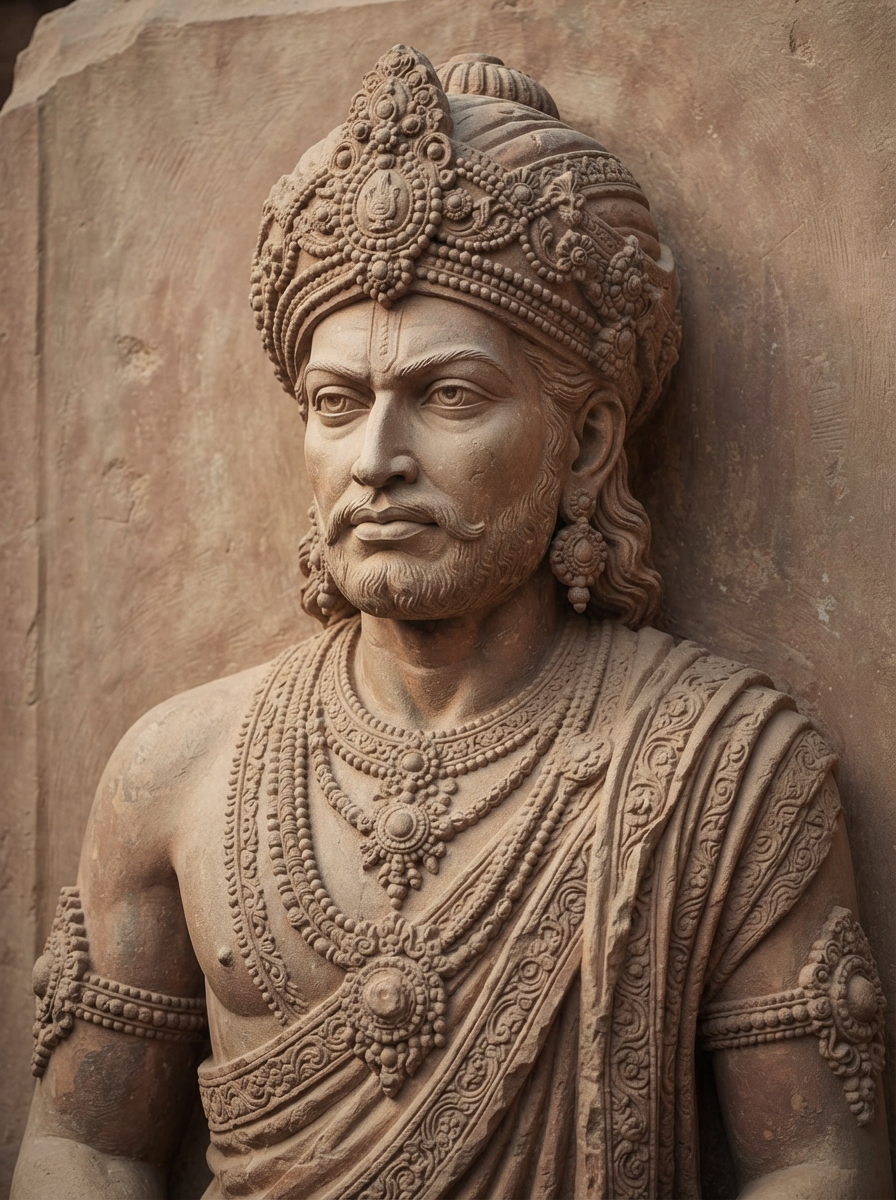
AI-assisted Portrait of Chandragupta Maurya
The Man Who Built a Subcontinent Out of Nothing
Nobody agrees on where he came from. The Buddhist chronicles make him a prince of a minor clan; the Jain and Hindu traditions make him low-born, the son of a Nanda king by a woman of no standing, or the child of peacock-tamers. The Greeks who met him simply called him Sandrokottos and noted that he had risen from obscurity. The confusion is itself the point: the founder of the first empire to hold most of the Indian subcontinent left behind no genealogy worth forging, because he did not need one. What he had instead was a plan, a teacher, and an appetite for execution that did not slacken for thirty years.
Around 322 BCE he destroyed the Nanda dynasty at Pataliputra — the richest and best-armed throne in the Ganges valley — and took it for himself. Within two decades he had absorbed the Macedonian satrapies left drifting by Alexander's death, fought Alexander's own general to a standstill, and extracted from him a treaty that pushed his frontier past the Hindu Kush. A Seleucid ambassador sat in his capital writing down the size of his army and the layout of his streets. He had built, from a beginning that history cannot even reliably date, an administrative machine that his grandson Ashoka would inherit intact and use to broadcast dharma across half of Asia.
And then, if Jain tradition is right, he handed it all to his son, walked south with a teacher, sat down on a hill in Karnataka, and starved himself to death on purpose. That last act is what makes him legible as an ENTJ rather than a pure conqueror: the same man who could organize a continent could also decide, absolutely and privately, that the organizing was finished.
Chandragupta is the ENTJ in its purest historical form — dominant Te that turns a vision into an apparatus, and then discovers it has no vocabulary for what to want once the apparatus is built.
The Empire as an Instrument
Overthrowing the Nandas was the easy half. Nanda Magadha was hated, over-taxed, and — by every surviving account — sitting on a treasury that made it worth taking. The hard half was what Chandragupta did next: he kept it. He did not loot Pataliputra and ride off. He turned a conquered kingdom into a state with departments, and then replicated that state westward across Malwa, Gujarat, and the Indus, and southward toward the Deccan, until a single revenue system reached from Bengal to Kandahar.
What that looked like on the ground survives, at second hand, in Megasthenes, the Seleucid ambassador who spent years at his court and whose Indica we now read only in the fragments later Greeks quoted. Megasthenes described boards of officials assigned to distinct functions — irrigation and land measurement, markets and weights, the supervision of foreigners, the registration of births and deaths — and a war office split into six committees, one each for infantry, cavalry, chariots, elephants, the navy, and the commissariat. Whatever a Greek observer got wrong about Indian caste, he was not inventing bureaucratic tables. He was describing a machine, and machines of that kind do not assemble themselves out of conquest.
The Arthashastra, attributed to Chanakya, is the theory to which that machine is the practice: spies as a standing branch of government, granaries audited, forts costed, treason priced. Te does not merely want power; it wants power that runs when the man holding it is asleep. Chandragupta's real achievement was not the battlefield but the ledger — an apparatus solid enough that his son Bindusara inherited it without civil war, and his grandson inherited it again.
A Map Nobody Had Drawn Yet
Before Chandragupta there was no India in the political sense. There were mahajanapadas, a dominant Magadha, a scatter of republics, and — after 326 BCE — a set of Greek garrisons on the Indus that belonged to a dead man's empire. To look at that map and see a single realm was not an obvious inference from the facts. It was a picture held in advance and then imposed on the facts, which is what auxiliary Ni does in service of Te: it supplies the one long-range objective that every short-range decision is measured against.
The partnership with Chanakya is best understood as that vision being argued into shape by two people. Tradition gives the Brahmin the grudge and the doctrine and gives Chandragupta the will and the army, but the sequencing is unmistakably strategic rather than opportunistic: peripheral territory first, alliances with hill peoples, the capital last. The traditional story in which a village woman scolds a boy for eating the middle of a hot dish before its edges — and Chanakya takes the rebuke as military instruction — is almost certainly a fable, and it is a fable about exactly the right thing. The target was never a battle. It was the shape of the finished thing.
Ni also explains the timing of the western war. Chandragupta did not move against the Macedonian holdings while Alexander lived, and he did not move while the succession was still fluid. He moved when Seleucus was committed elsewhere and the eastern satrapies had become an obligation the Seleucids could not afford. That is not opportunism, which takes what is available; it is patience, which waits for the moment a long-held picture becomes achievable.
Five Hundred Elephants
Between roughly 305 and 303 BCE, Chandragupta went to war with Seleucus I Nicator — a man who had commanded under Alexander, who held Babylon, and who came east intending to recover what his old king had taken. We do not have the battles. We have the settlement, and settlements do not lie about who was winning. Seleucus ceded the eastern satrapies — Arachosia, Gedrosia, Paropamisadae, a slice of Aria, territory covering much of what is now Afghanistan and Baluchistan — and received five hundred war elephants in return. A marriage alliance sealed it.
Read that trade coldly. A Successor king with a professional Macedonian army gave away the entire Indian frontier for animals. He did it because the animals were worth more to him at Ipsus, where in 301 BCE the elephants Chandragupta sold him broke Antigonus's line and decided the fate of Alexander's inheritance — but he also did it because pressing further east was not survivable. Tertiary Se in an ENTJ shows up precisely here: not in a love of danger, but in the willingness to commit force at full weight, at the right moment, and to convert the resulting physical fact into a signed advantage.
The same sensory decisiveness runs through the earlier campaign. Megasthenes reports a standing army of six hundred thousand foot, thirty thousand horse, and nine thousand elephants — inflated, surely, but not invented out of nothing, and a figure the Greeks found credible enough to repeat. Chandragupta was not a theorist of war who delegated the fighting. He led it, from the Punjab to the Deccan, for the better part of two decades, and the terms he won at the Hindu Kush were the terms of a man who had been present at the moments that produced them.
The Hill at Shravanabelagola
Jain tradition holds that late in his reign a twelve-year famine came to Magadha, and that Chandragupta — by then a listener to the ascetic teacher Bhadrabahu — abdicated in favour of Bindusara, took monastic vows, and walked south with the migrating Jain community to a granite hill at Shravanabelagola in present-day Karnataka. There he undertook sallekhana, the ritual fast to death, and died. The cave they point to still bears his name. The historicity is contested; the inscriptions attesting the tradition are centuries later. But nothing else in the record explains why a founder at the height of his power stopped.
Inferior Fi is not the absence of values. It is values that go unarticulated for decades and then arrive whole, non-negotiable, and immune to argument. An ENTJ who has spent his life converting conviction into structure has no practice at holding a conviction that structure cannot serve — so when one finally surfaces, it does not get modified into policy. It gets obeyed. Ahimsa and renunciation cannot be administered. They can only be personally undergone, and Chandragupta appears to have understood that with the same literalism he brought to everything else.
It is worth noticing what he did not do. He did not make Jainism the state religion, did not decree the reform, did not attempt to bend the empire toward his conscience. He left the machine running exactly as built, handed the keys to his son, and removed himself. Two generations later Ashoka would try the other approach — conviction broadcast on rock and pillar, an empire told what its ruler now believed. The grandfather's version was quieter and, in its way, more absolute: the state stays, the man goes.
Why ENTJ Over ESTJ
Why not ESTJ?
The ESTJ reading is tempting, because the visible output is an administrative system and ESTJs build those superbly. But an ESTJ works from precedent — an inherited office, an existing institution, a proven method extended further and run better. Chandragupta inherited nothing. There was no pan-Indian state to administer, no template for governing from Bengal to the Hindu Kush, and no reason from within the existing order to believe such a thing was possible. The empire was a picture first, worked out with Chanakya against the grain of every precedent available, and only afterward a bureaucracy. Si extends what exists; the Ni behind this career had to invent what did not.
The tell is the western war. An ESTJ ruler consolidating a new conquest secures his gains and fortifies the frontier. Chandragupta, with the Nanda throne barely warm, chose to attack a Successor of Alexander the Great — and then traded away five hundred elephants, an enormous strategic asset, for territory he did not yet need to govern. That is a man playing for the finished shape of something rather than the security of what he holds. The abdication makes the same point from the other end: the ESTJ's identity is bound to the office, and he dies in it. Chandragupta walked out of his.
Connected Figures
Further Reading
- Indica (surviving fragments) — MegasthenesThe eyewitness core of everything we know about Pataliputra, collected in R. C. Majumdar's The Classical Accounts of India.
- Asoka and the Decline of the Mauryas — Romila ThaparThe standard modern account of the dynasty Chandragupta founded and the state machinery he built.
- A History of Ancient and Early Medieval India — Upinder SinghPlaces the Mauryan rise in its archaeological and textual context, with a careful weighing of the origin legends.
- The Arthashastra — Kautilya, trans. L. N. RangarajanThe treatise attributed to Chanakya — the theory of the state that the Mauryan administration approximates in practice.
- The Mauryan Polity — V. R. Ramachandra DikshitarAn older but still-cited reconstruction of Mauryan institutions from Greek, Jain, and Brahmanical sources.
