 Historical Figure MBTI
#1128 · 8-21-26 · The Fall of the Han
He Jin
Butcher's Son · Regent · The Plot He Couldn't Finish
d. 189 CE
7 min read
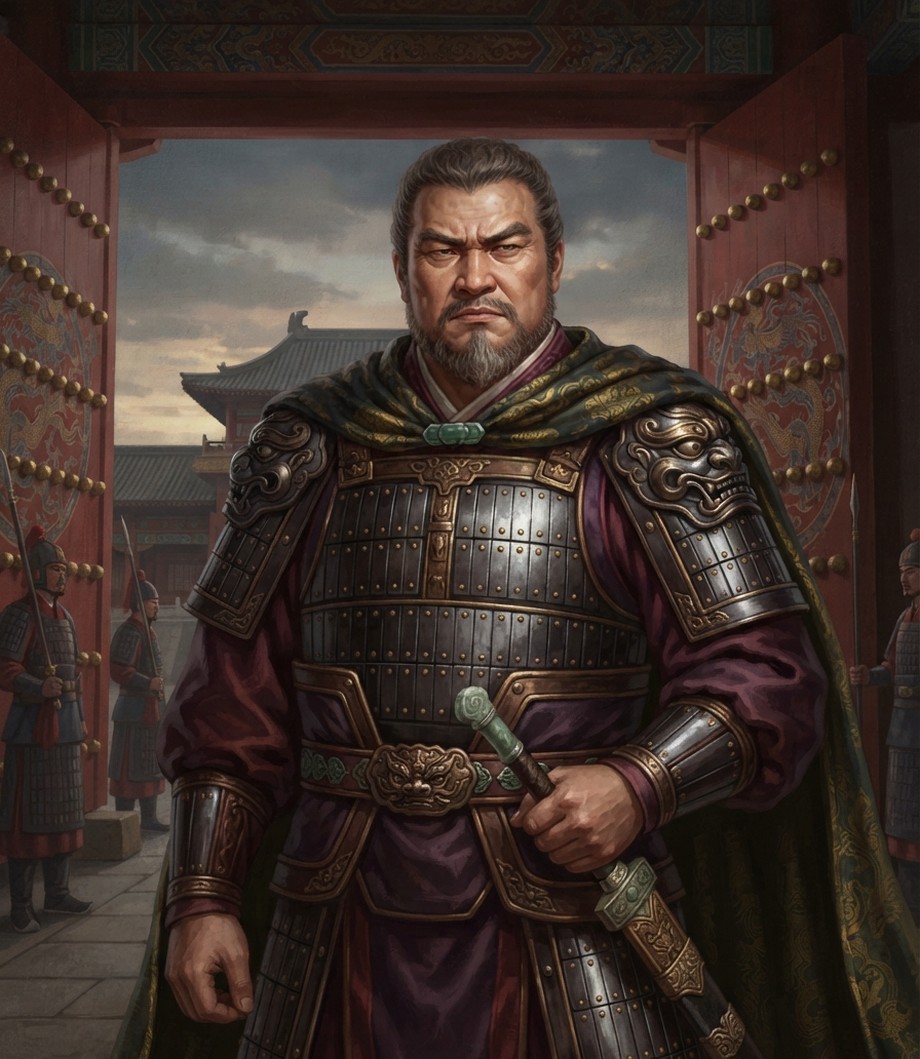
AI-assisted Portrait of He Jin
The Regent Who Needed Everyone's Blessing
He Jin never wanted power in the way conquerors want it. He inherited it, almost by accident of blood — a butcher's son from Nanyang whose half-sister happened to catch the eye of Emperor Ling, rose to Empress, and pulled her entire clan up the ladder of Han officialdom behind her. When Ling died in 189 and left a child on the throne, He Jin found himself Grand General of the empire, a title with none of the temperament to match it. He had not schemed his way there. He had been carried.
What followed was not tyranny or ambition but a slow-motion crisis of consensus. The court's eunuch faction — the Ten Attendants, led by the wily Zhang Rang — had run the palace for a generation, and He Jin, urged on by the aristocrat Yuan Shao, agreed they had to go. He agreed easily. He agreed publicly. What he could not do was act without the room's approval — above all his sister's, the new Dowager Empress, who owed the eunuchs her own rise and would not sign off on their destruction. So He Jin waited, negotiated, waited again, and finally reached for a lever no one had asked him to pull: he summoned the frontier general Dong Zhuo and his army toward the capital, not to fight, he told himself, but to persuade.
He Jin was an ESFJ down to the marrow — a dominant Fe that could organize a faction, a court, even an invading army into position, but that could never quite give the order to strike without every relationship in the room nodding along first.
The eunuchs did not wait for Dong Zhuo to arrive. They struck first, luring He Jin into the palace on a forged summons and killing him before the army he had raised ever crossed the city gate. His death was the spark; the massacre of the eunuchs that followed was the fire; and the vacuum left behind was walked into, calmly and permanently, by the very warlord He Jin himself had invited. Nothing about the Han collapse required a villain. It only required a decent, relationship-bound man in a seat built for someone willing to act alone.
A Coalition, Never a Command
Every decision He Jin made as regent was made through other people. He did not simply order the purge of the Ten Attendants; he recruited Yuan Shao to argue for it, deferred to his sister's authority to sanction it, and consulted his fellow officials as though the empire's survival were a matter to be settled by committee. That is Fe as He Jin lived it — not weakness exactly, but a conviction, bone-deep, that legitimate action has to be collectively willed before it can be personally taken.
It served him, for a while, as social glue. He held together a court riven by factions — palace eunuchs, provincial generals, reform-minded scholars — long enough to become the fulcrum everyone needed to court. But Fe dominance built for consensus curdles fast when consensus is the very thing the crisis has run out of time for. His sister would not budge; Yuan Shao kept pressing for boldness he wasn't equipped to supply on his own; and rather than break the deadlock by fiat, He Jin manufactured a third party to break it for him.
That third party was Dong Zhuo's army. Summoning it was not the act of a man seizing power — it was the act of a man still trying to build a coalition, this time armed, hoping the mere threat of overwhelming force would finally bring his sister and the eunuchs to heel without him ever having to personally order a killing. It is Fe's logic taken to its most dangerous extreme: if persuasion won't move the room, recruit something big enough to move it for you.
Doing It the Proper Way, to the End
He Jin's auxiliary Si shows up not as nostalgia but as procedure — an insistence that the purge of the eunuchs happen through the correct channels, with the correct signatures, in the correct order. He would not move against Zhang Rang and the Ten Attendants without an imperial edict behind him, because an unsanctioned purge, however justified, was not how a Grand General of the Han was supposed to operate. The office had rules. He meant to follow them even while dismantling the men who had corrupted them.
This is also why the Dowager's refusal paralyzed him rather than simply annoying him. For a man wired to work within established hierarchy, her withheld blessing was not one obstacle among several — it was the absence of the one thing that made the whole plan legitimate. He kept returning to her, kept re-litigating the same request, because Si told him that the proper form still mattered even as the situation outran it.
It is a peculiarly Han irony that the man trying hardest to preserve the propriety of the old order — court sanction, family hierarchy, established channels of authority — was the one whose caution about violating that order ended up destroying it outright. Si gave him patience. It did not give him the sense to know when patience had become the danger.
The Lateral Move That Undid Him
Summoning Dong Zhuo was, in its own strange way, an act of imagination. He Jin had exhausted the direct paths — his sister would not authorize the purge, and he would not order it without her — so his tertiary Ne reached sideways for an option nobody else at court had proposed: bring in an outside force whose sheer presence would tip the balance without anyone at the center having to take direct responsibility for the violence.
It has the shape of cleverness. A frontier army, marching on the capital, applies exactly the kind of ambient pressure a man who hates issuing direct orders would find appealing — it changes the equation without his own hand on the blade. Several of his advisors reportedly warned that inviting a warlord of Dong Zhuo's reputation into the capital was a plan with no good ending. He Jin heard the warning and pursued the idea anyway, drawn to its cleverness more than its consequences.
That is Ne unmoored from real strategic weight — a genuinely novel solution to an immediate social bind, reached for because it sidestepped the confrontation he could not bring himself to have, without ever being tested against what actually happens once an ambitious general's army is already on the road to an unguarded throne.
A Blind Spot Shaped Like an Army
What He Jin's plan needed, and never got, was rigorous downstream reasoning — the inferior Ti to ask, coldly, what happens after Dong Zhuo's army arrives, whether it can be sent home again, and who actually controls it once it is standing inside the capital's walls. That kind of interrogation was exactly what his psychology was worst equipped to supply under pressure.
He treated the summons as a lever with an off switch, something he could deploy to force his sister's hand and then quietly retract once the eunuchs backed down. Nowhere in the surviving record does he seem to have reasoned through the far likelier outcome: that an ambitious warlord, once given a legitimate pretext to march on Luoyang, would have no particular incentive to leave.
The eunuchs, cornered by exactly this threat, solved their own problem with brutal Ti-adjacent clarity — kill He Jin before his army-shaped pressure tactic could be brought fully to bear. He never got the chance to discover his own miscalculation, because the men he was trying to out-maneuver reasoned three steps ahead of him and struck first.
Why ESFJ Over ISFJ
Why not ISFJ?
It is tempting to read He Jin's paralysis as pure introverted caution — a quiet man overwhelmed by a crisis too large for him. But he was never passive. He actively recruited Yuan Shao to his cause, worked the court's factions for support, and ultimately mobilized an entire frontier army as a pressure tactic — an outward, socially coordinated campaign to manufacture consensus, not a retreat into wait-and-see. That is extroverted Fe reaching for leverage through other people, not introverted Si simply waiting for the storm to pass.
An ISFJ in his position might have stalled the purge out of sheer risk-aversion and left it there. He Jin instead kept building, recruiting, and escalating a coalition to force the outcome he wanted — he just could never bring himself to force it directly. The tragedy is not that he did nothing. It is that everything he did was aimed at getting someone else's blessing for a strike he was never going to deliver himself.
Connected Figures
Further Reading
- Fire over Luoyang: A History of the Later Han Dynasty — Rafe de CrespignyThe definitive account of He Jin's regency and death.
- A Biographical Dictionary of the Later Han to the Three Kingdoms — Rafe de CrespignyEntry on He Jin.
