 Historical Figure MBTI
6 min read
#279 · 3-25-26 · Catherinian Russia
Fyodor Ushakov
Admiral · Orthodox Saint · Russia's Invincible Sea Commander
1745 — 1817
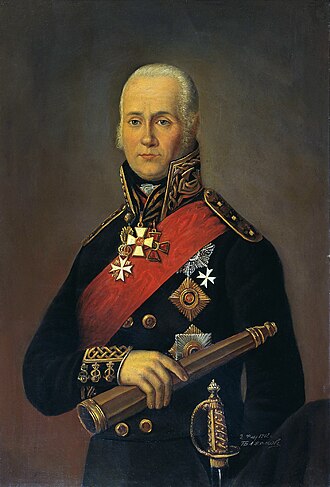
Portrait of Fyodor Ushakov
Forty-Three Engagements, Not a Ship Lost
The Russian Orthodox Church canonized Fyodor Fyodorovich Ushakov in 2001 as a "Righteous Warrior" — a category invented, essentially, for him. In forty-three engagements he never lost a ship, never had a sailor taken prisoner. He paid for the wounded from his own pocket, built churches with his retirement income, and declined Napoleon's invitation to join the Egyptian expedition without apparent deliberation.
The Siege of Corfu in 1799 — coordinating bombardment, troop landings, and irregular Greek fighters against French fortifications — anticipated combined-arms methods a century ahead. At Tendra in 1790, against an outnumbering Ottoman fleet, he demonstrated the qualities that defined him: meticulous preparation, disciplined execution, and the innovation of targeting the enemy flagship first to destroy cohesion before conventional gunnery could.
That's the ISTJ signature: duty performed with absolute precision, care expressed through correct execution, faith lived through accumulated right action rather than announced through feeling.
He died in 1817 having given away much of his wealth, buried at the Sanaksar Monastery near his birthplace. The canonization came two centuries later, but the qualities it recognized were visible throughout — not in dramatic gesture but in the steady, relentless doing of what was right, day after day, for seven decades.
The Standard He Would Not Relax
Si — introverted sensing — is not nostalgia; it is profound respect for what has been proven to work. For Ushakov it manifested as an obsession with standards — training, maintenance, operational — and a refusal to let those standards slip. His ships were famously well-maintained; his crews trained to a drill precision that distinguished the Black Sea Fleet from the rest of the Russian navy.
He inherited the tradition from commanders like Samuel Greig and internalized those standards deeply enough to improve on them. The "Ushakov tactic" — systematically targeting enemy flagships at the outset to collapse command coordination — was Si innovation: derived from careful observation of how battles unfold, then extracted into an actionable principle. Not Ne creativity ("what if we tried something different") but Si-Te rigor ("what does evidence consistently show, and how do we build a system around it").
Command as Organized Certainty
Te — extroverted thinking — is the ISTJ's auxiliary: the organizer that translates Si's accumulated knowledge into reliable operational procedure. Ushakov created systems so dependable that outcomes were as close to certain as naval warfare permitted.
The Siege of Corfu demonstrates Te at operational scale. No protocol existed for taking a heavily fortified island with Russian sailors, soldiers, and irregular Greek fighters — so Ushakov built one: organized the forces by capability, designed a plan, executed. The French surrendered; the operation became a model historians still cite. His Te then extended to the aftermath: helping establish a constitution for the freed Ionian Islands, because a durable victory requires stable institutions, not just a captured fort.
The Private Piety That Ran Everything
Fi — introverted feeling — is the ISTJ's tertiary: deeply felt, expressed through behavior rather than declaration. Ushakov did not announce his values; he lived them. His faith was practiced privately and at cost — money went to churches; in retirement, much of his income went to poor neighbors, widows, and orphans.
His care for sailors ran the same way: not speeches but paid medical bills and above-standard provisioning — Si-informed knowledge of what they needed, Fi-driven commitment to providing it. The "Righteous Warrior" designation captures this: not a saint of mystical withdrawal but of practical care without fanfare. When the French sought his services for the Egyptian expedition, the answer was a clean no. The ISTJ's Fi holds values that external incentive cannot negotiate.
The Limits of the Framework
Ne — extroverted intuition — is the ISTJ's inferior, and its absence marks Ushakov characteristically. Critics found him occasionally rigid — slower than Suvorov to exploit unexpected openings — and that reflects inferior Ne: when situations departed from the expected, he adapted the nearest precedent rather than inventing something new. Across forty-three victories this was no serious limitation; his greatest innovations were Ne-adjacent moves his Si-Te architecture had already scaffolded so thoroughly that the improvisation never destabilized the whole.
Why ISTJ Over ISFJ or ESTJ
Why not ISFJ?
ISFJs lead with Si but use Fe as auxiliary — relational warmth and social harmony. Ushakov's care for his sailors was real, but structural rather than emotional: he paid their medical bills; he did not comfort them personally. The Fe ISFJ's care is visible in manner; Ushakov's lived in standards and actions.
Why not ESTJ?
ESTJs lead with Te and use Si as auxiliary — procedurally confident, institutionally oriented. Ushakov had all of that, but his driving function was Si. The evidence is his training obsession: the Si type invests in standards because it has internalized what they require; the Te type because they produce measurable results. Ushakov's perfectionism had a custodial quality — guarding something received and passing it on intact — that is more Si than Te.
The ISTJ at its best is not a rule-follower but a person who has internalized the principles behind the rules so deeply that execution becomes identical with excellence. Ushakov never lost a ship not because he followed the manual but because he had made its principles his own. The forty-three victories are the Te expression of Si mastery; the sainthood is the Fi expression of the same root.
Connected Figures
Further Reading
- Russia and the Mediterranean, 1797–1807 — Norman E. SaulThe definitive English-language study of Russia's Mediterranean campaigns under Paul I — covers the Ionian Islands operation and the Siege of Corfu in full strategic context.
- Russian Warships in the Age of Sail, 1696–1860: Design, Construction, Careers and Fates — John Tredrea and Eduard SozaevComprehensive technical and operational history of the Imperial Russian Navy, covering the Black Sea Fleet that Ushakov built and commanded.
- The Russo-Turkish War, 1768–1774: Catherine II and the Ottoman Empire — Brian L. DaviesThe most thorough English scholarship on Catherine's Ottoman wars — essential background for the naval theater in which Ushakov's career took shape.
