 Historical Figure MBTI
#518 · 4-21-26 · The Wars of the Roses
George, Duke of Clarence
The Treacherous Brother, Drowned in Malmsey
1449 — 1478
8 min read
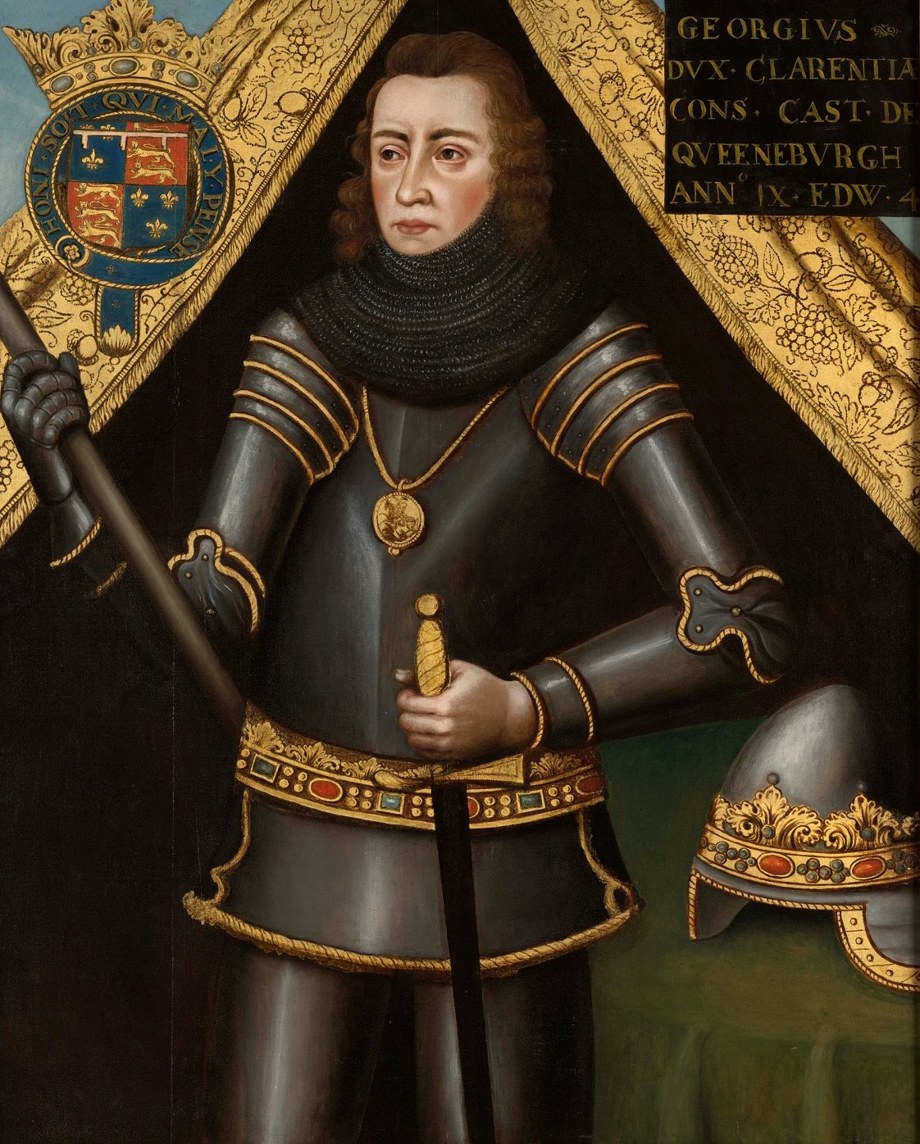
AI-assisted Portrait of George, Duke of Clarence
The Brother Who Could Not Stop Scheming
Of the three sons of York who survived to manhood, the middle one was the most dazzling and the least trustworthy. Edward was the soldier-king, all instinct and appetite; Richard III, the youngest, was the cold administrator who waited. George, Duke of Clarence, was the talker — clever, charming, vain, and bottomlessly ambitious, a man who could argue himself into any alliance and out of any loyalty within the same season. Born in 1449, raised to a dukedom by the brother he would spend his life resenting, he had every advantage the age could confer and squandered them all on plots that never quite cohered.
His career reads like a sequence of brilliant improvisations that each ended in ruin. In 1469 he betrayed Edward outright, allying with the Earl of Warwick the Kingmaker, marrying Warwick's daughter Isabel Neville, and joining the rebellion that briefly toppled his own brother — with George himself floated, for a giddy moment, as a possible puppet king. When that gambit soured he reconciled with Edward, was pardoned, and almost immediately drifted back into intrigue. He had a servant of his late wife seized and hanged on trumped-up charges of poisoning. He railed openly about Edward's legitimacy and his own claims. At last Edward had had enough: George was tried for treason and privately put to death in 1478, drowned — by enduring legend — in a butt of Malmsey wine, reputedly the manner he chose himself.
He is the ENTP as turncoat: verbal brilliance with no rudder, possibility-chasing that mistook every new angle for a strategy and ended by chasing himself off a cliff.
George was an intelligence in perpetual motion with nowhere to go — Ne generating plot after plot, Ti rationalizing each betrayal as the obvious move, and an inferior steadiness so thin that he could never hold a single course long enough to win.
The Restless Realigner
Ne — dominant
Dominant Ne lives in the space of what could be next. It scans for the unrealized possibility, the alliance not yet made, the door that might open if you push the right way — and it grows restless the moment a situation settles into mere fact. George had this engine running at full throttle and no governor on it. He was heir presumptive, fabulously rich, married into the most powerful magnate house in England, and none of it satisfied him, because Ne does not value what is; it craves what might still be.
You can see it in the sheer churn of his loyalties. He sided with Warwick against Edward, then abandoned Warwick when the rebellion swung toward restoring the Lancastrian Henry VI — an outcome that left no throne for George — and slipped back to his brother. Pardoned, he immediately began probing new possibilities: a foreign marriage to the heiress of Burgundy, fresh claims, fresh grievances. Each scheme was genuinely clever in isolation and reckless in sum, because Ne kept supplying the next idea before the last one had borne fruit. The verbal brilliance that contemporaries noted was the same faculty — a mind that could talk its way into a treason and then talk its way out of the gallows, twice.
What it never produced was a plan. George reinvented his position so often that he ended up nowhere, a man defined by motion rather than direction — the signature failure of unbalanced Ne, dazzled by every new branch and unable to commit to any trunk.
The Lawyer of His Own Treason
Ti — auxiliary
Auxiliary Ti is the internal logic that tells dominant Ne which of its possibilities is justified. In a balanced ENTP it is a quality check; in George it became a machine for self-justification. He never simply rebelled — he always had an argument. The charge that Edward was illegitimate, the insistence on his own seniority of claim, the legal theatre by which he condemned his wife's servant: each betrayal arrived dressed in reasoning, a structure of premises that made the indefensible look, to George, like the only rational conclusion.
This is Ti turned inward and corrupted by the dominant function's wants. The faculty that should test an idea for consistency was instead recruited to defend whatever the latest Ne impulse had already decided. His protests about Edward's legitimacy were not the cool analysis of a Ti seeking truth; they were rationalized ammunition, deployed because they served the scheme of the moment. The cleverness was real — George could build a case — but it was cleverness in the service of appetite, which is the most dangerous kind, because it lets a man believe his grievances are principles.
The Charm That Curdled
Fe — tertiary
Tertiary Fe gave George the surface graces that made him plausible: charm, a feel for an audience, the ability to win sympathy and recruit followers to a cause that was really only his own advancement. He was, by all accounts, attractive and persuasive, and he used those gifts to draw men into rebellion and to perform contrition when rebellion failed. Fe in this position reads the room and works it, but it is the third function — reactive, easily wounded, and prone to childish demands for recognition.
That brittleness is the key to his undoing. George wanted to be seen as the wronged party, the brother denied his due, and when the world withheld that recognition he lashed out theatrically — the public railing, the staged judicial murder of a servant, the loud insistence on injuries real and imagined. Tertiary Fe wants the approval of the group but cannot earn it through patience, so under pressure it curdles into grievance and display. George could charm a court into following him; he could never quietly endure being second, and the resentment leaked out in ways that made him impossible to keep.
The Want of a Steady Course
Si — inferior
Inferior Si is the faculty George most conspicuously lacked, and the lack is what killed him. Si is steadiness — the patient holding of a position, loyalty sustained over time, the willingness to let an advantage ripen rather than spend it at once. It is the constancy that turns a strong hand into a winning one. George had none of it. Where Si grounds a person in commitments honored and routines kept, he could not hold a course for two consecutive years.
Every structural advantage he possessed required only patience to pay off. As Edward's brother and heir presumptive, he stood to inherit enormous standing simply by remaining loyal and alive. But inferior Si cannot wait; it experiences steadiness as suffocation and reaches for the disruptive new possibility instead. So George burned his pardons, exhausted his brother's patience, and treated each reconciliation as a pause before the next betrayal. Edward forgave him once, which few kings would have done; the second cycle of intrigue left no room for a third mercy. A man who could simply have stayed put would have died a great magnate. George could not stay put, and so he died in a wine cask.
Why ENTP Over ENTJ
Why not ENTJ?
The ENTJ is the focused, executing strategist who selects a single objective and marches toward it — exactly what his father-in-law Warwick was, and exactly what George was not. An ENTJ in George's position would have chosen one path to power and built it methodically; George chased every possibility at once, his schemes reactive and self-undermining rather than directed. Warwick made and unmade kings with cold purpose; George could only generate sparks — brilliance without architecture, motion without a destination.
The distinction is between the strategist and the improviser. An ENTJ's ambition organizes itself around a goal and bends every move toward achieving it; George's ambition was diffuse, opportunistic, and ultimately incoherent — a hunger for advancement that never resolved into a plan to get it. He was the possibility-chasing ENTP whose gifts dazzled and whose dazzling led only to his own ruin, the turncoat undone not by lack of cleverness but by the want of anywhere to point it.
Connected Figures
Further Reading
- False, Fleeting, Perjur'd Clarence: George, Duke of Clarence, 1449–78 — Michael HicksThe definitive scholarly biography — sober, archival, and the best corrective to the legend.
- Edward IV — Charles RossThe standard life of the brother George betrayed; essential for the dynamics of the York court.
- The Wars of the Roses — Various (e.g. Dan Jones, Anthony Goodman)General narrative histories that situate George's intrigues within the wider Yorkist–Lancastrian conflict.
