 Historical Figure MBTI
#442 · 4-11-26 · The Age of Travelers
Giovanni da Pian del Carpine
Franciscan Friar · The First Papal Envoy to the Mongols
c. 1185 — 1252
8 min read
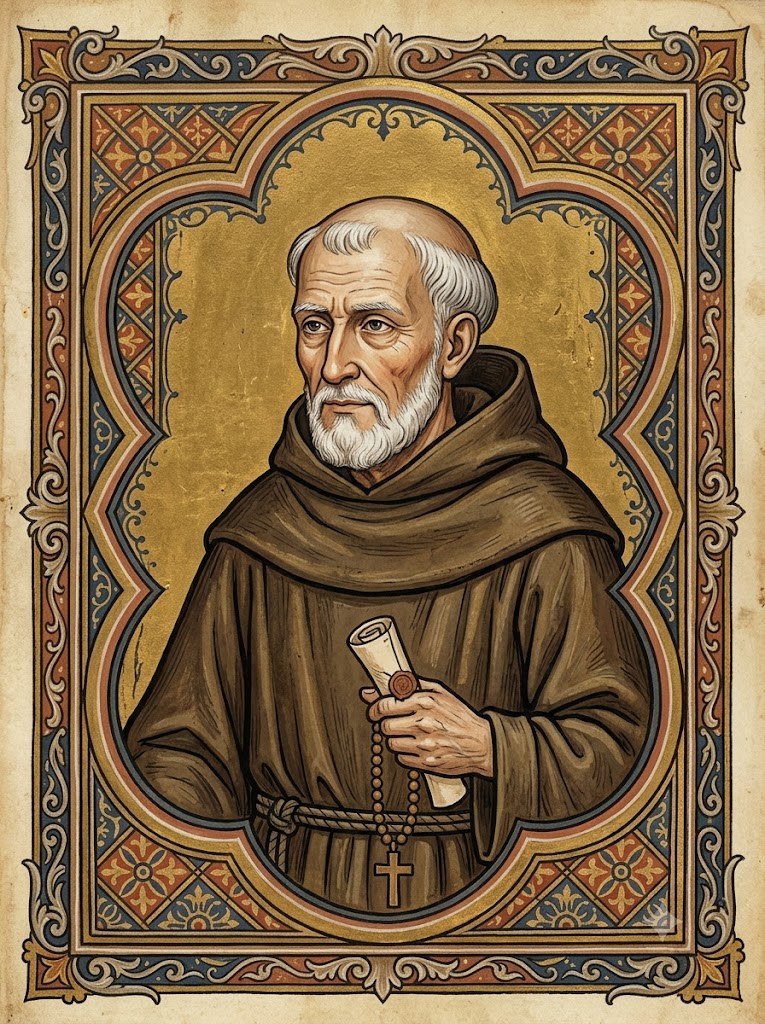
AI-assisted Portrait of Giovanni da Pian del Carpine
The Old Man Who Rode East
When the Mongol armies smashed through Hungary and Poland in 1241 and then, inexplicably, withdrew, Christendom was left in terror without understanding what had nearly destroyed it. Who were these horsemen? Where had they come from? Would they return? Pope Innocent IV decided that someone had to go and find out—and the man he chose was not a soldier or a young adventurer but a stout, grey-haired Franciscan in his sixtieth year, a man who had known Saint Francis of Assisi himself.
Giovanni da Pian del Carpine—John of Plano Carpini to the Latin-reading world—set out in 1245 as the first papal envoy ever dispatched to the Mongols. Over fifteen months he crossed thousands of miles of steppe, much of it on horseback at a punishing pace, arriving at last on the plains near Karakorum in time to witness the enthronement of the Great Khan Güyük in 1246. He carried the Pope's letters; he received in reply a haughty demand that the Pope and the kings of Europe come and submit. And then he turned around and rode all the way home to write it down.
What he wrote, the Ystoria Mongalorum, became the first detailed Western account of the Mongols—and, most usefully of all, a clear-eyed manual on how their armies fought and how a European force might resist them. It is the report of a man who saw his task plainly: observe carefully, record honestly, leave nothing out that might matter.
Carpini was the ISTJ abroad in a world built for no one like him: an old man who endured the steppe out of duty and answered terror not with prophecy or panic but with a faithful, factual account of exactly what he had seen.
The Faithful Witness
Si — dominant
Dominant Si is the memory function—the steady, concrete recording of what is actually there, checked against what came before. In Carpini it produced the temperament of a man who could be relied upon to bring back the truth. He did not embellish, he did not prophesy, and he did not let fear distort the picture. Where a more imaginative traveler might have spun the Mongols into demons out of Revelation, Carpini set down what he observed: how they dressed, what they ate, how they buried their dead, how they chose a khan, how many wives a man might keep.
The discipline of the account is itself the evidence. He organizes the world of the steppe into orderly chapters—the land, the people, their religion, their manners, their empire, their wars—each filled with patient, verifiable detail, and he is careful to distinguish what he saw himself from what he was merely told. This is the cast of mind that trusts the recorded particular over the dramatic generalization: an accountant's honesty applied to an entire civilization no European had ever described.
And beneath it all lay the most Si motive of all—sheer obligation. Carpini was roughly sixty, heavy, and far from strong; the journey nearly killed him. He records, without self-pity, riding so hard and so long that he and his companion had to bind their bodies to endure it. He went and he persevered not because he craved adventure but because the Pope had asked it and the duty was his to discharge. The old man simply kept his word.
The Intelligence Officer
Te — auxiliary
If Si gathered the facts, auxiliary Te decided what they were for. Carpini did not record the Mongols as a curiosity; he recorded them as a problem to be solved. The most striking chapters of the Ystoria are the practical ones—a hard-headed briefing on how the Mongol armies were organized, how they marched, how they used feigned retreats and encirclement, how they reduced fortified towns—followed by concrete recommendations for any Christian army that might one day have to meet them. This is Te in its purest form: information marshaled toward effective action.
The structure of the whole work reflects the same instinct. It is built like a report to be used, not a memoir to be admired—findings sorted, conclusions drawn, advice given. He tells European commanders to keep their forces concentrated, to fortify, to beware false truces and false flight, to expect the steppe armies to strike where least anticipated. A man with no military command of his own had, through sheer methodical observation, produced the first piece of Western strategic intelligence on the greatest land empire of the age.
There is something quietly characteristic in this. The dominant Si supplied the patience to notice everything; the auxiliary Te supplied the purpose that turned a friar's notebook into a usable defense plan. He was not a visionary about the Mongols—he was an organizer of facts about them, which in 1247 was exactly what Christendom needed and exactly what no one else had brought home.
The Private Conviction
Fi — tertiary
Tertiary Fi gave the dutiful machine its quiet engine: a deep, interior faith that asked nothing of an audience. Carpini had been among the earliest followers of Saint Francis, a man who taught that obedience and humility were not weakness but the whole of the religious life. That conviction is why an aging friar would accept an errand that younger men might have refused. He did not need the mission to be celebrated; he needed only to know it was right and that it had been entrusted to him.
You can feel the same private steadiness in how he carried himself before Güyük. The Mongol court was overwhelming—vast, alien, contemptuous of his errand—and the Khan's reply was an insult dressed as diplomacy. Carpini neither flattered nor flinched. He delivered the Pope's message, absorbed the rebuff, and held to his own sense of what he had been sent to do. Tertiary Fi in an ISTJ rarely makes speeches; it shows up as an unshowy refusal to be moved from one's ground.
The Road He Could Not Imagine
Ne — inferior
Inferior Ne is the weakest seat in the ISTJ stack, and Carpini's blind spots fall exactly where the theory predicts. He was a magnificent recorder of the present and a poor forecaster of the possible. He could describe the Mongol war machine in granular detail, yet he could not quite conceive of the diplomatic future it implied—that the way to deal with this power might lie in alliance or conversion rather than the defensive bracing his Te kept returning to. The imaginative leap into what the Mongols might become, or be turned into, was not his gift.
And yet inferior functions occasionally surprise. For all his concreteness, Carpini did one quietly visionary thing: he went at all. To set out across an unmapped world toward a court no European had ever reached required the faint, flickering openness to the unknown that even an ISTJ carries somewhere in the basement of the mind. He could not picture the road—so he simply rode it, one verified mile at a time, and let the map be made by his feet rather than his imagination.
Why ISTJ Over ESTJ
Why not ESTJ?
The ESTJ shares Carpini's love of order and his Te-driven practicality, but it leads with Te—it organizes the world outward, taking command, projecting authority, managing people. Carpini did none of that. He held no office on the steppe, led no embassy of state, and made no attempt to dominate the room at Karakorum. His contribution was inward-facing and quiet: the patient absorption and faithful ordering of what he saw, carried home in a notebook. That is dominant Si reporting to a Te servant, not a Te commander.
The deciding fact is the shape of his achievement. An ESTJ's legacy tends to be an institution run or an operation directed; Carpini's legacy is a document—an accurate, methodical record produced from duty and observation rather than from the exercise of authority. He was the watcher and recorder at the edge of the known world, not the administrator at its center. The reserved, dutiful, fact-gathering temperament is ISTJ to the core.
Connected Figures
Further Reading
- Mission to Asia — Christopher Dawson (ed.)The standard English collection of the friar-envoys' reports, with Carpini's account at its center.
- The Story of the Mongols Whom We Call the Tartars — Giovanni da Pian del Carpine (trans. Erik Hildinger)A clear, complete modern translation of the Ystoria Mongalorum — the primary source itself.
- Papal Envoys to the Great Khans — Igor de RachewiltzThe authoritative scholarly study of Carpini, Rubruck, and the thirteenth-century missions to the Mongols.
