 Historical Figure MBTI
#575 · 4-30-26 · The Ottoman Zenith
Hayreddin Barbarossa
Grand Admiral of the Fleet · Corsair King · Master of the Mediterranean
c. 1478 — 1546
6 min read
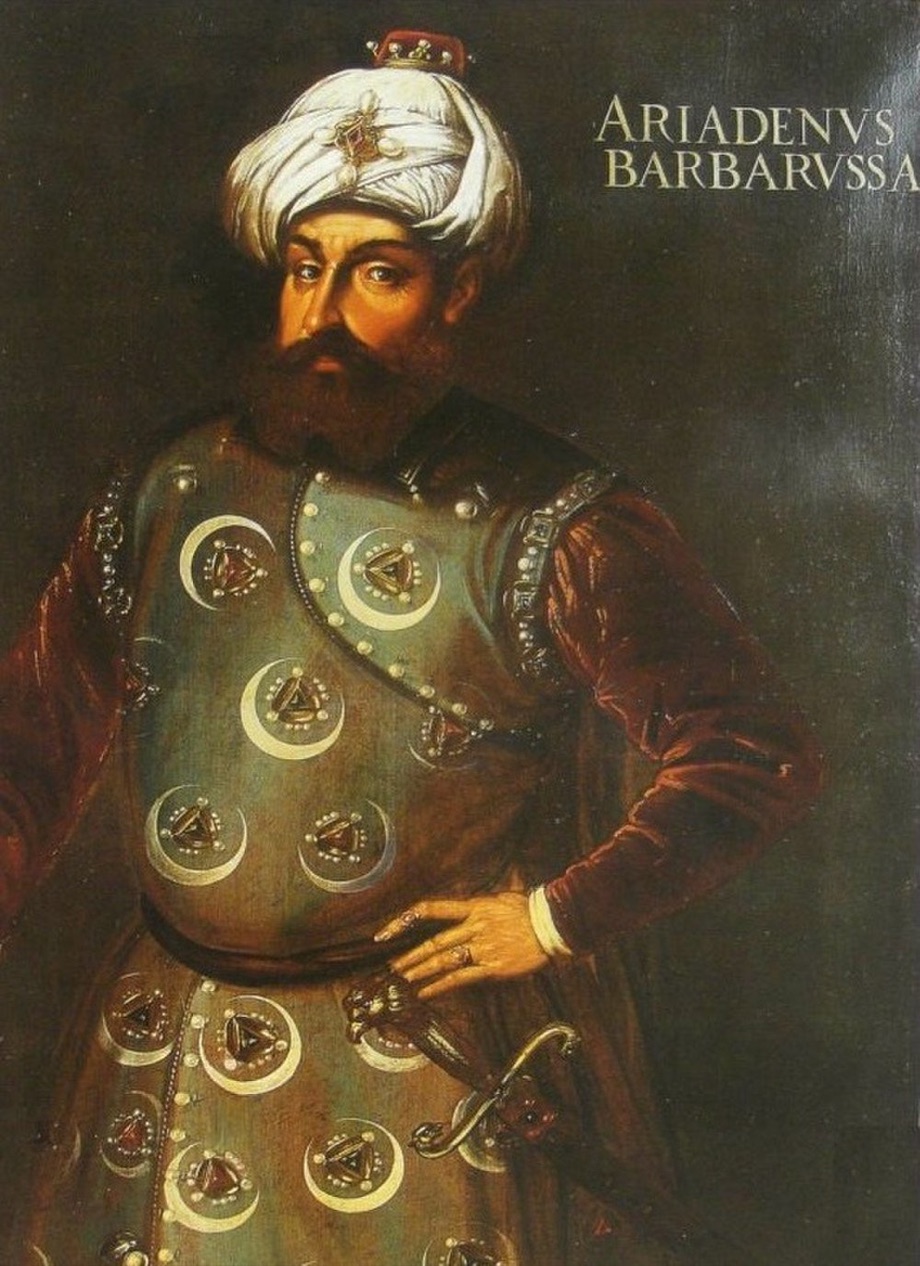
Portrait of Hayreddin Barbarossa
The Red Beard on the Water
He was a potter's son from Lesbos who ended his life as the most feared sailor on the Mediterranean, and he covered the distance between the two by never once waiting for permission. Hızır — later honored as Khayr al-Din — learned the sea as a young corsair alongside his brother Oruç, whose flame-colored beard gave the family its terror-name: Barbarossa, red beard. When Oruç was killed fighting the Spanish, Hızır inherited the beard, the name, and the war — and improvised an empire out of piracy.
He seized Algiers by force, then did the one thing a pure freebooter never does: he gave it away. Unable to hold the city against Spain alone, he offered it to the Ottoman sultan and took in return the title of beylerbey — governor — converting a corsair's lair into a province of the empire and himself into its master. Decades later Suleiman the Magnificent summoned that reputation to Istanbul and made him Kapudan Pasha, grand admiral of the whole Ottoman navy. From the deck of a raiding galley he had talked his way into command of a superpower's fleet.
Barbarossa is the ESTP as sea-wolf: Se reading wind, coast, and enemy in the live instant — the raid, the boarding action, the seized moment — fused to a cold Ti calculus of ships, ambush, and advantage that turned nerve into strategy and piracy into empire.
Wind, Coast, and the Boarding Action
Se — dominant
Dominant Se lives in the physical present, and no arena rewards it like the deck of a galley in a rising wind. Barbarossa read the sea the way a swordsman reads a duel — the set of a current, the lee of a headland, the moment an enemy hull swung broadside and exposed itself. He fought by closing, grappling, and boarding, trusting his nerve in the confusion of contact rather than any plan drawn beforehand. For years he raided the coasts of Italy and Spain, descending on a town at dawn and gone before any relief could gather — the tempo of a man who wins by acting first and fastest.
His masterpiece was pure Se elevated to grand strategy. At Preveza in 1538 he met the combined Christian fleet of the Holy League under the great Genoese admiral Andrea Doria, a force that outnumbered him. Reading the wind and Doria's hesitation in real time, Barbarossa held his formation, refused ground not his own, and struck when the enemy fell into disorder — scattering the League without losing a ship. That single afternoon handed the Ottomans command of the Mediterranean for a generation, won not by a bureaucrat's system but by a seaman's eye for the one decisive instant.
The Corsair's Calculus
Ti — auxiliary
Se supplies the nerve; auxiliary Ti supplies the angle. Barbarossa was never merely bold — he was a shrewd analyst of leverage who understood exactly what each ship, coast, and alliance was worth. The clearest proof is the gift of Algiers. A man ruled only by impulse hoards what he seizes; Barbarossa reasoned that a city he could not defend alone was worth more traded for the protection of an empire than held as a doomed private prize. Surrendering the title of independent prince to become the sultan's governor was not submission but arithmetic — and it made him untouchable.
The same logic ran through his campaigns. He rebuilt the Ottoman navy on a corsair's principles, captured Tunis, and picked his fights by advantage rather than honor. Even his diplomacy was tactical: in 1543 he wintered the entire Ottoman fleet at the French port of Toulon as Suleiman's ally against the Habsburgs, an audacious use of an enemy's enemy that turned the map itself into an instrument. He thought in terms of position and payoff, and was almost never wrong about either.
The Brotherhood of the Sea
Fe — tertiary
A corsair captain commands by loyalty or not at all, and Barbarossa held his men with a sure feel for morale, reputation, and shared glory. Tertiary Fe gave him the instinct to bind a polyglot brotherhood of raiders — renegades, Berbers, freed slaves, Anatolian Turks — into crews that would follow him into any wind. He rewarded daring and understood that the fear his name inspired was itself a weapon, softening a coast before a single sail appeared.
That social read reached its height at the Ottoman court. Arriving in Istanbul an aging pirate from the far edge of the empire, he carried himself to be received not as a suppliant but as a prize — presenting gifts, playing the part, and winning Suleiman's confidence completely enough to be handed the whole fleet. But the Fe stayed in service of the objective, never the reverse: he could charm a sultan or steady a crew, yet he spent men and cities without sentiment when the tactical situation required it.
Why ESTP Over ESTJ
Why not ESTJ?
He ended as grand admiral of an empire's navy, so the ESTJ reading — the organization man building a naval bureaucracy — is tempting. But it inverts how he rose. Barbarossa was a freebooter who seized Algiers by force and improvised his way into the sultan's service, winning by cunning and nerve rather than by system. The ESTJ administers an existing order; Barbarossa bent one to himself, reading each situation live and striking — Se–Ti seizing the moment, not Te–Si running the institution.
The distinction is the whole shape of his life. An ESTJ inherits a fleet and optimizes it; Barbarossa did the opposite — he took a corsair's galley and a captured city and fought and calculated his way to command of a great power's navy, then used it exactly as he had used his raiders: by reading the instant and striking. The empire came to fit the pirate, not the pirate to the empire.
Connected Figures
Further Reading
- The Sultan's Admiral: The Life of Barbarossa — Ernle BradfordThe standard English-language biography — a vivid narrative of the corsair's rise from Lesbos to grand admiral.
- Empires of the Sea: The Final Battle for the Mediterranean, 1521–1580 — Roger CrowleyThe definitive popular history of the great Ottoman–Christian naval struggle; places Barbarossa and Preveza in their epic context.
- The Ottoman Empire: The Classical Age, 1300–1600 — Halil İnalcıkThe authoritative account of the empire at its zenith — essential for understanding the naval and imperial world Barbarossa served.
