 Historical Figure MBTI
#767 · 6-8-26 · The Inca Empire
Huáscar
The Reformer Who Attacked the Mummy Cult
c. 1503 — 1532
7 min read
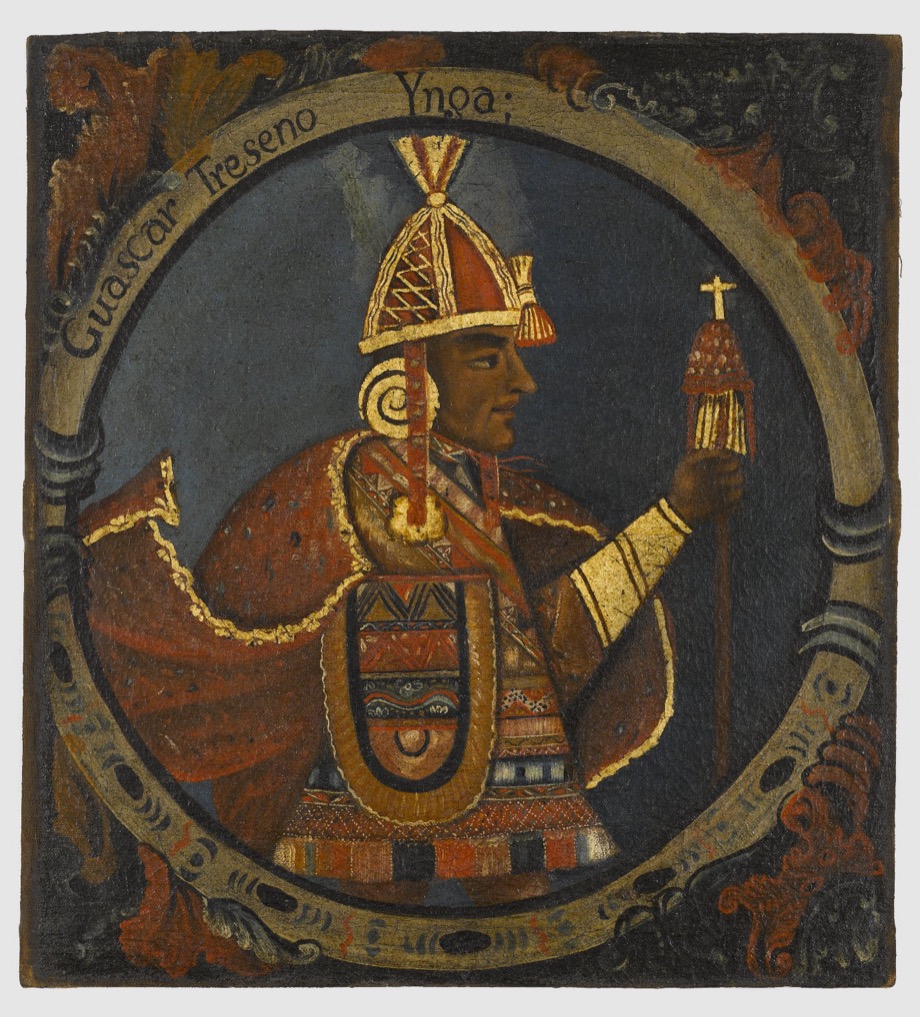
Portrait of Huáscar
The Executioner’s Version
When smallpox swept down the Andes ahead of the Spanish themselves, it killed Huayna Capac and his named heir, Ninan Cuyuchi, within the same season — leaving a succession that was normally violent but at least procedurally clear with no clear path forward at all. Huáscar, another son of Huayna Capac, claimed the throne in Cusco; his half-brother Atahualpa held the north, in command of their father’s veteran army and its seasoned generals. What followed was several years of civil war that ended with Huáscar captured, imprisoned, and — on Atahualpa’s order, relayed from Spanish custody at Cajamarca — killed in 1533, months before Pizarro’s men closed in on his brother in turn.
But before the war, Huáscar did something no other Sapa Inca had attempted: he moved against the panaca system, the corporate lineages that maintained the mummified bodies of dead emperors as though they still ruled — each with its own estates, servants, and labor levies frozen in perpetuity, untouchable by the living state. It was, by any reading of Andean political economy, an act of real structural ambition: an attempt to unlock wealth an entire cosmology had declared off-limits. It also turned Cusco’s most powerful families against him before Atahualpa ever raised an army.
The trouble is that almost nothing else survives about Huáscar except through the testimony of the side that destroyed him — Atahualpa’s faction, debriefed after the fact by Spanish chroniclers with every reason to accept the winner’s account. The hostile record calls him cruel, drunken, erratic, incompetent. Strip the adjectives and one fact remains, independently legible: he attacked the mummy cult. That is not the profile of a man undone by weakness.
Huáscar’s file was written by the men who killed him. What survives their editing is one concrete, high-cost act — and it reads as ESTP, dominant Se, not as the caricature built to bury him.
The Mummy Cult, Attacked Directly
The clearest evidence for Huáscar’s cognitive style isn’t reported temperament — it’s the target he chose. The panaca system was Cusco’s oldest, most sacred, most heavily defended institution: every dead Sapa Inca’s mummy continued to “own” property, retinues, and labor gangs, attended by descendants whose entire social position depended on maintaining the fiction that the emperor still required feeding, dressing, and consulting. Confronting it meant taking on ancestor-worship itself, not as abstract theology but as a concrete transfer of land and labor away from named families who held real power in Cusco. Huáscar didn’t propose a gradual reform or negotiate a compromise; he moved to seize and redistribute panaca wealth outright — an immediate, physical assertion of will against the empire’s most entrenched interest group.
That is the signature of dominant Se: engagement with the tangible present, a readiness to act on what is directly in front of him rather than accommodate the accumulated weight of precedent. Atahualpa, by contrast, spent the same years consolidating an army in the north — a slower, more patient project. Huáscar chose confrontation in the capital, against the class of people best positioned to destroy him, because the problem — dead men holding wealth the living state needed — was immediate, and, to him, self-evidently worth acting on regardless of the political cost.
The war itself confirms the pattern. Once Atahualpa’s generals moved south, accounts agree Huáscar met the threat directly rather than retreating into Cusco’s defenses or opening negotiations — he engaged, lost, and was captured in the field. Impulsive, in the hostile telling; but consistent, across both the panaca seizure and the battlefield, with a ruler oriented toward direct action on whatever stood in front of him.
A Redistribution Logic, Not a Whim
The mummy-estate seizure only looks erratic if you accept the victor’s framing. Looked at structurally, it is a coherent argument: land and labor devoted to maintaining dead men in the style of living rulers were land and labor the empire could not use for anything else — no new roads, no new storehouses, no support for the current administration’s own household and army. Huáscar’s move reads as an internally consistent principle applied without regard for whose feelings it hurt: resources should serve the state that needs them now, not the corpse of the state that needed them a generation ago.
That is auxiliary Ti at work — not cold calculation for its own sake, but a private, internally derived logic strong enough to override the overwhelming social pressure to leave the panacas alone. Every noble house in Cusco had a stake in the mummy cult; defying all of them at once required a ruler confident in his own reasoning independent of consensus. The hostile record frames this confidence as arrogance or cruelty. It reads more plausibly as a man who worked out for himself that the system was structurally wasteful, and acted on that conclusion without needing anyone else to agree first.
It is also why the reform, and not the war, is the more interesting fact about him. Losing a succession fight to a battle-hardened northern army commanded by veteran generals doesn’t require any particular flaw of character — plenty of capable rulers have lost worse-matched contests. Choosing, unprompted, to attack the single most sacred and self-serving institution in the capital does require a specific kind of mind: one willing to trust its own analysis of a resource problem over the accumulated authority of ancestor-worship itself.
Why ESTP Over ESFP
Why not ESFP?
The ESFP reading is the hostile record’s caricature dressed up in typological language: an impulsive, sensation-seeking, people-pleasing ruler who drifted into disaster because he lacked the discipline to hold his throne. But that portrait is built entirely from testimony collected by the faction that destroyed him and had every reason to make its victim look weak. The one fact about Huáscar that doesn’t depend on Atahualpa’s court for its telling — the panaca seizure — is not warm, accommodating, or crowd-pleasing; it is a cold, structural attack on the interest group best positioned to protect him. An ESFP ruler manages relationships to stay popular. Huáscar spent his popularity, deliberately, on a policy nobody who mattered wanted.
Rejecting the ESFP foil isn’t a matter of preference between two plausible readings; it is a matter of what the sources can actually support. Every “erratic,” “cruel,” or “weak” adjective attached to Huáscar comes from a chain of testimony that runs back to the men who killed him. The mummy-cult reform is the only substantial fact about his reign that survives independent of that chain, and it points the opposite direction: toward Se boldness paired with a Ti-driven willingness to act on his own reasoning against unanimous opposition. Read him against the record’s grain, and what is left isn’t the caricature the winners needed. It is an ESTP who tried, once, to make the empire serve the living — and lost to men better prepared for the fight that followed.
Connected Figures
Further Reading
- History of the Inca Realm — María RostworowskiThe most careful modern reconstruction of the Huáscar–Atahualpa civil war and its sources.
- The Conquest of the Incas — John HemmingStandard narrative history of the succession war.
- To Feed and Be Fed: The Cosmological Bases of Authority and Identity in the Andes — Susan E. RamírezOn the panaca and mummy-estate system Huáscar attacked.
- Religion in the Andes — Sabine MacCormackOn Inca ancestor cults and their political-economic weight.
