 Historical Figure MBTI
#774 · 6-9-26 · The Conquest of the Andes
Atahualpa
Measured the Ransom Room
c. 1502 — 1533
10 min read
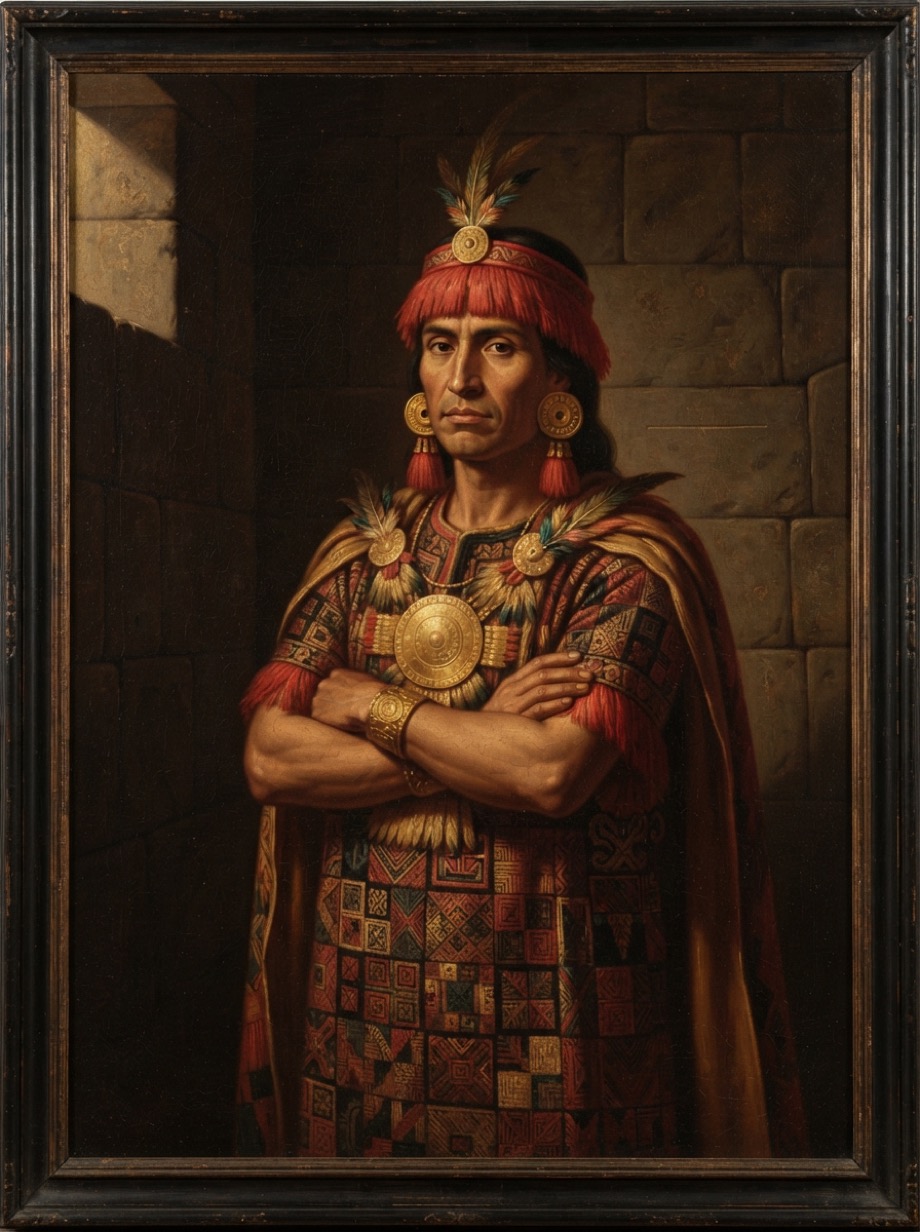
AI-assisted Portrait of Atahualpa
The Prisoner Who Kept Governing
He had won. That is the fact most often lost under the avalanche of what came next. When Atahualpa walked into the square at Cajamarca in November 1532, he was not a nervous heir or a contested claimant — he was a man who had just finished dismantling his half-brother’s empire from the north, using his father’s veteran army and three of the most capable field commanders the Andes ever produced. Huáscar was in chains. Chalcuchimac and Quizquiz held Cusco. The Tawantinsuyu, four quarters and several million people, had a single master again, and he was thirty years old.
Into this moment walked a hundred and sixty-eight Spaniards, exhausted, far from any support, deep inside a hostile empire. Atahualpa looked at them and made an assessment. Not a panicked one, not a superstitious one — an assessment. He came to meet them without weapons, carried on a litter, surrounded by attendants in ceremonial dress, because a force that size did not merit an army and because arriving as a conqueror rather than a combatant was itself a statement about who they were dealing with. It was the single worst judgment call in the history of the Andes. It was also, unmistakably, a judgment call — a reasoned conclusion drawn from a model of the world, not a failure to think.
Everything after the ambush is what makes him interesting. Most rulers, taken in an afternoon, lose the thread entirely. Atahualpa, inside a room he could not leave, surrounded by men whose language he did not speak, immediately began doing the only thing he had ever done: reading a system, finding its levers, and pulling them. He priced his own freedom. He learned his captors’ games. He ran an experiment on their literacy. He had his brother killed by remote command. He negotiated the disposal of his own corpse. None of this is the behavior of a man in shock. It is the behavior of an ENTJ whose empire has been reduced to the four walls around him and who has therefore begun administering the four walls.
Atahualpa is the archive’s clearest case of an ENTJ under total constraint: extraverted Thinking with nothing left to organize but its own captivity, and organizing it anyway.
The Man Who Priced His Own Freedom
The ransom is the purest artifact of his mind that survives. Within days of his capture, Atahualpa had worked out what his captors actually wanted — not submission, not conversion, not territory, but metal — and he made them an offer with a specification attached: this room, filled with gold to a line he marked on the wall, and twice over in silver in the rooms adjacent. He did not plead, and he did not offer vaguely. He gave a measurement. Extraverted Thinking does not negotiate in sentiment; it converts a situation into quantities, deliverables, and deadlines, and it does this reflexively, even when the situation is one’s own imprisonment.
Then — and this is the part that gets underweighted — he delivered. From inside confinement, with no freedom of movement and no direct line of sight over his own administration, he ran a logistics operation that stripped the temples of Cusco, Pachacamac, and Jauja and moved tonnes of worked gold hundreds of miles over mountain roads to a provincial town. The Spanish melted down an inconceivable amount of Andean art in a matter of months. That flow did not happen because an empire panicked; it happened because a captive issued clear instructions to a functioning bureaucracy and the bureaucracy executed them. He was still the state, and he still ran it, from a cell.
The Te reading also explains the shape of his rise. He did not win the civil war by charisma or by claim; he won it by holding the professional army and delegating to competent subordinates — Chalcuchimac and Quizquiz in the field, Rumiñahui holding the north — and letting them operate. An ENTJ’s characteristic method is to build the instrument, point it, and trust it to work. His half-brother in Cusco had the legitimacy, the capital, and the priesthood. Atahualpa had the org chart, and the org chart won.
A Word Written on a Thumbnail
The best surviving evidence of how he thought is a small, strange story told by several chroniclers. Early in his captivity, Atahualpa noticed that writing seemed to carry authority among the Spanish, and he wanted to know whether the power lay in the marks or in the men. So he had one of his guards write a word on his thumbnail, and then showed the thumbnail, in turn, to other Spaniards. Most read it back. One — by most accounts Pizarro himself — could not. From that single controlled trial he extracted something no interpreter would have told him: that this literacy was unevenly distributed, that it was not divine, and that the man at the top of the hierarchy holding him did not possess it.
This is introverted Intuition doing what it does best — treating surface behavior as evidence of a hidden structure, and designing the minimal probe that will expose it. He was not curious about reading. He was mapping the internal power relations of the organism that had swallowed him, because a map is the precondition for finding an exit. The same faculty shows up in how fast he took to chess and cards during those months. What he was learning was not the games; it was that these men operated by fixed, discoverable rules, and that anything rule-governed can be beaten.
And then the darkest application. From inside the room, Atahualpa gave the order that killed Huáscar. He understood — correctly, and long before the Spanish did — that his brother alive was a rival claimant the Spanish could install in his place the moment he became inconvenient, and that his own captivity was precisely the moment that danger peaked. So he closed the option, using a chain of command that reached from his confinement to a riverbank hundreds of miles away. It was fratricide, and it was also a perfectly lucid piece of forward modeling: he removed his replacement while he still had the authority to do it. Ni sees three moves out; Te makes the call.
The Litter, the Feathers, the Miscalculation
Tertiary Sensing in an ENTJ is not blindness to the physical world; it is a taste for commanding it theatrically, coupled with a habit of trusting the surface reading when the surface reading flatters the plan. Atahualpa entered Cajamarca in one of the great pieces of political staging of the sixteenth century — thousands of attendants in checkered livery sweeping the road ahead of him, gold and silver plate, feathered canopies, the litter itself carried shoulder-high. Every element of it was calculated to be seen, and it worked on its intended audience: the Spanish who wrote it all down were visibly shaken by the sheer scale of what walked toward them.
But he had judged the Spanish by what he could see of them, and what he could see was a hundred and sixty-eight tired men. He had reports of horses and of the noise their weapons made; he did not have a working concept of a cavalry charge into unarmed crowd in an enclosed square, and no amount of intuition generates a category that has never existed in your world. So he did what confident Te-Ni does when the data is thin and the stakes look low: he extrapolated from the visible and rounded the unknown down to zero.
He compounded it with contempt. When Vicente de Valverde pressed a breviary on him, Atahualpa examined it, found it silent, and threw it to the ground — a gesture the Spanish used as their pretext and one he had no reason to think would cost anything. It reads as arrogance, and it was. But arrogance is a conclusion, not an impulse: he had run the numbers on these strangers and concluded they were beneath a proper response. The Se failure here is not that he was reckless in the moment. It is that he never gathered the moment’s details closely enough to notice the plan was built on a category error.
The Bargain Over the Body
The ransom was paid in full. The Spanish tried him anyway, on charges — treason, idolatry, polygamy, the murder of Huáscar — assembled to justify a decision already made, and sentenced him to burn. And here Atahualpa, in the last hours of his life, made one final trade. He accepted baptism, because baptism converted the sentence from the stake to the garrote, and a garroted body remains a body. A burned one cannot be mummified, cannot be seated among the ancestors, cannot be brought out at festivals to be consulted and fed. For an Inca sovereign, the corpse was not a relic of rule; it was a continuation of it.
Inferior Feeling in an ENTJ tends to surface late, narrowly, and around a single thing the person has decided is beyond negotiation — and it surfaces in the vocabulary of a bargain, because that is the only vocabulary available. Atahualpa did not convert. He purchased. What he cared about enough to pay a theological price for was not his soul in the Christian sense but his persistence: the intact body, the mummy cult, the line of ancestors he had spent his whole reign fighting to head. It is the one moment in the record where you can see something in him that is not strategy — and even then, he could only express it as a transaction.
The transaction, characteristically, was honored in letter and broken in spirit. He was baptized, garroted rather than burned, and given a Christian burial — after which, by some accounts, his followers removed the body from the church and carried it north anyway. He had bought exactly the thing he asked for and could not control what happened after. That gap, between a precisely engineered outcome and the world’s refusal to stay engineered, is where his whole story lives.
Why ENTJ Over ESTP
Why not ESTP?
The ESTP case rests almost entirely on Cajamarca: a bold, physically confident ruler walks unarmed into an unknown situation and gets burned, which looks like Se-Ti risk appetite operating in the present tense. But an ESTP’s signature strength is precisely the thing Atahualpa failed at — live reading of a room as it changes. He did not adjust when the square emptied of Spaniards, when the cannon was sighted, when the priest advanced alone; he executed a ceremony he had planned days earlier. And the eight months that follow are the opposite of moment-to-moment adaptation: a fixed ransom figure held to over a quarter of a year, an experimental probe of his captors’ hierarchy, a fratricide ordered for a contingency that had not yet arrived, and a negotiation about the state of his body after death. That is sustained forward modeling converted into policy — Ni feeding Te — not tactical improvisation.
The comparison that settles it is not with an ESTP at all but with Moctezuma II, whose entry sits a cluster away in this archive with the identical anomaly at its center: an emperor of enormous power, undone by an initial catastrophic misjudgment of a tiny Spanish force, then held hostage in his own capital. The anomaly is the same; the psychology could not be more different. Moctezuma, the archive’s INFJ, absorbs the shock inward — he consults omens, withdraws, defers, drifts into a captivity that becomes indistinguishable from collaboration, and ends unable to command even his own people. Atahualpa, captured, becomes more active than before: he sets a price, runs an empire by courier, eliminates a rival, studies his jailers, and haggles over his corpse. Put the two side by side and the type argument makes itself. The same catastrophe fell on both men; only one of them spent it working.
A caveat worth carrying lightly: nearly everything here reaches us through Spanish chroniclers with conquests to justify or through later Inca-descended writers like Garcilaso de la Vega and Guamán Poma de Ayala, who had reasons of their own to shade Atahualpa as a usurper. His character is genuinely contested. But the four load-bearing episodes — the measured ransom and its delivery, the speed at the games, the thumbnail experiment, and the baptism-for-garrote trade — are corroborated across accounts written by men who agreed on very little else. They point the same way.
Connected Figures
Further Reading
- The Conquest of the Incas — John HemmingThe definitive narrative of the capture, the ransom, and the execution — still the first book to reach for.
- The Men of Cajamarca — James LockhartA prosopography of every Spaniard in the square, and the best corrective to the myth of a heroic few.
- History of the Inca Realm — María RostworowskiThe Andean-side context: the succession system, the panaca lineages, and the civil war he had just won.
- The Last Days of the Incas — Kim MacQuarrieAccessible modern narrative that carries the story through Vilcabamba to Túpac Amaru.
- History of the Conquest of Peru — William H. PrescottThe nineteenth-century classic — dated in its judgments, still widely cited for its handling of the sources.
