 Historical Figure MBTI
#770 · 6-8-26 · The Inca Empire
Rumiñahui
Burned Quito Rather Than Hand It Over
d. 1535
6 min read
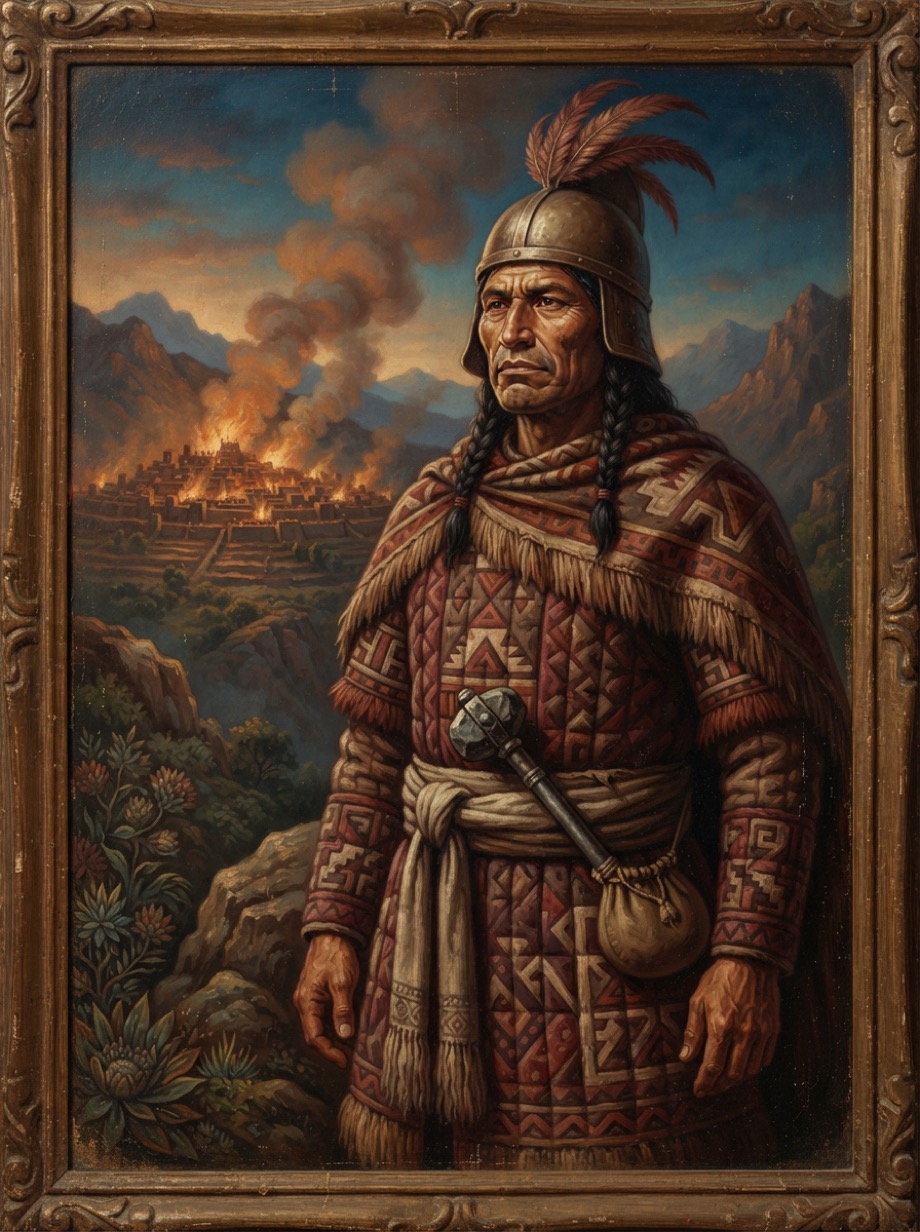
AI-assisted Portrait of Rumiñahui
The General Who Left Nothing to Take
By the time Sebastián de Belalcázar's columns closed on Quito in 1534, the Inca civil war had already claimed Rumiñahui's emperor. Atahualpa was dead, garroted at Cajamarca after paying a ransom room in gold that bought him nothing. Chalcuchimac, the empire's most feared field commander, had been burned alive by the Spanish not long after. Quizquiz still fought in the south, grinding down toward his own mutiny and death. Rumiñahui, who had held the northern quarter around Quito since Atahualpa's rise, faced the same arithmetic every Inca commander faced that year — and answered it differently than any of them had.
He did not negotiate. He did not retreat intact and wait for terms, as a cautious defender might. He ordered Quito destroyed — its buildings fired, its wealth hidden or broken up, its value to the invader erased before the invader arrived. Then he vanished into the highlands to keep fighting for another year, and when the Spanish finally caught him and tortured him for the treasure's location, he told them nothing, and they killed him anyway.
It is a life almost entirely made of decisions, each one made alone, each one closing a door rather than opening a negotiation. That pattern — the fast, physical, irreversible act, governed by a private sense of what actually mattered — is the signature of an ISTP.
Rumiñahui didn't defend Quito. He decided what Quito was worth to the enemy, and then made sure the answer was nothing — the private, load-bearing logic of an ISTP's dominant Ti, executed through Se.
The Logic of Denial
Burning your own capital is not an obvious move. The conventional playbooks available to Rumiñahui in 1534 — a fortified defense, a negotiated surrender that might preserve the city and buy his own life, a token resistance followed by flight — all treated Quito as an asset to be protected, spent, or traded. Rumiñahui treated it as a variable to be zeroed out. If the Spanish wanted Quito for its gold and its symbolic weight as Atahualpa's northern seat, then the correct response was to remove both before they arrived. That is not strategy handed down from a council or a precedent; it is a private calculation, run independently and trusted absolutely.
The same internal logic held under torture a year later. The Spanish wanted one fact — where the treasure was hidden — and they had every physical means to extract it. Rumiñahui's refusal wasn't defiance performed for an audience or loyalty to a chain of command that no longer existed; Atahualpa was long dead, and no Inca state remained to reward him for his silence. It was a conclusion he had already reached and did not need to revisit: the treasure's value lay precisely in the Spanish never having it, and no amount of pain changed that equation. This is Ti at its most extreme — reasoning that answers to itself, closed to renegotiation by outside pressure, even mortal pressure.
A Year in the Highlands
After Quito burned, Rumiñahui didn't simply disappear — he kept fighting, and he fought as a man reacting to what was directly in front of him rather than executing a long-laid design. The guerrilla campaign he ran through the northern highlands for roughly a year had no capital to defend, no throne to restore, no larger political program beyond denying the Spanish an easy conquest for as long as physically possible. Each engagement was its own decision, made on the ground, in the moment — the hallmark of Se harnessed to a fight rather than to pleasure or spectacle.
That physical, present-tense resistance is also what makes his final act legible. A man who thought primarily in abstractions or long time horizons might have gambled on eventual reinforcement, a shift in fortune, a future in which the treasure mattered again. Rumiñahui's attention stayed locked on the concrete and immediate: the city in front of him, the army approaching it, the fact of his own capture and the pain applied to his body. He met all three the same way — directly, physically, on his own terms, refusing to let any of them dictate what he did next.
Why ISTP Over ISTJ
Why not ISTJ?
ISTJ is the tempting foil because Rumiñahui was disciplined, effective, and clearly capable of sustained duty. But an ISTJ commander in his position would more likely have followed the established chain of command or a recognized precedent for defense and surrender — there was none for burning your own capital. Rumiñahui instead improvised a solution no manual would have supplied, and under torture he answered to a private conclusion rather than to any structure of loyalty, rank, or command that could still make a claim on him. That is autonomous Ti-Se problem-solving, not ISTJ's dutiful Si-Fe.
The distinction matters because both types can look, from the outside, like grim competence under pressure. What separates them is where the authority for the decision comes from. An ISTJ's resolve is anchored to something external — an order, an oath, an established way things are done — even when that structure has collapsed around them. Rumiñahui's resolve was anchored nowhere but in his own reasoning about what the moment required, which is exactly why he could make a decision as unprecedented as burning Quito, and exactly why no torture could talk him out of one he had already settled.
Connected Figures
Further Reading
- The Conquest of the Incas — John HemmingThe standard narrative covering Rumiñahui's burning of Quito and his death under torture
- History of the Inca Realm — María RostworowskiOn the northern Inca resistance and the generals who led it
- Quito 1599: City and Colony in Transition — Kris LaneBackground on colonial-era Quito and its Inca-period predecessor
